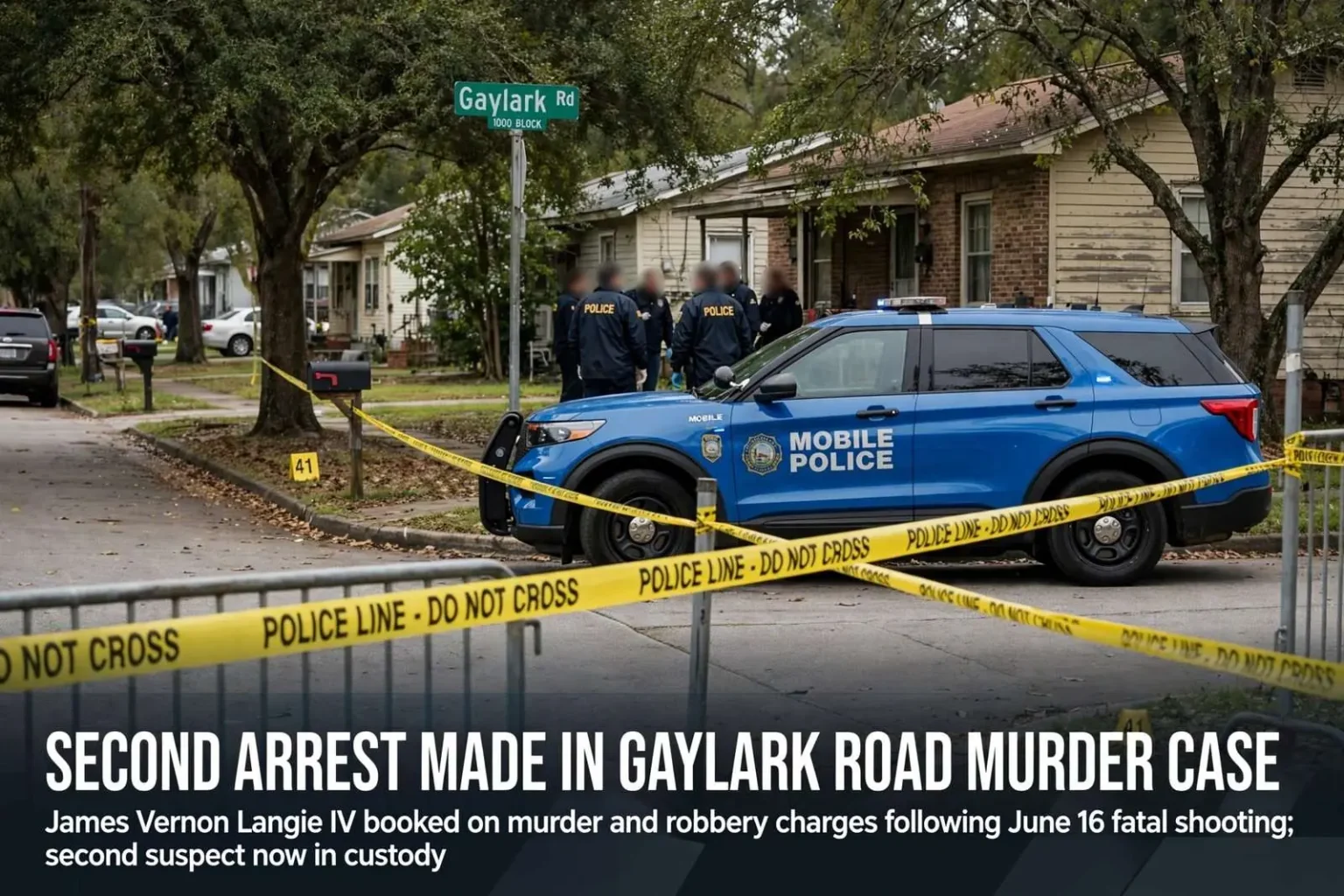
A second person has been arrested in connection with the fatal shooting of Jamail Mitchell on Gaylark Road. According to Mobile Metro Jail booking records, James Vernon Langie IV was arrested and charged with murder and robbery in Mitchell’s death, which occurred June 16. Langie was booked into the jail Thursday morning and is being held pending a bond hearing.
The arrest follows the earlier arrest of Elishia Langie, who was booked on murder and robbery charges on June 23 in connection with the same case. It has not been confirmed whether the two share a family connection, and authorities have not released further details on how the two arrests are related. What the booking records establish is a case now spanning two defendants, two arrest dates a week apart, and the same pair of charges — murder and robbery — filed against both.
The case as it stands
Jamail Mitchell was shot to death on June 16, and the investigation that followed produced its first arrest within a week, when Elishia Langie was booked into Mobile Metro Jail on murder and robbery charges June 23. The second arrest, of James Vernon Langie IV, came Thursday morning, when booking records showed him entering the jail on the same charges. In Alabama, murder and robbery are both felony charges, and robbery — armed or otherwise — is frequently filed alongside murder when a death occurs during another felony, a pairing that can expose defendants to capital or life-level sentencing exposure under state law.
Both defendants are being held pending bond hearings, where a judge will determine whether bail is set and at what amount. In cases involving homicide charges, bond can be denied outright or set high enough that pretrial release is unlikely, and the hearings typically take place within days of booking. Until those hearings and any subsequent court filings, the public record consists largely of the booking entries themselves, which record the charges but not the evidence behind them.
How Mobile homicide cases proceed
Homicide investigations in Mobile begin with patrol officers securing the scene and Mobile Police homicide detectives taking the case, and they proceed through evidence collection, witness interviews, and forensic work that can take weeks or months. Arrests on murder charges typically come only when investigators believe they can establish probable cause, and additional arrests after the first are not unusual when evidence implicates more than one participant — as accessories, principals, or co-defendants acting together. The week that separated the two bookings in this case is consistent with an investigation continuing after the first arrest was made.
Once both defendants have been arrested, the cases move into the court system. Preliminary hearings or grand jury review determine whether the charges proceed to Mobile County Circuit Court, where felony cases are tried. Prosecutors evaluate each defendant’s alleged role separately, and co-defendants are sometimes tried together and sometimes severed, depending on the evidence and the defense strategies involved. None of that machinery is visible in booking records, which is why the gap between an arrest and a trial so often leaves the public record thin.
Reading the booking records
Mobile Metro Jail booking records are the public window into arrests in the county. Each entry records who was booked, when, and on what charges, along with bond status once it is set. The entries for James Vernon Langie IV and Elishia Langie told the outside world what it could know: two people, both charged with murder and robbery in Jamail Mitchell’s June 16 death, booked a week apart, both held pending bond hearings. The records do not describe the evidence, the relationship between defendants, or the roles each is alleged to have played — those details emerge, if at all, through court filings and testimony.
That restraint matters for another reason: an arrest is a stage in a legal process, not a verdict. Both defendants are presumed innocent until proven guilty in court, and the charges against them can be resolved in any number of ways — dismissal, reduction, plea agreement, acquittal, or conviction. The murder and robbery counts filed in this case are serious enough that the proceedings will unfold over months, with a defense attorney for each defendant entitled to examine the state’s evidence before any trial.
Gaylark Road and the neighborhood
Gaylark Road sits in Mobile’s residential fabric, a street of homes where a fatal shooting in June ended a life and drew investigators to a block that rarely sees them. Homicides in Mobile’s neighborhoods follow a pattern familiar to police and residents alike: a scene secured with tape, detectives door to door, and a family’s grief playing out in public as word spreads. A second arrest a week later signals to the neighborhood that the investigation kept moving, but it does not restore what the street lost on June 16.
The robbery charge attached to both defendants indicates that authorities allege the shooting occurred in connection with a robbery — a fact that, if proven, matters enormously in how the case is charged and punished under Alabama law. Deaths occurring during robberies fall within the state’s capital murder framework, giving prosecutors sentencing options far beyond ordinary murder, and defense attorneys respond by contesting every element of the alleged connection between the robbery and the killing.
What comes next
With both defendants booked, the case moves through its early court stages. Bond hearings come first, where each defendant’s counsel will argue for release and prosecutors will cite the gravity of the charges. From there, the cases proceed toward grand jury review and, if indicted, toward arraignment and eventual trial in Circuit Court — a path that in Mobile County typically takes a year or more from arrest to verdict, given the volume of felony cases and the complexity of homicide trials.
For Jamail Mitchell’s family, the second arrest is one marker in a process that will require their patience and, eventually, their presence in court. Families of homicide victims in Mobile are supported by victim services officers who guide them through the proceedings, notify them of hearings, and prepare them for the realities of a criminal case: continuances, plea negotiations, and the possibility that the full story of what happened on Gaylark Road will only emerge in a courtroom, long after the bookings that started it all.
Multiple arrests in one case
When a homicide investigation produces arrests a week apart, the pattern usually reflects investigators building their case layer by layer. The first arrest may come on the strength of the initial evidence, with additional defendants charged as interviews and forensics fill in the picture of who participated and how. In some cases the second arrest follows from evidence found during the first defendant’s arrest — phones, vehicles, statements to others — and in others it comes from witnesses who come forward once an initial arrest shows the investigation is serious. The booking records in this case document the outcome of that work without revealing which path it took.
The unconfirmed question of whether the two defendants share a family connection has drawn attention, as it does whenever defendants with the same surname are charged in a single case. Surnames in Mobile’s records often reflect extended families spanning generations in the same neighborhoods, but a shared name alone establishes nothing, and authorities have not released details on how the two arrests are related. Until prosecutors file the documents that describe each defendant’s alleged role, the relationship — familial or otherwise — remains among the questions the case has not answered.
The charges and the law
Murder under Alabama law covers the intentional killing of another person, among other forms, and carries sentences that can run from decades to life imprisonment. Robbery, in its armed or first-degree form, is also among the state’s most serious felonies. When a death occurs during a robbery, prosecutors may pursue capital murder charges, which expose a defendant to the state’s harshest penalties if proven. The decision of which charge to file rests with the District Attorney’s office, which evaluates the evidence before the grand jury and after, and the filing of murder and robbery counts against both defendants here signals the seriousness with which the case is being treated.
The bond hearings scheduled after each booking will set the immediate course of both cases. In homicide cases, Alabama law allows judges to deny bail under specific circumstances or to set conditions meant to ensure defendants appear for trial. Whatever the hearings produce, the practical effect of the June bookings is that two people accused in Jamail Mitchell’s death are now in the criminal justice system rather than at large — the outcome investigators work toward and the beginning of a process the courts will carry forward.
The investigation remains active as of the second arrest, and authorities have not released further details about the case. This article reports what the Mobile Metro Jail booking records establish: two arrests, the same two charges, and a community still waiting for the fuller account of what happened on Gaylark Road on June 16.