Coast Guard Sector Mobile Command Center in 2009
A 2009 WKRG report examined the command-center and search-and-rescue work of Coast Guard Sector Mobile.
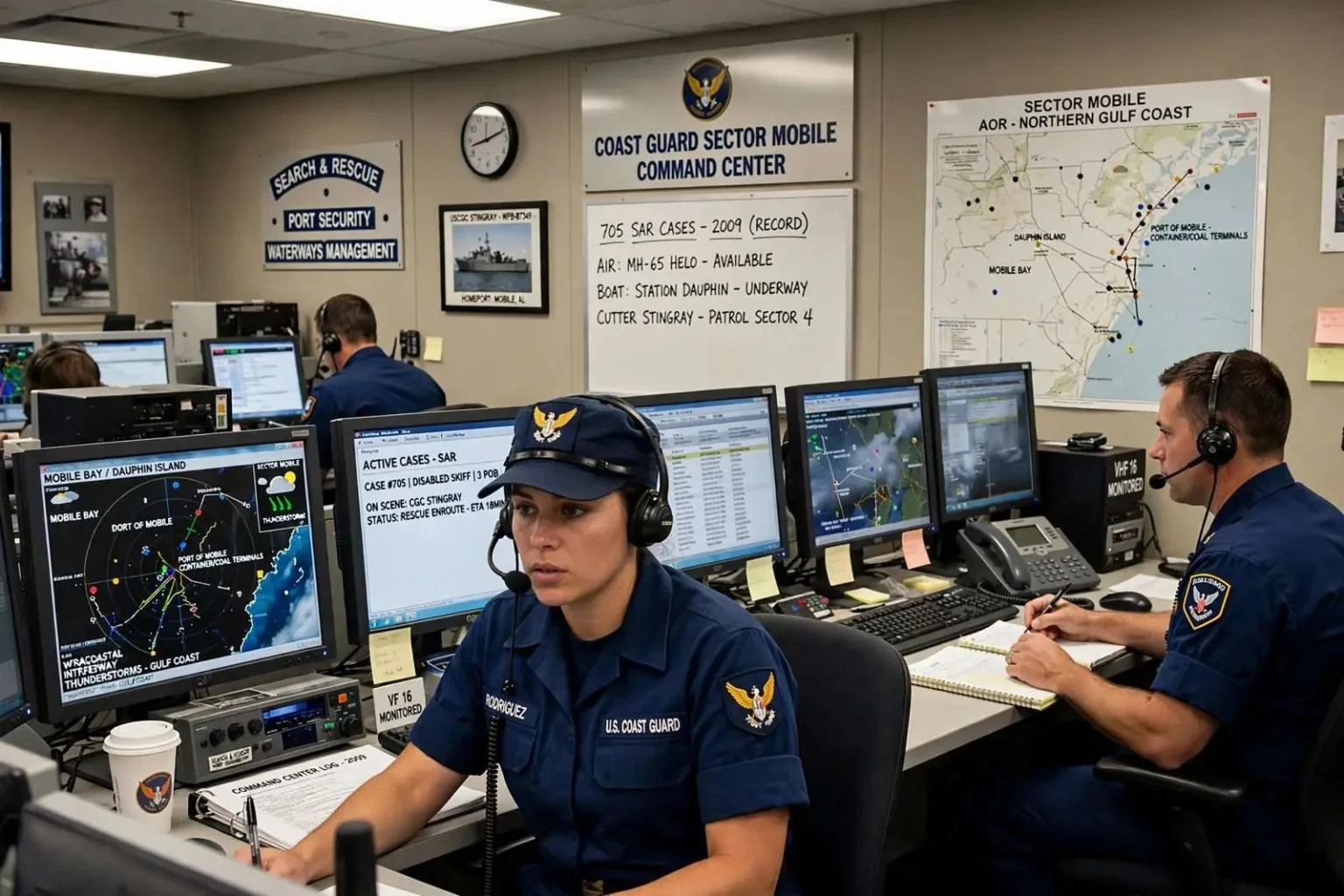
Coast Guard Sector Mobile’s command center served as an information hub for emergencies and other maritime operations, according to a 2009 local news report. The facility tied together radio traffic, telephone calls and electronic databases so that duty officers could track vessels, weather and ongoing cases from a single room. From that workspace, planners coordinated responses that could involve aircraft, boats or both, depending on where a distress call originated and how quickly it needed to be answered.
The command center functioned much like the nerve center it was designed to be. Watch standers monitored channels used by commercial traffic, recreational boaters and other Coast Guard units across the region. When a call for help came in, the same room handled the logging of the case, the tasking of resources and the relay of information between aircrews in the sky, boat crews on the water and senior officers who needed to approve major decisions.
Sector Mobile’s area of responsibility covers a demanding stretch of the northern Gulf Coast. It includes Mobile Bay, the Port of Alabama’s busy container and coal terminals, the Intracoastal Waterway, Dauphin Island passes and the connecting waters that carry everything from oyster boats to ocean-going freighters. Summer thunderstorms, fog in the cooler months and heavy recreational traffic on weekends all shape the workload that watch standers manage on any given day.
Search and rescue stood first among missions
Search and rescue was described as the unit’s top mission, and 2009 made that emphasis plain. Sector Mobile reported a then-record 705 search-and-rescue cases that year, a figure that reflected both the volume of boating activity along the Alabama and Mississippi coasts and the sector’s role as the coordinating hub for rescues across its area. Each case ranged from a disabled skiff drifting with the tide to far more serious emergencies involving people in the water.
The record number also illustrated how the command center’s tools mattered in practice. Radio traffic from mariners in distress, follow-up telephone calls to families and harbormasters, and electronic databases holding vessel information all fed into the same planning picture. A rescue coordinator could pull up a boat’s registration details, check the latest weather, and decide within minutes whether to launch a helicopter, dispatch a surface unit or ask a Good Samaritan vessel nearby to stand by.
Rescue coordination of that kind depends on layered resources. Coast Guard helicopters based at the aviation facility in Mobile could reach cases far offshore, while small-boat stations along the coast handled closer-to-shore work. Local fire departments, marine police and volunteer responders frequently joined as well. The command center’s job was to keep all of those moving parts talking to one another so that the person in the water or the disabled vessel got help from the nearest capable unit.
Ports, waterways and critical infrastructure
Rescue work was only part of the picture the 2009 report painted. The sector’s work also centered on protecting ports, waterways and critical infrastructure, a mission that had taken on added weight in the years after federal agencies reorganized maritime security responsibilities nationwide. Sector Mobile stood watch over an industrial port complex where tankers, bulk carriers, tugs and barges converge, and where an incident in the shipping channel could idle commerce far beyond Alabama.
Port protection involved patrols of restricted areas, enforcement of security zones around terminals, and coordination with the pilots, terminal operators and federal partners who share responsibility for the port’s safety. The Waterside portion of the mission put Coast Guard boats on the water near sensitive facilities, while the command center tracked movements and kept schedules updated for vessels arriving and departing.
Waterways management rounded out the daily workload. Aids to navigation such as buoys and channel markers guided commercial traffic through Mobile Bay and its approaches, and when storms knocked them askew, the sector helped alert mariners and coordinate corrections. Regatta permits, bridge issues and local boating events all passed through the same channels, giving the command center a steady rhythm of routine business beneath the emergency calls.
A look aboard the cutter Stingray
The 2009 report also followed the cutter Stingray, one of the patrol boats that gave Sector Mobile its reach on the water. Homeported in Mobile, the Stingray and her crew performed the kind of work the command center planned from shore: patrols of the bay and coastal waters, boardings of fishing and recreational vessels, and responses when a case on the watch floor needed a hull on scene.
Patrol boats of this class typically carried a relatively small crew, and life aboard mixed long stretches of routine with bursts of intense activity. A boarding could mean checking safety equipment, licenses and catch aboard a commercial fishing vessel in the morning and then standing by a regatta or a fireworks security zone that evening. The crew trained continually for search and rescue, law enforcement and damage control, since any patrol could turn into any of the three without warning.
For the command center, a cutter like the Stingray was a flexible asset. Unlike a station’s small boats, which generally worked near their base, a patrol boat could take on multi-day patrols, escort duties or search patterns well offshore. Coordinators on the watch floor could assign the cutter a patrol area matched to the season’s risks, whether that meant heavy recreational traffic on summer weekends or fishing fleets working their grounds.
The Stingray’s presence in the report underscored the connection between the planning room and the people afloat. Radio checks between the command center and the cutter, position updates passed over data links, and the constant exchange of weather and traffic information were the daily texture of that relationship. When something went wrong on the water, the same channels carried the tasking that put the cutter underway.
How a case moved through the watch floor
Understanding the command center means understanding the life of a single case. A mariner broadcasts a mayday on VHF channel 16. A watch stander answers, collects the position, number of people aboard and nature of the emergency, and logs the case into the electronic system that tracks every incident. The coordinator then checks what resources are available and what the weather allows, and a decision is made about what to launch.
Telephone calls fill in what radio cannot. A call to a marina might confirm which slip a vessel left from; a call to a family member might establish how many people were actually aboard; a call to a hospital alerts medical staff that a patient is inbound. Electronic databases let the watch stander verify a vessel’s description and ownership so that searchers know what they are looking for on the water.
As the case develops, the command center remains the common thread. Aircraft report what they see, boats report what they find, and the coordinator adjusts the search plan as the picture sharpens. Cases can close in twenty minutes or run for days, and throughout that span the information hub keeps its records straight, because those records matter for investigations, family notifications and after-action reviews alike.
What the record year meant locally
A record 705 search-and-rescue cases in a single year carried meaning for coastal residents beyond the statistics themselves. It meant that the waters off Alabama were busy, that storms and breakdowns regularly put people at risk, and that the region’s rescue network was being exercised constantly. For boaters, the number was a reminder that distress can happen close to home, on familiar waters, on an ordinary afternoon.
The volume also had practical effects on the sector itself. Sustained case loads test crew rest, maintenance schedules and training time, and units respond with careful management of who stands watch and when. Local observers in 2009 noted that the pace had made the command center’s coordination role more visible than ever, since no single boat or aircraft could have covered that many cases alone.
The 2009 report closed with the caveat that applies to any historical summary: it described operations and statistics as they stood at the time. Search-and-rescue counts, staffing and even the structure of Coast Guard commands have continued to evolve since then, and current figures may differ from those reported in 2009.
Sector Mobile in the larger Coast Guard picture
Sector Mobile occupies a distinctive place among Coast Guard units on the Gulf Coast. Sectors were created nationwide to combine former groups and marine safety offices into single commands, uniting search-and-rescue coordination, port operations, waterways management and marine environmental response under one roof. That consolidation is precisely why the command center in Mobile could function as an information hub for so many different kinds of emergencies at once.
The sector also sits alongside a major Coast Guard aviation presence in the city, where aircrews train and deploy for missions across the Gulf of Mexico. That proximity matters operationally: helicopter crews and command center coordinators work the same waters, share the same weather picture, and can talk directly when a case is developing. For mariners in trouble far from shore, the combination of a responsive watch floor and nearby aircraft is often the difference in how quickly help arrives.
Regional partnerships extend the sector’s reach further. Sheriffs’ marine patrols, marine resources officers from the state, fire departments with dive teams, and volunteer organizations all play roles in coastal emergencies. The command center’s databases and communication channels are what allow those agencies to plug into a coordinated response rather than operating side by side by accident.
Why the 2009 report still resonates
Local news coverage like the 2009 report serves a purpose beyond the day it airs. It shows coastal residents how the machinery behind a rescue actually works: the radio watch, the phone calls, the record-keeping and the launches that turn a distress call into a rescue. It also documents a moment in the region’s history, when a record year of cases tested the system and the system held.
The themes of that report have proven durable. Command centers still blend radio, telephone and electronic records; cutters still patrol from Mobile; search and rescue remains the mission the public sees most often; and the port still depends on vigilant oversight of its waterways and infrastructure. The specific numbers have moved on, but the responsibilities they represented remain in place for today’s watch standers.
For residents of Mobile, Baldwin County and the neighboring Mississippi coast, the account is a practical reminder as much as a historical one. Boaters who file float plans, carry working radios and know their positions give the modern descendants of that 2009 watch floor the raw material they need. The record 705 cases of 2009 were resolved, in the end, by coordination, and coordination begins with the first good call from the water.
This article is a historical summary of a 2009 local news report about Coast Guard Sector Mobile’s command center, the cutter Stingray and the sector’s record search-and-rescue year. Current operations, staffing and statistics may have changed since the report was published, and readers should consult official Coast Guard sources for present-day information.