Selma woman sentenced for drug-smuggling scheme at Atmore jail
A Selma woman, Haley Fuentes, was sentenced to 35 months for a drug-smuggling scheme that funneled methamphetamine and marijuana into the Atmore jail.
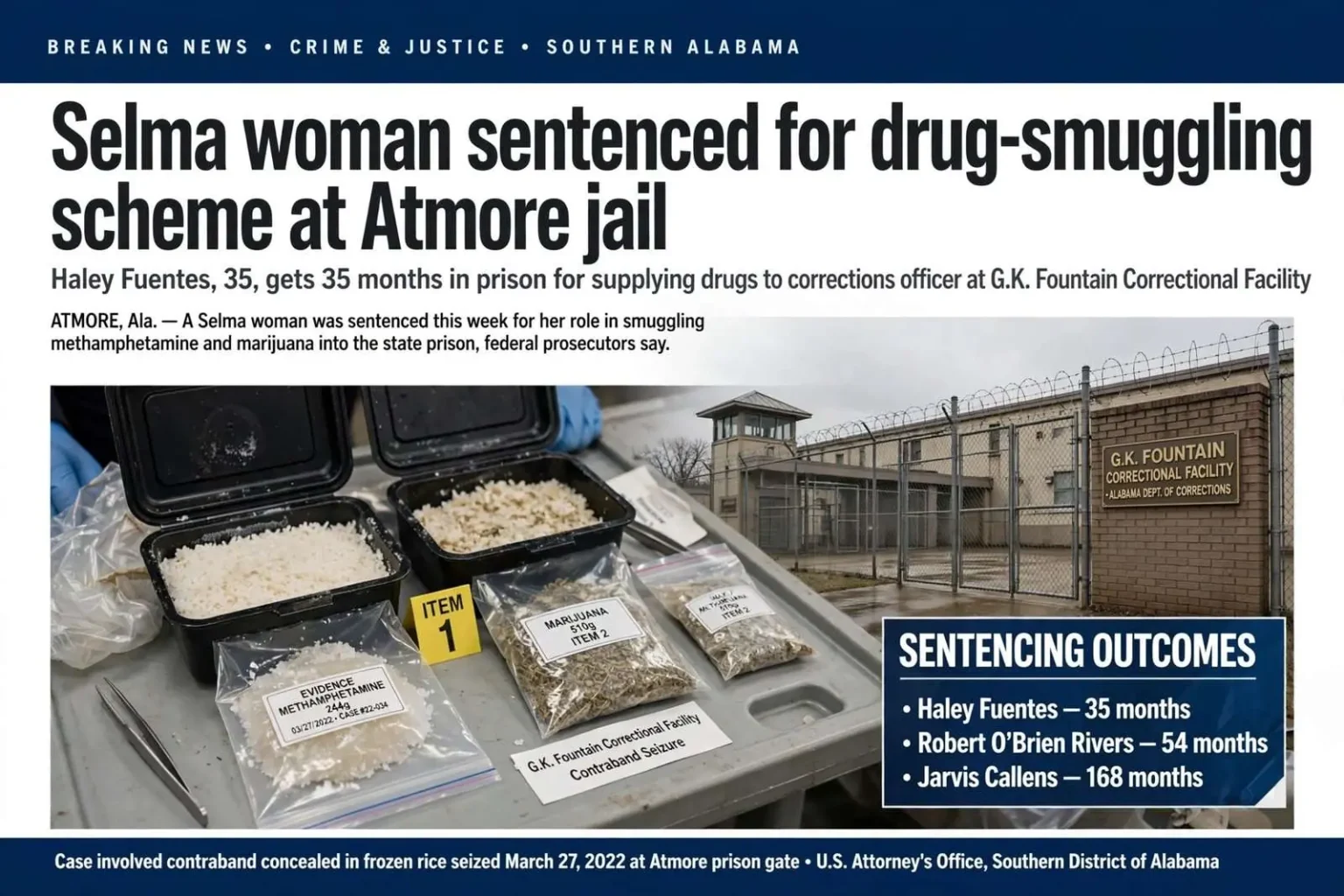
A Selma woman has been sentenced to 35 months in prison for her role in a drug-smuggling scheme at an Atmore prison, according to the U.S. Attorney’s Office. Haley Fuentes, of Selma, provided drugs to an Alabama Department of Corrections employee who was passing them to an inmate at the facility, prosecutors said.
The case is part of the ongoing effort to stop the flow of contraband into Alabama’s prisons — a flow that corrections officials describe as a constant battle fought at vehicle checkpoints, among employees and across fences. This scheme came apart, prosecutors said, when officers searching employees and their vehicles found the drugs before they ever reached an inmate.
On March 27, 2022, corrections employee Robert O’Brien Rivers reported for work at the G.K. Fountain Correctional Facility in Atmore. That morning, officers searching employees and their vehicles found two black containers with frozen rice. Hidden underneath were 244 grams of methamphetamine and 510 grams of marijuana, according to court documents.
Rivers, who knowingly received the drugs from Fuentes and Jarvis Callens to smuggle to an inmate, had done so multiple times, according to the release. The search that morning turned a routine shift into a federal case that ultimately reached everyone involved in the supply chain outside the fence.
How the scheme came apart
The frozen rice was the concealment method: drugs sealed inside containers packed with frozen rice, a trick designed to defeat a casual search and, officers said, to mask the smell that drug dogs and trained officers look for. It did not survive a real search. Officers inspecting employees and vehicles at the prison found the two black containers, opened them and discovered the methamphetamine and marijuana packed underneath the rice.
The seizure on March 27, 2022 was not an isolated event, investigators determined. Rivers had received drugs from Fuentes and Callens before and smuggled them to an inmate on multiple occasions, according to prosecutors. In federal court, that pattern matters: a scheme that repeats becomes a conspiracy, and everyone who supplies it — the courier, the middleman and the employee who carries it through the gate — shares responsibility for the whole operation.
The sentencing of Fuentes to 35 months in prison closes out the roles of the people who moved the drugs in from outside. Rivers was previously sentenced to 54 months in prison for his part as the corrections employee who carried contraband through the gates of the facility where he worked. Callens, the third member of the scheme, received the longest sentence — 168 months, or 14 years — reflecting his role in supplying the drugs that moved through the operation.
The traffic stop that predated the March search also became part of the record. On Christmas Day 2021, Monroe County Sheriff’s Office deputies stopped Fuentes and Callens and found 165 grams of methamphetamine that, prosecutors said, the pair were taking to Rivers. That stop — months before the seizure at Fountain — documented the pipeline between Selma, Monroe County and the prison in Atmore, and it gave federal investigators a second window into how the scheme operated.
Contraband in Alabama’s prisons
G.K. Fountain Correctional Facility is one of the Alabama Department of Corrections’ larger institutions, a close-security prison in Escambia County that houses more than a thousand men. Like every facility in the state system, Fountain fights a continuous battle against contraband — cellphones, tobacco, and above all drugs — that corrections officials describe as the driving force behind much of the violence inside Alabama’s prisons.
The economics explain the persistence. Inside a prison, a gram of methamphetamine or an ounce of marijuana can be worth many times its street price, and the inmate who controls a supply of drugs accumulates debts, loyalty and power. That is why the state’s contraband problem is not primarily a fence problem — it is a delivery problem, and the deliveries come folded into laundry, thrown over fences by drone or catapult, and, as this case shows, carried through the front gate by employees.
Staff smuggling is the version corrections officials fear most, because an employee with a badge and a vehicle bypasses every layer of security built to stop an outsider. Departments across the country screen employees, search vehicles, monitor finances and rotate assignments to counter it, and Alabama has prosecuted its own corrections staff repeatedly for bringing in drugs, phones and tobacco. The sentences in this case — 54 months for Rivers, 168 months for Callens, 35 months for Fuentes — are part of the deterrence equation federal prosecutors point to when they announce these cases.
Methamphetamine and the court system
The quantities involved were substantial. The seizure at Fountain included 244 grams of methamphetamine, an amount that represents hundreds of individual doses once it is divided and sold inside a prison. The 510 grams of marijuana and the 165 grams of meth stopped in Monroe County on Christmas Day 2021 added to the total that moved through the conspiracy, and the weight of methamphetamine involved is a central factor in how federal sentences are calculated under the sentencing guidelines.
Federal prosecution is the usual route for prison contraband cases in Alabama because the conduct maps onto federal drug and contraband statutes, and because federal sentences are served in full without parole. The U.S. Attorney’s Office for the Southern District of Alabama, which covers Mobile and the counties north and east of the bay, has made prison corruption and drug pipelines a recurring feature of its criminal docket.
For the communities involved, the case traced a line on the map: drugs moving from Selma in the Black Belt, through Monroe County on the route south, to Atmore in Escambia County. Each stop along the way — a sheriff’s deputy’s traffic stop on Christmas Day, a search table at a prison gate — was a point where the pipeline could have been missed. Instead, the amounts were seized, the roles were documented, and all three participants in the scheme are now serving federal prison sentences.
Corrections officials say the fight continues as long as demand inside the walls remains. Every seizure like the one at Fountain on the morning of March 27, 2022, interrupts a supply that will be rebuilt by someone else unless the people supplying it — inside and outside the system — face the kind of consequences this case produced: decades, combined, in federal prison for a corrections officer, a supplier and a courier.
What the sentences add up to
The arithmetic of the case tells its own story about how the justice system weighs roles in a smuggling operation. Rivers, the corrections officer who physically carried the drugs through the security checkpoints of the prison where he worked, received 54 months. Fuentes, the Selma woman who supplied drugs to Rivers on multiple occasions, received 35 months. Callens, whose role in supplying the operation proved most significant under the sentencing guidelines, received 168 months — 14 years, more than the other two sentences combined. Prosecutors described the outcomes as the result of investigating the scheme as a whole rather than as a series of disconnected seizures.
The Christmas Day stop in Monroe County shows how these cases typically begin to unravel. Deputies working holiday shifts on the corridors that connect the Black Belt to south Alabama routinely look for exactly this kind of traffic, and a load of 165 grams of methamphetamine — a serious quantity by any standard — turned a traffic stop into an investigation. Once the names of the people in the car were connected to a corrections officer at Fountain, investigators could begin assembling the pattern that the March 27, 2022, search at the prison would confirm.
Federal prosecutors credited the cooperation among agencies for the result: the Monroe County Sheriff’s Office on the traffic stop, corrections investigators at the facility, and federal agents who turned individual seizures into a conspiracy case. That cooperation is the model in contraband prosecutions, because no single agency sees the whole pipeline. The deputy sees a car on a highway; the gate officer sees an employee with containers; the federal case is what ties the two together into a single, prosecutable scheme.
The view from Selma and Atmore
For Selma, the case is one more chapter in the city’s long struggle with methamphetamine distribution. The drug has been a persistent problem across Alabama’s Black Belt and beyond, and trafficking cases originating in Dallas County regularly appear on the federal docket in Montgomery and Mobile. Small trafficking networks that move product between rural supply points and urban markets are the bread-and-butter of federal drug prosecutions in the state, and the sentences they carry are among the longest in the criminal system.
For Atmore and Escambia County, the Fountain facility is a fixture of local life — a major employer in a small city on the northern edge of the county, and a neighbor whose operations the community follows closely. Contraband cases at the prison draw attention precisely because they touch the trust between the institution and its workforce: most employees at Fountain and its sister prisons across the state do their jobs in difficult conditions without breaking the law, and each smuggling case reflects on all of them. Corrections leadership has repeatedly emphasized that the vast majority of staff never bring contraband past a checkpoint, and that prosecutions like this one exist to keep it that way.
The inmate at the end of the pipeline also faces consequences. Introducing drugs into a correctional facility is a crime in itself under Alabama law, and inmates caught with contraband lose privileges, earn disciplinary time and see their parole prospects damaged. The demand side of the trade is subject to the same enforcement logic as the supply side, even if the public announcements tend to focus on the sentences of the couriers and the corrections officers who feed it.
What remains of the case now belongs to the federal prison system. Fuentes, 35 months; Rivers, 54; Callens, 168 — three sentences that will outlast the news cycle in Atmore, Monroe County and Selma, and three reminders of how Alabama’s courts have come to treat the smuggling of methamphetamine into its prisons: not as a favor between acquaintances or a victimless hustle, but as a drug conspiracy with a corrections officer at its center, and with sentences to match.