Semmes Girls Softball Asks the City to Close Community Park to Unaccompanied Minors After Gate Damage
After a volunteer saw a teenage boy knock down a gate at Semmes Community Park on Sept. 8, the Semmes Girls Softball organization is asking the city to close the park to unaccompanied minors at dusk, citing weeks of littering and illegal dumping.
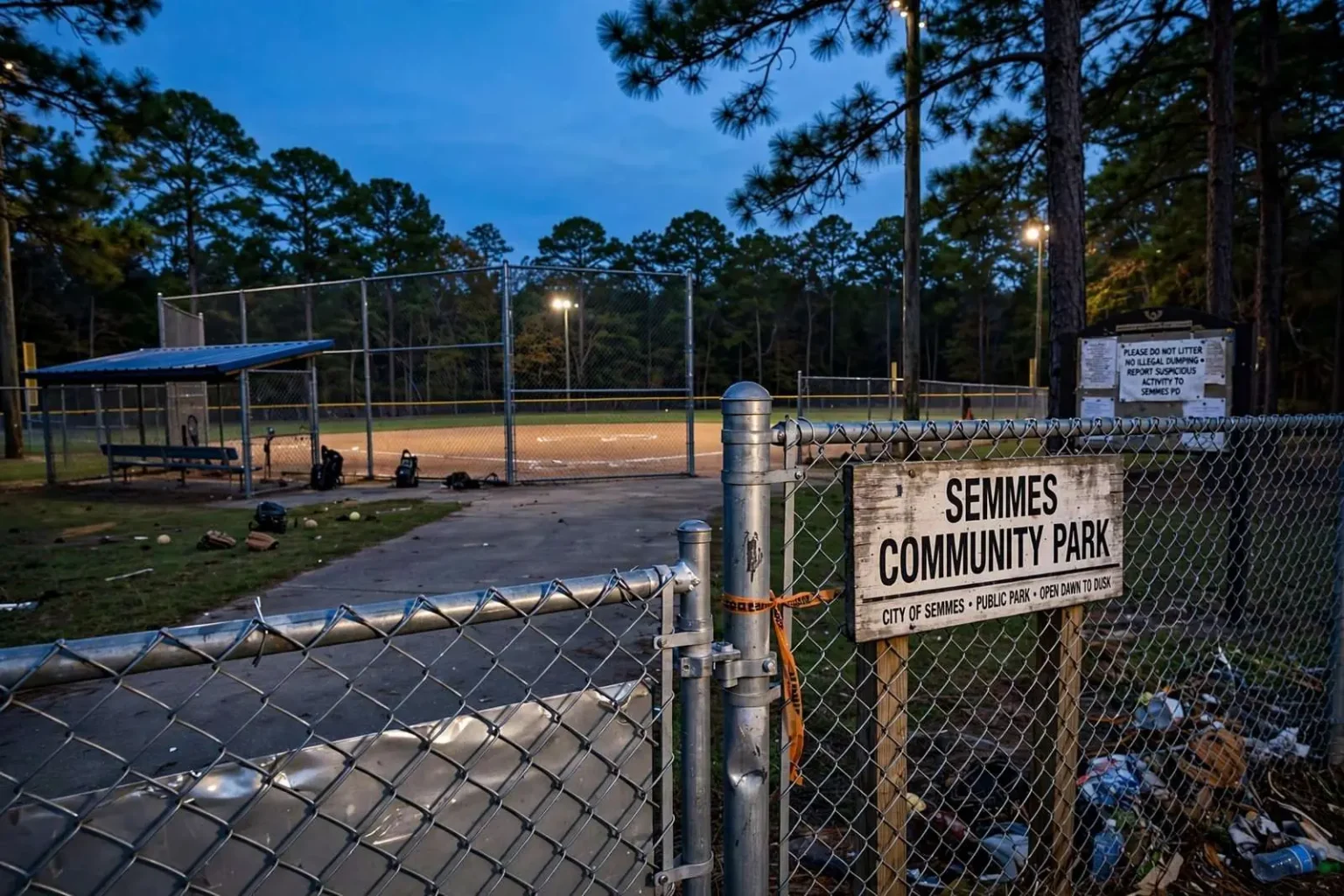
SEMMES, Ala. — The Semmes Girls Softball organization is speaking publicly after its park was damaged Tuesday night, and is asking the City of Semmes to close Semmes Community Park to unaccompanied minors at dusk.
According to organization members, a volunteer saw a teenage boy knock down a gate at the park on Sept. 8 before leaving in a white vehicle with friends.
Park leaders said the gate has been repaired. But they said the gate is not the only problem they have been dealing with.
Over the past few weeks, they said, they have seen littering and illegal dumping at the park.
What the Organization Is Asking For
The request is specific: that the city close Semmes Community Park to unaccompanied minors at dusk, in hopes of preventing further incidents.
That is a narrower measure than a general curfew or a full closure, and the distinction matters. It would not close the park at dusk, and it would not restrict adults or families. It would restrict minors present without an adult after dark.
Municipalities have broad authority to set hours and conditions of use for public parks, and rules of this kind are common. Many cities close parks entirely at dusk or at a set hour; others restrict specific facilities.
Enforcement is the practical question that follows. A rule requires someone to enforce it, and a small city’s police department has finite patrol capacity. A restriction that exists on paper without periodic patrol presence tends not to change behavior.
Who Actually Absorbs This
Youth sports organizations of this kind run almost entirely on volunteer labor and registration fees.
Parents coach. Parents drag infields, line fields, run concession stands, maintain equipment and handle scheduling. Registration fees and fundraising cover uniforms, equipment, umpires and field upkeep. There is generally no staff and no reserve fund.
In that structure, a damaged gate is not an abstraction. It is a repair paid for out of money raised for something else, and labor donated by someone who has already donated a great deal. Illegal dumping means volunteers hauling other people’s waste before they can prepare a field.
Every hour spent on that is an hour not spent on the program, and every dollar spent on it is a dollar not spent on equipment or on reducing what families pay.
Why Ball Fields Draw This
Sports complexes have characteristics that make them recurring targets for after-hours activity.
They are large, open and unstaffed at night. They have parking. They are set back from residences, so activity there is less likely to be observed or reported. And they sit empty for long stretches, particularly outside the playing season.
Illegal dumping follows a similar logic. A site with vehicle access, no lighting, no cameras and no one present is where household waste, construction debris, tires and appliances get left by people avoiding disposal fees.
The cost of that falls on whoever maintains the property. For a volunteer softball organization, that is the volunteers.
What Tends to Help
Communities dealing with recurring problems at recreational facilities generally work through a set of measures, in rough order of cost:
Lighting. Well-lit areas see substantially less after-hours activity than dark ones. Lighting at entrances, parking areas and along access points addresses the conditions that make a site attractive.
Access control. Gates, bollards and barriers that prevent vehicles from entering after hours address dumping directly, since dumping requires driving in.
Cameras. Even a small number of cameras at entry points changes behavior, and provides evidence when something occurs. Systems have become considerably less expensive than they were.
Posted hours. A clearly posted closing time gives officers a basis to address people present after hours and removes ambiguity.
Patrol presence. Periodic drive-throughs during evening hours are among the most effective measures, and cost only officer time.
Reporting. Incidents that are not reported do not appear in the data that drives patrol allocation. An organization that documents every occurrence builds the record that supports a request for attention.
Semmes and Its Park
Semmes is a city of roughly 6,000 in western Mobile County, incorporated in 2016 — making it one of Alabama’s newer municipalities.
A city that young is still building its municipal capacity. Departments, ordinances, budgets and service levels that established cities developed over generations are being assembled in real time, and recreational facilities frequently depend on volunteer organizations to a degree larger cities do not require.
Semmes Community Park is a significant asset in that context. For a growing suburban community, a park with ball fields is where a substantial share of youth activity happens, and where families spend evenings and weekends across the spring and fall seasons.
The city has been working through other questions of municipal capacity as well, including an ongoing exploration of whether to establish its own school system separate from Mobile County Public Schools.
What Happens Next
The organization’s request now goes to the City of Semmes, where any change to park hours or use restrictions would be a matter for city officials.
Anyone with information about the Sept. 8 gate damage or about illegal dumping at the park is encouraged to report it to local law enforcement. The organization described a teenage boy leaving in a white vehicle with others.
South Alabama News will report on any action the city takes regarding park hours.