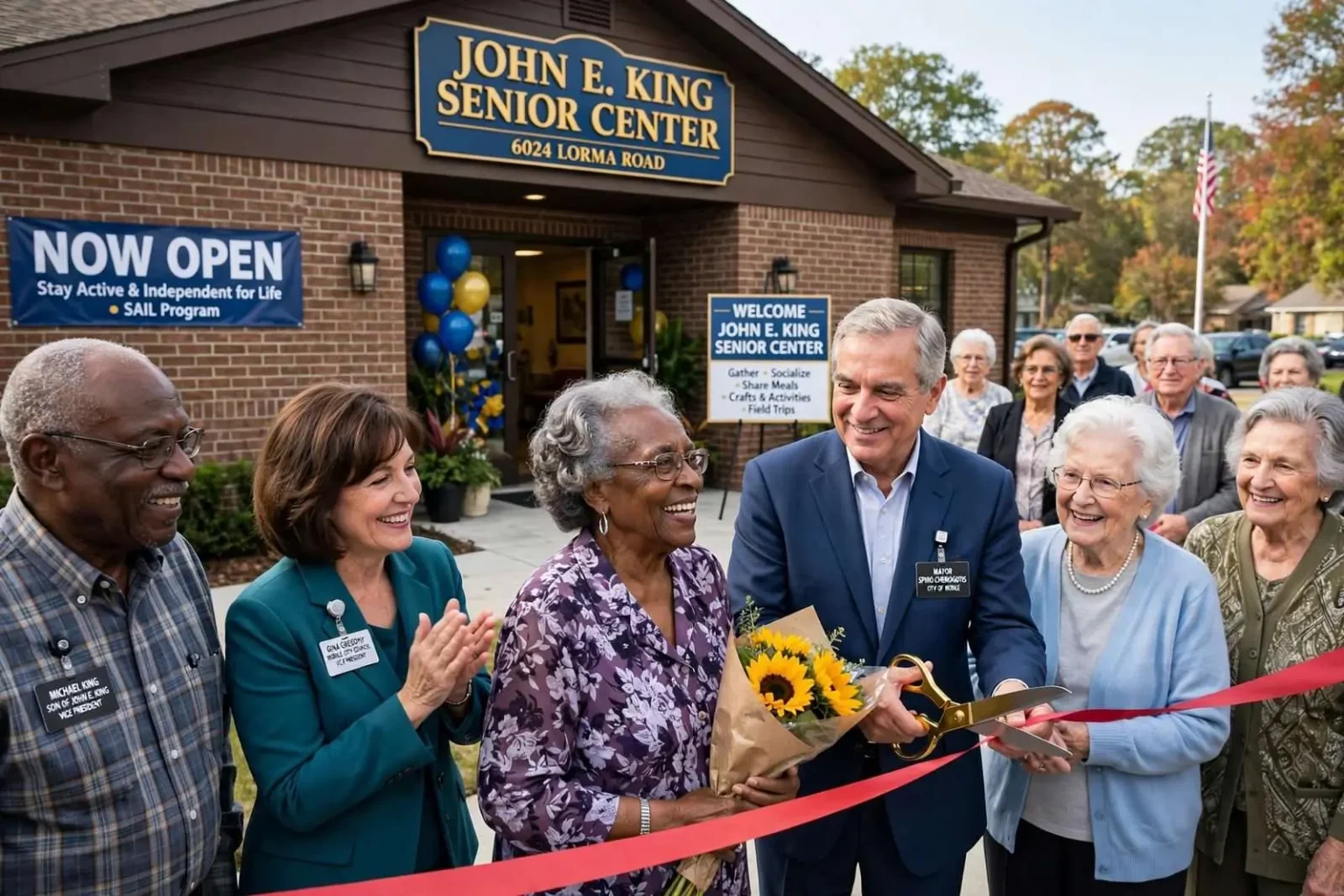
City leaders, Hillsdale residents and members of the King family gathered Thursday to celebrate the opening of the John E. King Senior Center in Mobile — a newly renovated space designed to give older adults a place to socialize, stay active and share meals.
The center, located at 6024 Lorma Road, includes tables and chairs, televisions, room for games and crafts, shelving for activity materials, restrooms and a warming kitchen for hot meals served through the City of Mobile’s Stay Active and Independent for Life program, known as SAIL.
A tight fit at the rec center
For seniors in Hillsdale and Mobile Terrace, the opening means having their own place after previously sharing smaller rooms at the nearby recreation center.
“The seniors have requested a senior center in this area,” Mobile City Council Vice President Gina Gregory said. “In the rec center, they share it with the young people — a lot of kids running around, which is great, but for the seniors who really want some space to themselves, it was just a tight fit.”
Gregory said the city began looking for a way to create that dedicated space and decided to renovate the existing building. She said the center now gives seniors room for crafts, food preparation and activities, with a separate storage unit for supplies planned for the fall.
Honoring a community legacy
The opening carries another meaning for the neighborhood: the center is named after John E. King, a longtime community advocate remembered for pushing for better opportunities and spaces for local families.
His son, Michael King, said his father would have been proud. “My dad did so much work out here in the neighborhood and in the community,” he said. “He was always doing something for other kids — it was his calling to help people.”
Michael King said his family moved to the neighborhood in the early 1960s. He remembers his father seeing activity around the building that concerned him because children were nearby. “He had this thing about kids having to be around, exposed to the right things,” King said. “So he went and talked to a city councilman.”
That conversation led city leaders to visit the site and agree that changes were needed, King said. His father later helped advocate for projects including tennis courts and a lighted baseball diamond. A Hillsdale HOA representative described John E. King as one of the community’s trailblazers, noting he also helped lead efforts for infrastructure improvements in Mobile Terrace and for the original construction of the building now named in his honor.
Inside the center, plaques also recognize other neighborhood trailblazers, including Leona Harris and Mary Allison Folks.
Connection is the point
For the seniors expected to fill the building, the most immediate benefit is connection. Mildred McCasky said the group has been waiting for a space of its own.
“It’s good to come out and have company,” McCasky said. “We can chat with each other and drink coffee and talk and laugh and have a good time.”
A senior center, she said, offers something simple but meaningful: somewhere to go. “A lot of times we just need somewhere to go and to socialize with each other,” she said. “It gets me personally out of the house.” McCasky said she has participated in senior activities for about five years and is looking forward to a permanent home where members can gather, enjoy activities and build friendships. “We’re looking for different activities and the friendship,” she said. “We can laugh and joke and still have a good time.”
Mayor Spiro Cheriogotis said community, friendship and fellowship are especially important to older adults’ health and quality of life. “The seniors are the backbone in our community,” he said. “At this stage in their life, having community, having friendship and fellowship is so important to health.”
Meals, field trips and new programming
Mary Lee, the center’s senior nutrition manager, said staff plans to move in within the next few weeks. She is excited to work with seniors on activities, field trips and new programming.
“It makes me very happy to have them,” Lee said. “I’d like to have more seniors come from the community and bring ideas. We go on field trips. We do activities. We just want to enhance their lives.”
The center will provide hot meals through the city’s SAIL program, and leaders say the new space is intended to keep seniors active, independent and connected in the community many of them have helped build.
The Public Health Case for Senior Centers
Public health researchers have spent decades documenting the toll that social isolation takes on older adults, and their findings help explain why cities continue to invest in dedicated senior centers even as budgets tighten elsewhere. Studies on aging and isolation have repeatedly linked a lack of regular social contact among seniors to higher rates of depression, cognitive decline, and even cardiovascular disease, with some researchers describing the health risk of chronic loneliness as comparable to more familiar risk factors like smoking or physical inactivity. A senior center is, in that light, not simply a recreational amenity but a low-cost public health intervention: a place where regular attendance creates the kind of routine social contact — chatting over coffee, playing cards, sharing a meal — that gerontologists consistently find protective against the mental and physical decline associated with isolation. That is part of why Mayor Cheriogotis’s comment linking “community, friendship and fellowship” directly to seniors’ health reflects a well-established finding in aging research rather than just a nice sentiment for a ribbon-cutting.
How Congregate Meal Programs Like SAIL Fit a National Model
The City of Mobile’s Stay Active and Independent for Life program is a local version of a model used in senior nutrition programs across the country, often built around what public health officials call “congregate meals” — hot meals served in a group setting rather than delivered to individual homes. That structure traces back to the federal Older Americans Act of 1965, which established the framework that many local Area Agencies on Aging still use today to fund senior nutrition and social service programs, usually through a mix of federal, state, and local dollars administered by regional aging agencies. The congregate model is intentionally designed to serve two goals at once: ensuring older adults get consistent, nutritious meals, and giving them a reason to leave the house and interact with peers, which program administrators generally see as inseparable from the nutritional mission itself. Home-delivered meal programs — often known by the Meals on Wheels name — serve a complementary role for seniors who are homebound, while congregate sites like the new King Center are aimed at the larger population of older adults who are mobile enough to attend but benefit enormously from having a nearby, dedicated place to do so.
Why Space Matters: The Shared-Facility Problem
The situation described in Hillsdale, where seniors shared recreation center space with youth programs, is a common growing pain for municipal recreation systems that were originally built decades ago around youth sports and after-school programming rather than the now-larger population of older residents. As a community’s median age rises — a trend playing out in many mid-sized Southern cities as populations age and younger residents sometimes move to newer suburban developments — the demand for senior-specific programming often outpaces the physical space originally allocated to it inside general-purpose recreation centers. City parks and recreation departments around the country have responded in various ways, from building new stand-alone senior centers, to converting underused buildings like former schools or community halls, to expanding hours and dedicated rooms within existing recreation centers. Mobile’s approach — renovating an existing building specifically for senior use rather than constructing new from the ground up — is a common and comparatively cost-effective path that lets cities respond more quickly to a documented need like the one Hillsdale seniors raised with Council Vice President Gregory.
Naming Public Buildings After Community Advocates
The decision to name the center after John E. King reflects a common civic practice: honoring local residents whose sustained, often unpaid advocacy shaped public infrastructure long before officials formally recognized it. Cities frequently name parks, community centers, and other public facilities after neighborhood figures specifically because those buildings and programs would not exist without their years of pressing city officials for attention and resources — exactly the arc described in the King family’s account of conversations with a city councilman that eventually led to improvements in the neighborhood. This kind of naming is more than ceremonial; it also serves to preserve local history that might otherwise go undocumented, since neighborhood advocacy that predates official records or press coverage often survives primarily through family memory and oral history, the kind Michael King shared about his father’s efforts dating back to the early 1960s.
Aging in Place and the Broader Trend Toward Neighborhood-Based Senior Services
The push for neighborhood-level senior centers, rather than a single large centralized facility serving an entire city, reflects a broader shift in how aging services are delivered. Many older adults prefer to “age in place” — remaining in their own homes and communities rather than relocating to assisted living or other institutional settings — and researchers and aging-services providers generally agree that successful aging in place depends heavily on access to nearby, walkable, or easily reachable community resources, since seniors who lose mobility or driving ability can quickly become isolated if the nearest social or nutrition program is far from home. A center located within an established neighborhood like Hillsdale, rather than requiring residents to travel across town, fits this model directly, reducing the transportation barrier that is one of the most commonly cited obstacles to consistent senior center attendance nationally. Programming that includes field trips, crafts, and games — the kind Mary Lee described planning for the King Center — is also a deliberate design choice: aging-services professionals generally recommend a mix of activities that combine physical movement, social interaction, and mental engagement, since research on healthy aging points to all three as protective factors against cognitive and physical decline.