
‘Sensational Sixties’ Fashion Exhibit Opens at History Museum of Mobile
The History Museum of Mobile's 'Sensational Sixties' exhibit explores 1960s fashion from haute couture to hippies, on view through Aug. 18.
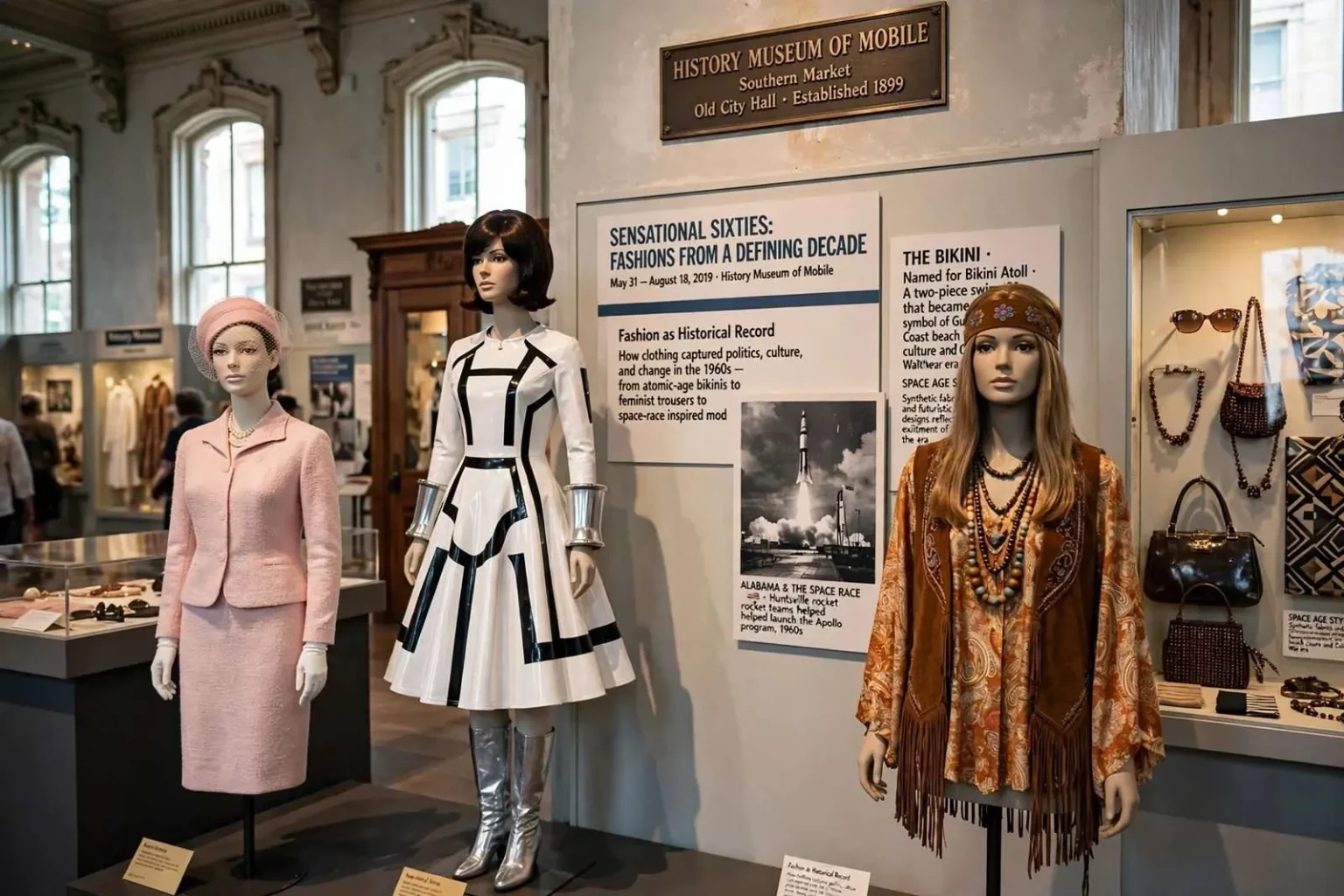
The swinging decade gets its due this summer at the History Museum of Mobile, where a new exhibit traces how 1960s fashion mirrored one of America’s most turbulent eras. “Sensational Sixties: Fashions from a Defining Decade” opened May 31, 2019, and runs through Aug. 18, showcasing everything from haute couture to hippie styles from the museum’s collection and beyond. The exhibition gives Gulf Coast visitors a close look at clothing that most people have only ever seen in photographs and old television footage, displayed in the institution that has served as the keeper of Mobile’s material history for generations.
Curators use clothing as an entry point into the politics and culture of the decade: bikinis named for an atomic testing site, trousers tied to the rise of feminism, and mod materials inspired by the space race all make appearances, showing how style absorbed the social revolutions happening around it. That framing sets the show apart from a simple costume display. Rather than presenting garments as isolated objects of taste, the exhibition treats each piece as evidence — of changing attitudes toward women’s roles, of the Cold War anxieties that seeped into everyday life, and of the technological optimism that put mannequins in vinyl and metallic fabrics while rockets lifted off from launch pads just a few hundred miles away.
Museum director Meg Fowler joined Stephanie Evans in previewing the exhibit, which gives visitors a chance to see how hemlines and fabrics recorded history as vividly as headlines did. For museum staff, the show is also an opportunity to display pieces from the institution’s own textile collection — garments that spent years in careful storage — alongside borrowed items that fill out the story. Textile exhibitions of this kind take months to assemble, since historic clothing must be mounted and lit with special care to prevent damage from stress and exposure.
What Visitors Will See
The range of styles on display covers the full sweep of the decade’s fashion, from the polished haute couture of its early years to the counterculture looks that closed it out. The early 1960s still belonged largely to the tailored, structured silhouettes that had dominated the late 1950s — the world of gloves, suits and pillbox hats, when American women’s fashion was at its most restrained and put-together. As the decade wore on, that world came apart. Designers in London and New York pushed hemlines upward, boutiques began selling youthful fashions that deliberately broke with their parents’ generation, and by the late 1960s the hippie aesthetic — long hair, flowing fabrics, secondhand and handmade clothing — had moved from the fringes into the mainstream.
The bikini story is one of the exhibit’s more striking examples of how fashion and world events intertwined. The two-piece swimsuit took its name from Bikini Atoll, the Pacific island chain where the United States conducted nuclear tests in the years after World War II — a naming choice meant to signal something explosive. By the 1960s the swimsuit had become a fixture of American beach culture, and along the Gulf Coast it was part of a beach-and-leisure identity that visitors and residents will recognize immediately.
Trousers tell another story that the exhibit uses to connect clothing with social change. Before the 1960s, pants for women were largely confined to casual and practical settings; across the decade they moved into offices, restaurants and everyday public life, part of a broader assertion of women’s independence that ran alongside the era’s feminist organizing. What a woman wore to work became a visible marker of the changing expectations placed on women in society, and the garments in the show capture that shift hanger by hanger.
The Space Age in the Closet
Nothing says “1960s” quite like the futuristic fashions inspired by the space race, and the exhibit leans into that connection. Mod materials — shiny synthetics, geometric patterns, plastic and metallic finishes — reflected a culture watching human beings leave the planet for the first time. Designers imagined clothing for a world of space stations and supersonic travel, and even everyday consumers bought into the aesthetic with white boots, shift dresses and A-line cuts that rejected the fitted hourglass of the previous decade in favor of shapes that looked borrowed from science fiction.
The space connection had particular resonance in Alabama. The state played a central role in the American space program during the decade, with the Huntsville rocket team leading development of the boosters that would eventually carry astronauts toward the moon. The era’s fascination with space travel was therefore never an abstraction here — it was an industry playing out a few hours north, complete with headlines, jobs and civic pride that flowed through every part of Alabama. A Mobile visitor walking through the exhibit is looking at the domestic face of a technological race that was being run, in part, within the state’s own borders.
The Museum Behind the Exhibit
The History Museum of Mobile, located in the Southern Market/Old City Hall complex in downtown Mobile, is among the oldest and most significant museum institutions on the Gulf Coast. Its home is itself a piece of history: the Southern Market building and the adjoining Old City Hall date to the mid-19th century, an Italianate landmark that served as the city’s market house and municipal seat before becoming a museum. The building’s National Register pedigree and its location at the corner of Government and Royal streets put it within easy walking distance of the city’s central business district and the attractions around Cooper Riverside Park.
Institutions like the History Museum do more than preserve artifacts; they anchor a city’s cultural tourism. Fashion exhibitions in particular have proven to be reliable draws, appealing to visitors who might not come for a display of documents or military relics but will happily spend an afternoon looking at clothing. The museum’s use of its own collection, supplemented by loans, follows the standard practice of costume exhibitions everywhere: historic textiles are fragile, light-sensitive and labor-intensive to display, which makes each show a significant undertaking for a museum staff.
The Sensational Sixties run also reflects a broader pattern among regional museums of building programming around the decades that shaped their visitors’ own memories. For Mobile residents in their sixties and seventies, the clothes in the exhibit are not history at all — they are what they wore to school dances, weddings and work. Museums have found that those personal connections turn casual visitors into engaged ones, and that an afternoon spent with the fashions of one’s youth is often followed by donations of family photographs, letters and garments that enrich future exhibitions.
Planning a Visit
The exhibit remains open daily through Aug. 18 at the museum in downtown Mobile’s Southern Market/Old City Hall complex. Summer visitors can pair the show with the city’s other downtown attractions, making a morning or afternoon of the historic district’s museums, galleries and restaurants. For parents looking for an end-of-summer outing before school resumes, a fashion exhibition offers an unusual hook: teenaged and younger visitors may find the clothes more immediately engaging than most museum fare, and the social history wrapped around them delivers the educational payoff without feeling like a lecture.
Anyone with memories of the era, or garments and accessories from the 1960s stored in an attic, may also find that a visit sparks a conversation worth having with the museum’s staff, which continues to build its collections through community contributions. The Sensational Sixties closes Aug. 18, giving Mobile-area residents a limited window to see how a single decade of hemlines, fabrics and silhouettes managed to record a nation’s upheaval as vividly as any front page — and to appreciate that the Gulf Coast’s own history museum can mount an exhibition with the scope and polish to tell that story well.
Fashion as Historical Record
The exhibit’s central argument — that clothing records history as faithfully as newspapers do — will be familiar to anyone who studies material culture, but it lands with special force in a decade as eventful as the 1960s. The ten years between 1960 and 1970 contained the civil rights movement’s pivotal campaigns, the escalation of the Vietnam War, the assassinations that shocked the country, the moon landing and a sexual and social revolution that transformed daily life. Fashion moved through all of it. The miniskirt, the hippie census of beadwork and denim, the mod graphics and the returned-to-nature fabrics of the late decade were not merely styles; they were positions taken, sometimes deliberately, by a generation deciding what kind of America it wanted.
Historians of dress have long made exactly the case the museum is advancing: garments survive as evidence of labor, class, technology and identity in ways written sources often miss. A shift dress carries the story of new synthetic fibers developed for wartime and repurposed for the consumer market; a wedding gown shows what a family could afford and what it valued; a pair of well-worn jeans says something no memoir quite captures. By grouping such pieces under the headings of atomic-age naming, feminist dressing and space-race design, the curators give visitors a framework for reading clothing the way they would read any other primary source.
For Mobile audiences, that framework also connects the exhibit to the city’s own 1960s history, a decade in which the Gulf Coast experienced the same national currents — civil rights struggles, economic change, the growing reach of television and national consumer culture — that the clothes reflect. Local residents walking the galleries are seeing the wardrobe of their own streets and churches and shopping centers, presented with the interpretive care that only distance and a museum setting can provide.


