Several Hundred People March Through Downtown Pensacola in Peaceful Protest
Up to 300 people marched down Palafox Street in downtown Pensacola in a peaceful demonstration in solidarity with the black community.
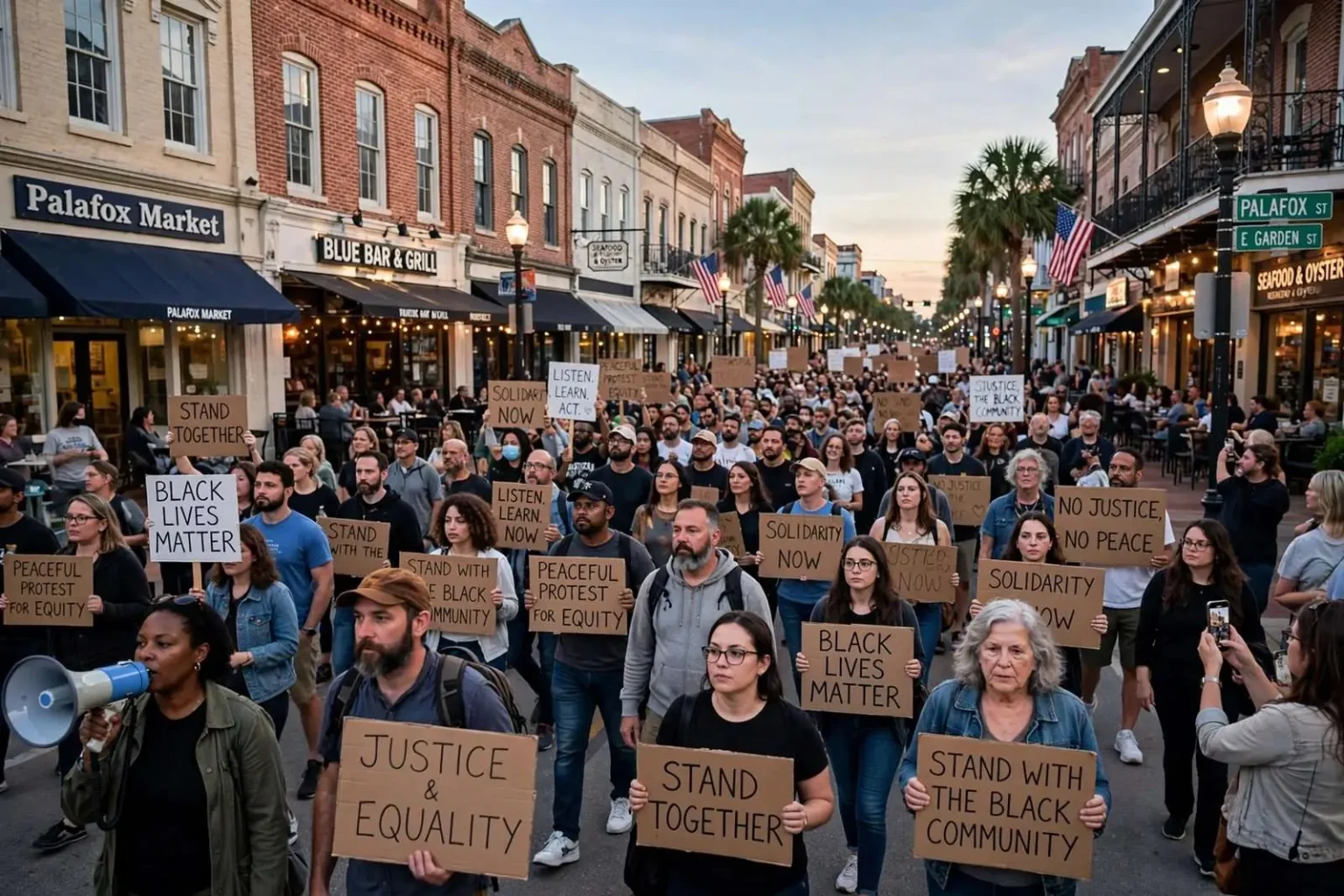
Up to 300 people marched down Palafox Street in downtown Pensacola Friday evening in a peaceful demonstration in solidarity with the black community. The march began at Plaza de Luna around 5 p.m. and ended at Martin Luther King Jr. Plaza on Palafox Street, just north of Garden Street, tracing one of the most recognizable routes in the city’s downtown before gathering at the plaza that bears the name of the civil rights leader.
The organizer said she wanted everyone to stand together to raise awareness of social injustice and inequality. That message framed the evening’s event, which was peaceful from start to finish, with no reports of trouble as the crowd moved through the heart of downtown. Many participants made their own signs, and their chants were heard by patrons at downtown bars and restaurants along the route, where Friday evening crowds turned to watch the procession pass.
The Route Through Downtown
The choice of route gave the march a natural stage. Plaza de Luna, at the foot of Palafox Street on the Pensacola waterfront, is a familiar gathering point for public events in the city, and marching north up Palafox carried the demonstrators past the storefronts, restaurants and bars that anchor downtown’s busiest blocks. Palafox Street has long served as Pensacola’s main street — the spine of its historic district and the place where the city’s residents naturally converge when something matters to them.
Ending at Martin Luther King Jr. Plaza closed the march with symbolic weight. The plaza, just north of Garden Street, sits a short distance from the end of the route and offers the kind of open space where crowds can gather, listen and speak. Marches across the country have similarly concluded at plazas and parks named for Dr. King, using the setting to connect present-day demonstrations to the longer history of the civil rights movement.
A Peaceful Evening
The demonstration remained peaceful throughout, a point that mattered both to organizers and to city officials who had been watching similar events nationwide. Marchers chanted as they walked, and the sound carried into the restaurants and bars lining the route, where patrons stepped outside or turned from their tables to watch. Some in the crowds along Palafox recorded the march on their phones; others simply observed as the procession passed.
Cornelius Jenkins, one of the marchers, said there were some people they passed who may have been uncomfortable, but he says that was part of the point. “It was very good to see them uncomfortable,” Jenkins said. “It was also good to see people who were supporting and encouraging us along the way as well. And as I’ve seen so far, we’ve had a lot more support than hate, which has been the feedback on Facebook, but as far as reality, it’s been nothing but love out here.”
What the Organizer Hoped to Accomplish
The organizer’s stated goal — standing together to raise awareness of social injustice and inequality — put the march in the tradition of demonstrations that aim less at a specific demand than at visibility itself. A crowd of up to 300 people moving through a city’s downtown on a Friday evening cannot be ignored: it interrupts the ordinary rhythm of the night, draws the attention of hundreds more who did not attend, and starts conversations in workplaces, churches and homes the next day.
That visibility is precisely what participants like Jenkins described. The point, as he framed it, was not to make everyone agree but to make the message unavoidable — to be seen and heard in the center of the city rather than confined to a park or a meeting hall. The warm reception the marchers reported along the route, and the support they said they saw online, suggested the event reached beyond the people who marched.
Pensacola’s History of Public Demonstration
Pensacola has a long history of public gatherings and demonstrations, from civil rights-era activism in its black neighborhoods to the regular rallies and events that fill its downtown plazas today. The city’s black community has deep roots in the area — in neighborhoods, churches and institutions that stretch back generations — and issues of racial equity and justice have surfaced repeatedly in local civic life over the decades, as they have in communities across Florida and the nation.
The geography of Friday’s march reflected that continuity. Plaza de Luna and the waterfront anchors the city’s modern public life, while Martin Luther King Jr. Plaza honors the movement whose legacy every such demonstration invokes. Between the two lies a downtown that has been rebuilt over decades into a destination — a place where residents and visitors mingle every weekend, and therefore an effective place to be seen with a message.
Timing mattered as well. A Friday evening start at 5 p.m. put the march on the streets as the weekend crowd was arriving, ensuring the largest possible audience along Palafox. Restaurants and bars were filling, the waterfront was active, and the demonstrators passed through at the hour when downtown Pensacola is at its busiest — exactly when a message meant for the whole community is most likely to be seen and heard.
Marching in a Moment of National Attention
The march came during a period when demonstrations over racial injustice and inequality were occurring in cities large and small across the country, and Pensacola’s version followed the pattern of most: locally organized, family-friendly and peaceful. Communities along the Gulf Coast — from Pensacola to Mobile and across the Panhandle — saw gatherings of this kind as residents sought ways to express solidarity close to home rather than traveling to larger cities.
Local demonstrations carry their own dynamics. Participants in a city the size of Pensacola are likely to know — or to know of — police officers, business owners and elected officials along the route, which changes the tone of an event compared with a march through a metropolis. The feedback Jenkins described, with support far outweighing hostility both on the street and online, fit the character of a community-sized demonstration where the crowds on the sidewalk are neighbors as much as strangers.
The Role of Small-City Demonstrations
Sociologists and community organizers have long noted that demonstrations in mid-sized cities play a distinct role in national movements. A march of several hundred people in a community like Pensacola represents a larger share of the local population than the same crowd would in a major metropolis, and it reaches a higher proportion of residents through direct sight and local news coverage. Participants are also more likely to be first-time demonstrators — neighbors moved to act by events in the news — which is exactly the kind of broadening that organizers of solidarity marches seek.
Friday’s event also showed how the practical work of organizing has changed. Hand-made signs remained a centerpiece, but the organizer’s account of feedback arriving on Facebook underscored how these events now unfold on two stages at once: the street and the feed. A peaceful march through downtown generates photos and video that spread far beyond the hundreds present, extending the event’s reach to audiences across the Gulf Coast and giving participants a way to stay engaged after the crowd disperses.
What Comes After a March
Organizers and participants in events like Friday’s march often describe the demonstration itself as the beginning of a conversation rather than the end of one. A march can raise awareness and build a sense of solidarity, but the follow-through — voter registration drives, community meetings, conversations with local officials, support for local organizations — is where participants typically look next. In Pensacola, as elsewhere, the question of what follows a peaceful protest is one the community answers over the weeks and months after the signs are put away.
For Friday evening, though, the event accomplished what its organizer set out to do. Hundreds of people stood together in downtown Pensacola, delivered their message in chants and hand-made signs, and did so peacefully from Plaza de Luna to Martin Luther King Jr. Plaza. The patrons who watched from bars and restaurants, the supporters who cheered from sidewalks, and the thousands more who saw photos and video afterward all became part of the audience the marchers set out to reach.
The demonstration ended where it meant to — under the name of Dr. King, in the city’s downtown, with its message of solidarity and awareness delivered in full view of the community it was meant to reach.
For the participants, the evening delivered the experience Jenkins described: more support than hostility, more encouragement than confrontation, and a sense that the community they marched through was largely willing to listen. Whether the march becomes a one-night event or the start of sustained local engagement, it added Pensacola’s name to the list of Gulf Coast cities where residents have taken to their own streets to make their voices heard on questions of justice and equality.