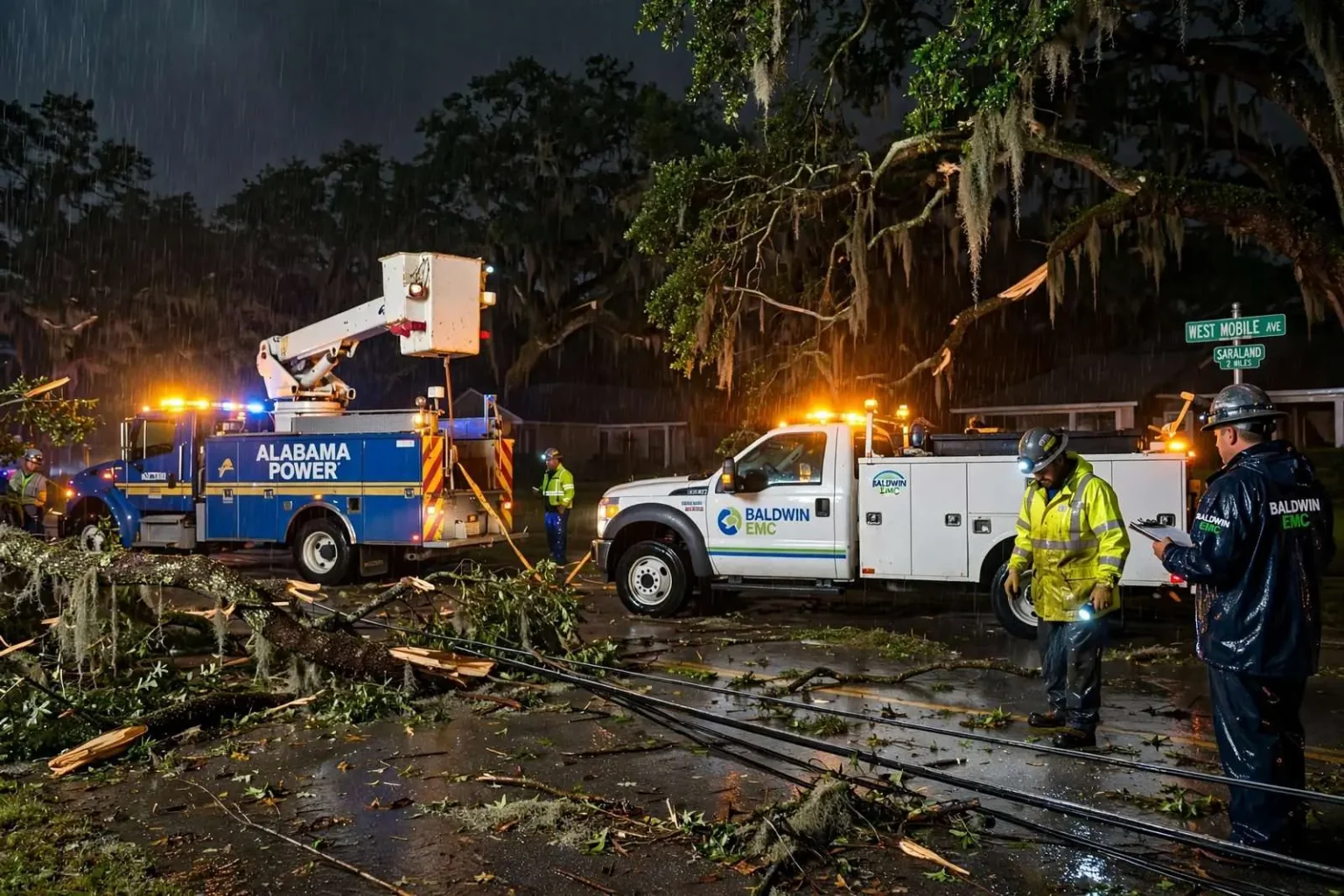
Severe thunderstorms sweeping through the Mobile area on the evening of June 27, 2019, knocked out electricity to roughly 16,000 customers at the peak of the event, according to Alabama Power, leaving crews from both of the bay region’s major utilities working through the night to bring the lights back on. The storms moved through the metro area at the dinner hour, carrying the lightning, gusty winds, and torrential rain that define Gulf Coast summer convection, and they found Mobile’s dense overhead distribution network with little tolerance for either.
The utility reported that most outages were concentrated in downtown Mobile, West Mobile and Saraland — three areas whose outage patterns tell the story of how the storm moved. Downtown Mobile’s grid is dense and largely overhead in the older sections, where mature tree canopy overhangs the same lines that serve the business district and historic neighborhoods. West Mobile’s sprawling suburban feeder lines run through some of the city’s heaviest tree cover. Saraland, north of the city along U.S. 43 and Interstate 65, sits squarely in the path that summer storm cells frequently track up the Mobile Bay corridor from the southwest.
The outage count climbed steadily through the evening as the storm’s damage accumulated faster than crews could counter it. Alabama Power reported about 11,000 customers without power by 9 p.m., roughly 15,000 an hour later, and then about 16,000 at the peak. The progression is typical of a fast-moving squall line: lightning strikes and wind-thrown limbs trip breakers and snap feeders one after another, and for the hour or two while the storm is still crossing the area, the number can only go up. Crews staged to begin restoration work as soon as conditions allowed, with line workers held back from the field while lightning remained a hazard to the bucket trucks that would follow.
Across the bay in Baldwin County, the same storm line inflicted its own damage. Baldwin EMC, the member-owned electric cooperative that serves most of the county outside the municipal utility areas, reported widespread outages affecting approximately 1,056 members, with trees and power lines down in several areas. The co-op said an outage near Bryant’s Landing in north Baldwin was expected to take several hours to repair because of the damage there — the kind of concentrated destruction that requires rebuilding line rather than simply resetting equipment.
Two Utilities, One Storm
The two-county response drew on the region’s two very different utility structures. Alabama Power, the investor-owned utility that serves the city of Mobile and much of the metro area, operates from a division base with standing storm-response protocols: damage assessors fan out first, restoration is triaged so that repairs bring the most customers back per repair first, and crews move through a published sequence that typically starts with transmission and main distribution lines. Baldwin EMC, by contrast, is a cooperative owned by the roughly 80,000 members it serves across Baldwin County, with crews based in Summerdale and Stockton and a service territory that stretches from Mobile Bay to the Florida line. When a storm crosses both territories, as this one did, the two systems coordinate informally while running their own restoration queues.
Utility crews from both companies worked through the night, and the restoration curve bent the way Gulf Coast customers have learned to expect. By early the next morning, Alabama Power reported the number of customers still without service had fallen to a few hundred, mostly in the downtown area, with restoration efforts continuing until all customers were back online. The overnight timeline reflects both the scale of the damage and the region’s familiarity with this kind of event: a June thunderstorm outage in Mobile is not a hurricane, and the crews, equipment, and triage plans that exist for tropical systems make short work of a summer squall line once the lightning clears.
The customers who waited longest are usually the ones on the smallest branches of the system. Distribution networks are built like trees — a handful of large transmission lines feeding main feeders feeding secondary lines feeding individual service drops — and restoration works back from the trunk. A subdivision whose single feeder is back on flips thousands of meters dark-to-light in an hour; the last few hundred customers, scattered on individual damaged laterals, can take as long as everything before them combined. That is why the “few hundred remaining, mostly downtown” figure at dawn represented hours more work, and why outage maps always look worst precisely where the storm passed and then resolve outward in rings.
The storm’s timing magnified its inconvenience. A 9 p.m. peak on a late-June Thursday catches households mid-evening — air conditioners laboring against the Gulf Coast humidity, refrigerators loading, families home — and knocks them offline at the hour when nobody wants to sit in the dark. Summer outages also carry a safety dimension beyond inconvenience: hours without air conditioning matter for elderly residents and infants, food spoilage clocks start running, and the traffic signals that die with the grid turn the evening commute’s last leg into a four-way-stop exercise. By the next morning, with power restored across the area, the event had settled into the category Gulf Coast residents file most June storms under — damaging, briefly disruptive, and forgotten within a week.
Downed Lines: The Standing Warning
Officials reminded residents during the storm to stay well away from downed power lines and to report them rather than approach them — the standing warning that accompanies every serious storm in the region and saves lives every year it is heeded. The physics behind it are simple and counterintuitive: a line lying in a wet yard or flooded street can energize the ground around it, and a live wire does not need to spark or move to be lethal. Storm-broken lines can also remain energized even when they appear dead, and tree limbs in contact with them can conduct current to anyone touching the limb.
The guidance officials repeat with each event bears restating because the storm damage creates the traps. Treat every downed line as live. Report its location to the utility’s outage line or, if it is blocking a roadway or arcing, to 911. Stay clear of anything in contact with the line — fences, vehicles, tree limbs, standing water. If a line falls on a vehicle, occupants should stay inside until help arrives. And after the storm, residents running portable generators must keep them outdoors and away from windows, since a generator connected to a home’s wiring can backfeed electricity onto supposedly dead lines — a hazard to the very line crews working to restore power.
The June 27, 2019 storms ultimately cost the region one bad evening and one long night of line work. Roughly 16,000 Alabama Power customers and more than a thousand Baldwin EMC members lost power; trees and lines came down from downtown Mobile to north Baldwin County; and by the following morning the lights were coming back on across the bay. But the event was also a routine rehearsal for something worse — the same geography, the same utilities, the same protocols, exercised at a scale the region hopes it never has to repeat at hurricane strength.
Baldwin County’s experience that night illustrated the co-op’s particular challenges. A member-owned cooperative’s service territory is largely rural and wooded, and its lines run long distances between small clusters of meters — which means a single fallen tree in a stretch of north Baldwin woods can knock out service to a handful of members while consuming hours of a crew’s night. The Bryant’s Landing outage, on the county’s northern reaches near the Tensaw delta, was exactly that kind of repair: accessible waterways, heavy timber, and line that had to be rebuilt rather than reset. Co-ops like Baldwin EMC maintain mutual-aid agreements with neighboring cooperatives for precisely these events, calling in outside crews when local damage outstrips local capacity, though a storm of this scale rarely requires it.
For residents watching the evening unfold, the utilities’ outage maps and social media updates have become part of the routine. Alabama Power maintains an online outage map that displays affected customers by area, and the utility uses its social channels to post restoration estimates and safety warnings during storm events; Baldwin EMC does the same for its members. The information flow serves a practical purpose beyond reassurance — reported outages help the utilities locate damage, since a feeder can fail without anyone at the substation knowing exactly where. Customers who call in an outage, and report a downed line they can see, materially speed the restoration for their neighbors as well as themselves.
The storm also passed through a region that measures its weather risk in hurricanes and sometimes forgets the ordinary summer variety. Meteorologically, a late-June squall line over south Alabama carries the same building blocks as its tropical cousins — unstable Gulf moisture, strong heating, and wind aloft — and on any given evening can produce 60-mile-per-hour gusts without ever earning a name. Emergency managers in Mobile and Baldwin counties remind residents that the preparedness basics overlap: charged phones, water on hand, medications located, and a plan for the hours when the power is out. June 27, 2019 was an inexpensive lesson in all of them.
By the following day, the region had returned to normal — outage maps clear, co-op members restored, and the only visible remnants the curbside piles of storm-cut limbs that follow every serious Gulf Coast thunderstorm. The event joined the long ledger of Mobile Bay severe weather: brief, damaging, well-handled, and a reminder that on the Gulf Coast, the next round of clouds is never far offshore.