Retired Historian Unpacks an Alabama Planter Family’s Klan Ties in ‘Shades of Complicity’; Mobile Talks Set
Historian Michael W. Fitzgerald’s “Shades of Complicity” follows the Black Belt’s Pickens family through war, Reconstruction and the Klan. He speaks in Mobile Oct. 29 and Nov. 2.
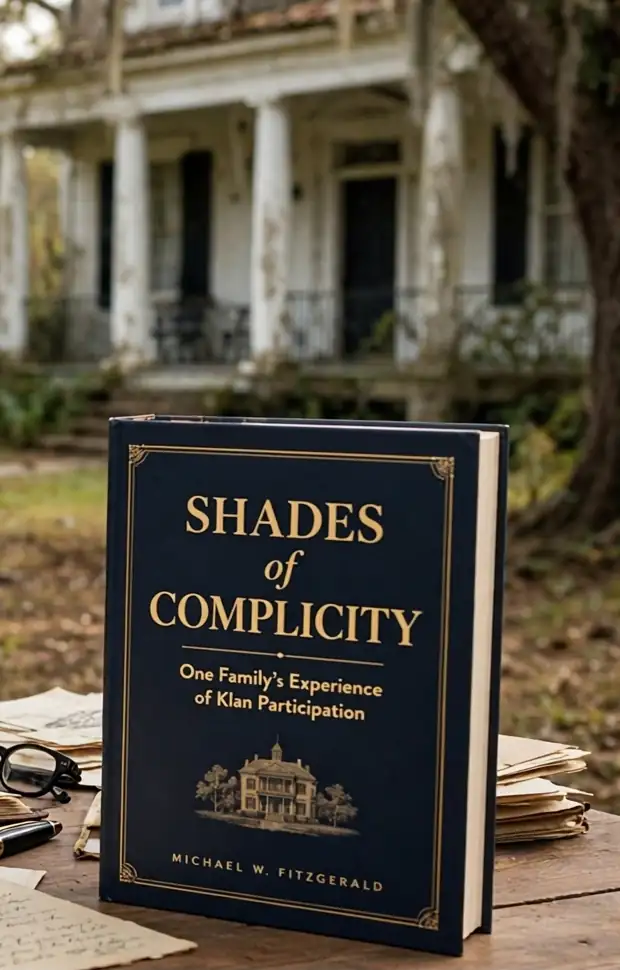
MOBILE, Ala. — A retired historian who has spent years reading a single Alabama family’s letters will bring his findings to Mobile this week. Michael W. Fitzgerald’s new book, “Shades of Complicity”, traces how the wealthy Pickens family of the Black Belt responded to the Civil War, emancipation and Reconstruction, and how some of its members came to support or join the Ku Klux Klan.
Fitzgerald will discuss the book at two public events in Mobile: a Book Talk on Thursday, Oct. 29, at the University of South Alabama’s Marx Library, and a Civil War Roundtable session on Monday, Nov. 2, at Iron Hand Brewing downtown.
The book, subtitled “One Family’s Experience of Klan Participation,” reads in places like the outline of a sweeping family saga, with strong personalities and a story that spans generations. But it is a work of history, not fiction, and it offers readers no heroes. Instead, it shows how a privileged family’s sense of its own standing became bound up with a violent vigilante movement, and how that legacy echoed long after the first Klan faded.
A historian returns to Alabama’s past
Fitzgerald is a retired history professor who taught at St. Olaf College in Minnesota and has written extensively about Alabama and the Reconstruction-era South. Mobile readers may know his 2002 book “Urban Emancipation,” a study of racial politics in Mobile before, during and after the Civil War.
That earlier book drew attention for revelations that surprised many readers, including evidence that some free Black residents of Mobile petitioned to be enslaved again as the war approached, a measure of how desperate and vulnerable their nominally free status had become in the city on the eve of secession.
His new book is set mostly in the Black Belt, the band of rich, dark soil and former plantation country that stretches across central Alabama. Its focus falls on Hale and Greene counties, west of Selma, where cotton wealth built a planter elite before the war.
The Pickens family and Umbria
The story centers on the Pickens family of the Sawyerville community in Hale County. Before the Civil War, the family ranked among the 40 wealthiest in Alabama. Its manor house, known as Umbria, was a showplace, surrounded by rose gardens, orchards and fields of grain. The harder labor of cotton farming took place on two outlying tracts, and the family held about 200 people in slavery.
Umbria was a Greek Revival plantation house set on about 5,000 acres in Hale County, south of Tuscaloosa in the direction of Demopolis, and it was one of three family plantations near Greensboro. The relatives at the center of the book had a notable political pedigree.
“The family we’re talking about are the nephews and nieces of [former Alabama] Gov. Israel Pickens,” Fitzgerald said.
Israel Pickens served as Alabama’s third governor, from 1821 to 1825.
The war and the emancipation that followed overturned that world and badly damaged the family’s fortunes. In that respect the Pickens family was hardly unique among Black Belt planters. Nor is it surprising, Fitzgerald’s account suggests, that the upheaval radicalized some of its members. Some actively supported the Ku Klux Klan or took part in its first campaign of terror, which ran from roughly 1865 to 1871, while others condoned the Klan’s actions or at least accepted them.
The first Klan arose in the South after the war as a loosely organized network of night riders who used intimidation, beatings and murder against freed people, their white allies and Republican officeholders, seeking to overturn Reconstruction and restore white political control. Alabama’s Black Belt, with its large Black population and fierce contests over voting and political power, saw some of the worst of that violence.
A family that wrote everything down
What sets the Pickens family apart, and makes the book possible, is how much its members wrote. They produced letters and diaries, and later newspaper articles and books. A great deal of that material survives, including newly available Pickens family correspondence housed in the University of South Alabama’s McCall Library archives, which Fitzgerald relied on for a major portion of his research, giving historians an unusually detailed view of how the family’s lives and attitudes changed over time.
Sometimes family members wrote candidly about race relations and about violent events such as the 1870 riot in Eutaw, the Greene County seat. Other times, their views emerge only between the lines. The letters also have their lighter moments: Fitzgerald found that young men writing about lust and carousing sounded much the same in the 19th century as they might today.
Fitzgerald said he took in the entire record.
“I think there must be like 10,000 letters. I read everything. I read everything from statehood till the trail grows cold. … I read a century of the correspondence.”
Shared values, different choices
The evidence in “Shades of Complicity” builds a layered portrait. Older members of the family lived through the war in all its brutality. Younger members, too young to fight, felt they had been robbed of a chance at glory. Some relatives simply got on with life in a changed world, while others devoted their lives to building the mythology of the Lost Cause.
Fitzgerald said the family members held strikingly similar convictions.
“They share very similar values,” he said. “All of them are secessionists. All of them are states’ rights, hardcore people, from a family of hardcore people, secessionists, Confederate to the end. … They hated Reconstruction. They did not like emancipation because they lost nine-tenths of their wealth in it and they loathed the Yankees.”
Yet those shared beliefs did not lead everyone down the same path, he said.
“But saying all that, not everybody wants to become a murderer,” Fitzgerald said. “Not everybody wants to be complicit in murder. And that’s kind of significant.”
A study in radicalization
In some ways, the book is an examination of how people become radicalized. In his introduction, Fitzgerald captures the dynamic in one deceptively mild sentence: “Their whole world of privilege had been shattered, and they responded vigorously across the board.”
That response did not end when the first wave of night riders disappeared in the early 1870s. It carried on for decades.
One thread leads directly to Mobile. Eyre Damer, a close relative of the Pickens family by marriage who at times lived in the household, later became a newspaper editor in Mobile and wrote an admiring history of the Ku Klux Klan that was published.
“What happens in later life is that Eyre Damer becomes an editor in Mobile and then writes a laudatory history of the Ku Klux Klan, which is published,” Fitzgerald said.
The Damer brothers and the Eutaw Klan
Eyre Damer and his brother, Murray, were orphaned brothers-in-law of James Pickens who came into the family through marriage as teenagers.
“[Through marriage], they wind up with a couple teenagers they apprentice out because they have caused a fair amount of trouble in the family,” Fitzgerald said.
Their drinking and romantic escapades were scandal enough, but the Damers also became involved with a terrorist cell operating out of Eutaw, a Klan stronghold in Greene County. Letters the brothers sent to the Pickens family gave firsthand accounts of their part in violent acts.
“It is kind of interesting to watch because the youngest teenage boys in this rich Pickens family are quite enthused about it. They’re verbally supportive,” Fitzgerald said.
The wider family shared the political and cultural views behind the violence, but some members met the terror itself with a more reserved silence.
“Ultimately, they are part of the system, sure, but they aren’t loving this,” Fitzgerald said.
Eyre Damer’s Mobile career
As was typical in 19th-century Alabama, when nearly every road and most of the rivers led to Mobile, then the state’s most prosperous and populous city, the Damers eventually followed.
“There are a lot of Mobile letters in there,” Fitzgerald said. “Eyre Damer winds up at [a Mobile newspaper]. He does some editorial writing and is the editor of their agricultural sheet.”
After 15 years at the newspaper, Fitzgerald said, Damer served on the city council. Historical records show he was Mobile’s tax commissioner in 1899 and served a term in the Alabama House of Representatives. He spent about 30 years in all at the paper, including a stint as associate editor, and in 1900 he bought another local newspaper, which folded in 1901.
“He winds up as kind of a labor progressive, kind of moderate on the race issue as an editor. He’s not pushing disfranchisement,” Fitzgerald said.
Damer later returned to the Black Belt to continue working in journalism. His 1912 book, “When the Klan Rode,” drew far more attention. The memoir drew on his earlier sympathy for the night riders’ methods, leaned heavily on Lost Cause mythology and cast the Klan as a natural and noble answer to federal overreach.
Steeped in Jim Crow-era attitudes, Damer’s portrayal of the Klan strikes modern readers as strikingly similar to Thomas Dixon Jr.’s notorious novel “The Clansman,” which D.W. Griffith later adapted into the 1915 film “The Birth of a Nation.” Damer died of a stroke in Selma in 1922.
Two women who joined the family through marriage became promoters of the “moonlight and magnolias” image of the Old South, the romanticized vision of gracious plantations and contented slaves that spread through Southern writing in the late 19th and early 20th centuries. Fitzgerald labels them, in a chapter heading, culture warriors in the Jim Crow South.
Through that work, they helped lay the intellectual groundwork for the Klan’s revival in the early 20th century. In Fitzgerald’s words, they “contributed to the national popularization of racism that accompanied Jim Crow.” The second Klan, founded in 1915, grew into a national organization with millions of members in the 1920s, drawing on just such romanticized versions of Reconstruction history.
Decline, and an unexpected coda
Fitzgerald follows the family through its long decline and eventual disappearance from the area, including the sale of the ancestral home and its later destruction by fire. The book notes some gentler moments, including the kindness the last family member to live there showed to people in the community and the affection with which she was remembered. Still, the ending is a somber one.
In conversation, though, Fitzgerald offers a more hopeful postscript. On a recent trip back to the area, he said, he saw signs of reconciliation across racial lines among residents who can trace a shared history, and likely some shared ancestry, back to the Pickens family.
“This interaction is really interesting,” he said. “I’m just flabbergasted that they become friends, but then, who else is interested in 150-year-old stuff?”
Hear the author of Shades of Complicity in Mobile
Fitzgerald will make two public appearances in Mobile to discuss the book:
- Book Talk: Presented by the University of South Alabama Department of History. Thursday, Oct. 29, at 4:30 p.m., Rodning Gallery, USA Marx Library. A reception follows in the McCall Library foyer.
- Civil War Roundtable: Presented by the Mobile Area Civil War Roundtable. Monday, Nov. 2, at Iron Hand Brewing, 206 State St., Mobile. A social and dinner period runs from 5:30 to 6:30 p.m., with food and drinks available for purchase; the program begins at 6:30 p.m.
The Marx Library sits on the University of South Alabama’s main campus in west Mobile and houses the university’s library collections. Iron Hand Brewing is in downtown Mobile, a short walk from the city’s historic core.
About the book
- Title: “Shades of Complicity: One Family’s Experience of Klan Participation”
- Author: Michael W. Fitzgerald
- Setting: Primarily Hale and Greene counties in Alabama’s Black Belt, with ties to Mobile
- Formats and prices: Hardcover, $45; e-book, $19.95
- Availability: On sale now
Why this history still matters
Books about the Reconstruction-era Klan often focus on its leaders or its victims. “Shades of Complicity” takes a different angle by following one well-documented family across a century, showing the range of ways ordinary members of a powerful household related to political violence, from direct participation to quiet approval to the slow, lasting work of shaping how later generations remembered the era.
For readers in Mobile, the book’s connections are close to home. Part of the evidence lives in an archive at the University of South Alabama, one of the family’s in-laws edited a Mobile newspaper and wrote a flattering history of the Klan, and the author himself has long studied the city’s own history of emancipation and Reconstruction. The two talks offer a chance to hear directly from the historian who read the family’s letters, all of them, and to ask him what they reveal.
Fitzgerald said he believes that approach can reach readers across today’s divides.
“I think just letting these people from history talk for themselves, seeing how implicated they are and seeing how they’re wrestling with that kind of pulls people out of their trenches,” he said.