Shelby Defends Mobile’s Tanker Win in Financial Times Op-Ed as Boeing Backers Pile On
Sen. Richard Shelby used a Financial Times op-ed to defend the Air Force's tanker contract award to a Northrop Grumman-EADS team, arguing the deal would bring thousands of jobs to a new Mobile assembly site, not send them overseas.
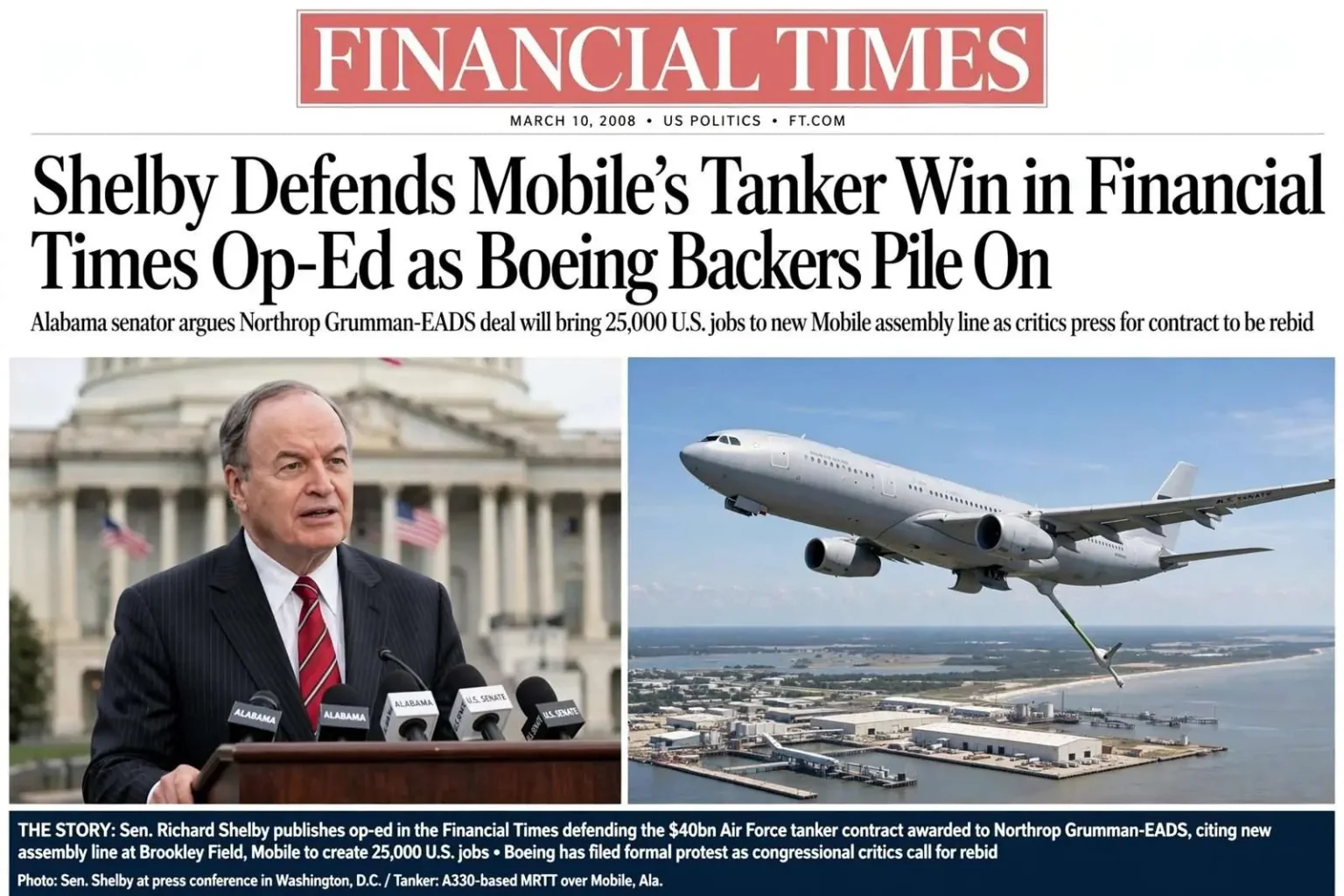
As Washington’s fight over a roughly $40 billion Air Force refueling tanker contract dragged into March 2008, Alabama’s senior senator took his defense of the deal to the pages of a London-based financial newspaper, arguing that the award to a Northrop Grumman-EADS team would bring, not export, American jobs. The contract, which called for a new assembly line at Mobile’s Brookley Field, had drawn fire in Washington almost from the moment the Air Force chose the Northrop Grumman-EADS team over Boeing.
House Speaker Nancy Pelosi used the award as a political cudgel against Sen. John McCain, the presumptive Republican presidential nominee, who years earlier had pushed the Air Force away from a leasing arrangement with Boeing after that plan produced criminal convictions for a Boeing executive and an Air Force procurement officer.
In the weeks since the award, critics in Congress and the press had largely lined up against the Air Force’s decision, with few voices beyond Alabama’s congressional delegation willing to defend it publicly. Sen. Richard Shelby had been one of the most visible of those defenders, making a string of cable news appearances to make the case for the award. On March 10, he added an op-ed in the Financial Times to that effort.
The senator’s argument
“As members of Congress, we are concerned about US jobs. But any assertion that this award ‘outsources’ jobs to France is simply false. With a new assembly site in Mobile, Alabama, this contract will bring tens of thousands of jobs into the US,” Shelby wrote. “According to the job-forecasting tool from the department of commerce, Northrop Grumman will employ about the same number of US workers on the tanker contract as Boeing would have. The Northrop Grumman tanker team will employ about 25,000 US workers at more than 230 supplier companies in 49 states.”
The statistics were aimed directly at the attack line Shelby’s opponents had settled on, that a French-parented company building an American military aircraft amounted to shipping defense work overseas. By citing the Commerce Department’s own forecasting model, Shelby argued that the jobs arithmetic favored the Northrop-EADS bid, with the assembly line in Mobile anchoring a supplier network that reached nearly every state in the country.
The op-ed was one piece of a broader public campaign. Shelby and the rest of Alabama’s delegation had spent the weeks since the award repeating the same themes in hearings, floor statements and television appearances: the Air Force ran a fair competition, Boeing lost it on the merits, and reopening the process would cost the military years and the taxpayers billions.
What Mobile stood to gain
For Mobile, the stakes in that argument went well beyond a single senator’s talking points. Brookley Field had sat largely dormant since the Air Force closed Brookley Air Force Base in 1969, a closure that cost the city thousands of jobs and, by some estimates, a meaningful share of its population. A new aircraft assembly line on those same runways represented one of the largest economic development prospects Mobile had seen in a generation, which is why local and state officials worked so hard to keep the deal from unraveling under congressional pressure.
The base closure four decades earlier had left a scar on the city’s economy that residents still measured things against. Brookley’s shutdown dispersed machinists, mechanics and engineers across the country, and the vast airfield south of downtown spent generations as an industrial park waiting for an anchor tenant. The tanker award, in that context, was pitched locally as a reversal of history: the return of major aerospace manufacturing to the very ground the Air Force had abandoned.
State and local incentives for the project had been assembled with that promise in mind, and Mobile’s congressional delegation, led by Shelby in the Senate, had inserted itself into every stage of the procurement fight. When the award came in late February 2008, celebration on the Gulf Coast was immediate; when the protests began in Washington almost the same week, local officials understood that the prize could still be lost in the appeals.
Washington pushes back
The opposition to the award had organized quickly. Boeing, which had built every tanker the Air Force had flown for half a century, filed a formal protest with the Government Accountability Office, and members of Congress from Washington state and Kansas, where Boeing’s work is concentrated, pressed for the contract to be rebid. The company’s allies argued the Air Force had misjudged lifecycle costs and tilted the specifications toward the Northrop-EADS airframe.
Pelosi’s turn against the award added a partisan dimension that went beyond regional economics. By tying the tanker fight to McCain, whose earlier intervention had blown open the procurement scandal that sent Boeing executives to prison, Democratic leaders framed the award as the late chapter of a story about a flawed process. McCain, for his part, defended the competition he had helped force, arguing that open bidding had saved the Air Force money and that second-guessing the outcome would chill every future contest.
The choice of outlet was notable. The Financial Times, a European financial publication, had generally been sympathetic to EADS throughout the tanker fight, giving Shelby a friendly platform but not necessarily one that would move skeptical American lawmakers or reporters. Still, with domestic media coverage tilted toward Boeing’s objections and the broader American economy already showing signs of strain, Shelby and the rest of Alabama’s delegation needed every outlet they could get to keep the jobs argument in front of readers, in Washington and beyond.
The stakes for the industry
The tanker fight was also a fight over the future structure of American defense manufacturing. EADS North America’s bid represented the first time a foreign-headquartered company had won a major Pentagon platform outright on an open competition, a prospect that excited some defense analysts and alarmed others. The Mobile assembly line was the physical answer to the outsourcing charge: a European company building American planes, with American workers, on American soil, under Pentagon contract terms.
Shelby’s op-ed leaned on that distinction. The senator argued that opposing the award to preserve Boeing’s franchise amounted to protecting one company’s backlog at the expense of the warfighter and the taxpayer, and he warned that overturning a fair competition would teach every future bidder that losing was only a negotiating position.
In Mobile, the argument landed on fertile ground. The Brookley Aeroplex’s industrial authority had spent years preparing the site for aerospace tenants, and the tanker line was to be its centerpiece. City and county officials who had watched prospective employers come and go for decades viewed the contract as the moment the region’s aerospace ambitions either took root or withered, which is why every protest filing in Washington was read locally as a direct threat to the region’s future.
Whatever the eventual outcome of the protests and the politics, March 2008 marked the peak of the public relations war over the tanker, with Alabama’s senior senator now arguing the case on three continents’ newsstands as well as on American television.
The history behind the fight
The intensity of the tanker battle made more sense against the procurement scandal that preceded it. In the early 2000s, the Air Force had arranged to lease, rather than buy, a fleet of converted Boeing 767 tankers, a deal pushed through Congress as a way to modernize an aging refueling fleet quickly. The arrangement unraveled when an internal investigation revealed a corrupt exchange between Boeing’s chief financial officer and the Air Force’s second-highest procurement official, who had negotiated jobs for herself at the company while steering billions to it. Both were convicted, the lease deal was scuttled, and the tanker requirement went back to open competition, this time with Boeing facing a real challenger.
That challenger was the Northrop Grumman-EADS team, pairing America’s third-largest defense contractor with the European parent of Airbus. Their bid was built around a larger airframe, a converted A330, assembled in Mobile, with aerial refueling boom technology supplied by American manufacturers. When the Air Force announced its decision in February 2008, it handed the team a contract that would define military air refueling for decades and put a final assembly line on the Gulf Coast.
For Mobile, the moment capped years of quiet groundwork. The city had recruited aviation suppliers to the Brookley Aeroplex through the 1990s and 2000s, building the workforce training partnerships and infrastructure that made a final assembly bid plausible. Local officials had repeatedly been told the city lacked the aerospace pedigree to win such work; the Air Force’s decision said otherwise.
The politics of the protest
The GAO protest process that followed gave Boeing a venue to argue the Air Force had evaluated the bids incorrectly, and its filing stretched to hundreds of pages, challenging everything from the cost model to the refueling performance calculations. Alabama’s delegation responded with a coordinated defense, arguing that reopening the award would signal that no competition was ever final, a message they said would drive up bids across the defense industry for years.
Shelby’s Financial Times piece was part of that counteroffensive, aimed at a business readership that would judge the deal on economics rather than regional loyalty. The senator’s job numbers, 25,000 American workers across more than 230 suppliers in 49 states, were drawn from the same Commerce Department methodology the contract’s critics cited, a deliberate choice meant to take the statistical ground out from under the opposition.
The broader economy added urgency on both sides. With 2008’s financial strain deepening, every member of Congress weighing in on the tanker fight did so in the language of jobs, and the prospect of thousands of construction and manufacturing jobs along the Gulf Coast carried weight far beyond Alabama’s borders.
For the moment, all sides continued to make their case in protests, op-eds and hearings, while in Mobile the first site work and hiring plans proceeded on the assumption that the award would hold. The spring of 2008 would determine whether the city’s generation-long wait for an aerospace anchor ended in an assembly line or in another round of bids.