
Sheriff’s Race Set: Deputy Burch to Face Newcomer Perkins in November
Paul Burch won the GOP nod with over 80% while Labarron Perkins ran unopposed for Democrats, setting up November's Mobile County sheriff race.
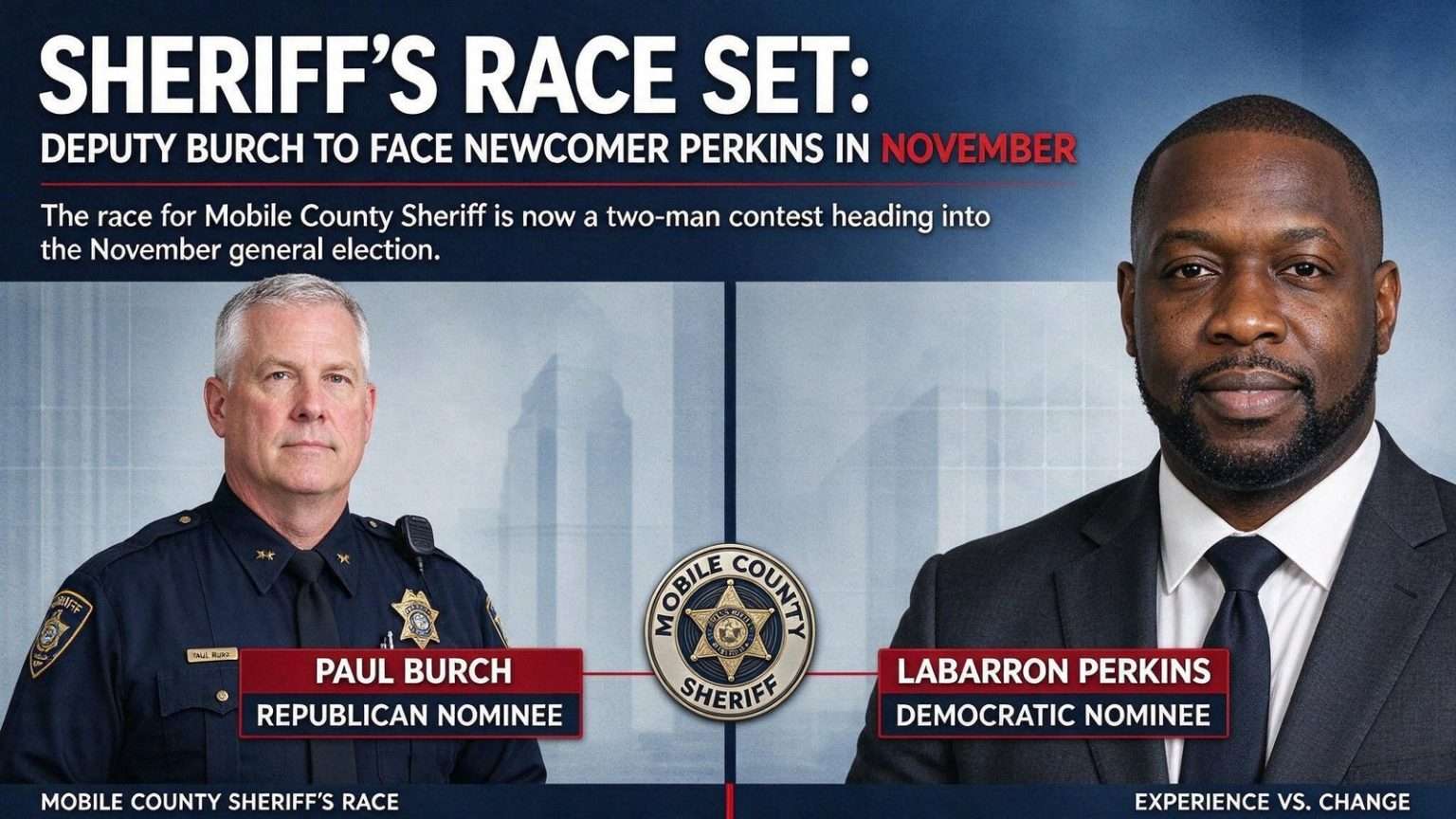
The race for Mobile County Sheriff is now a two-man contest heading into the November general election, pairing a longtime sheriff’s deputy against a political newcomer. On one side is Captain Paul Burch, the Republican nominee and a veteran of the Sheriff’s Office; on the other is Labarron Perkins, the Democratic nominee, a small business owner making his first run for public office. The winner will lead one of the largest law enforcement agencies in Alabama, overseeing a department responsible for patrol, investigations and jail operations across a county of more than 400,000 residents.
The contrast between the two candidates frames the campaign that will unfold between now and November: institutional experience against an outsider’s call for change, and a decades-long law enforcement résumé against a platform built on budget increases, hiring and transparency.
Perkins ran unopposed for Democratic nomination
Labarron Perkins secured the Democratic nomination without appearing on Tuesday’s primary ballot at all — he ran unopposed. The path left him with an unusual general-election setup: no primary fight to sharpen his message, no network of precinct workers battle-tested by a campaign, but also no primary spending to recover from and a clean slate heading into the fall.
“It’s time we put politics aside and put safety first,” Perkins said, arguing that voters want change at the Mobile County Sheriff’s Office. His message leans on the idea that the department’s leadership has grown stale and that a fresh perspective, untethered to the agency’s chain of command, is what the county’s neighborhoods need.
He acknowledged an uphill climb: roughly twice as many people voted in the Republican sheriff’s race as cast ballots in the entire Mobile County Democratic primary. The arithmetic is the wall every countywide Democrat in Mobile runs into — an electorate that votes Republican in countywide races by wide margins — and Perkins is running straight at it rather than around it.
Perkins said he is optimistic he can attract independents and disaffected Republicans. The strategy requires holding the Democratic base while persuading the middle of the electorate, a coalition that has elected moderate Democrats in Mobile municipal races even as countywide offices have stayed in Republican hands.
Though he has never served as a sworn law enforcement officer, he argued his outsider perspective is an asset, citing college coursework in criminal justice, private-sector security experience, and his current work as a small business owner. The résumé is a deliberate counterpunch to the inevitable experience argument: Perkins contends that managing budgets, personnel and accountability — the sheriff’s job at its core — does not require rising through the department’s ranks first.
“We need to increase the law enforcement budget in Mobile County, we need to hire more deputies and look at the current hiring practice at the agency,” Perkins said, adding that the office needs more transparency. The platform puts staffing at the center of the race — a live issue for sheriff’s offices across the country, which have struggled with recruiting since the pandemic and face competition from better-paying municipal departments.
Burch wins GOP nomination decisively
On the Republican side, Captain Paul Burch — a veteran Mobile County deputy — captured more than 80 percent of the GOP vote, easily defeating fellow deputy Ed Albritton for the nomination. The margin handed Burch both the nomination and the strongest possible entering argument: a decisive, countywide endorsement from the voters most likely to turn out in November.
Burch’s campaign built on his standing inside the Sheriff’s Office, where he has served in roles spanning patrol and command, and on the endorsement network that comes with decades in county law enforcement. The primary victory over a respected fellow deputy — rather than a political outsider — demonstrated that his support ran deep in the party’s law-and-order base.
For the Sheriff’s Office itself, the primary’s end also settles a question that hangs over every agency election: the career paths of the deputies who ran. Albritton’s return to the department after the campaign is the kind of institutional continuity that sheriffs and candidates alike work to preserve once the votes are counted.
The office the winner inherits
The Mobile County Sheriff’s Office the next sheriff will run is a major agency by any measure: a patrol division covering the county’s unincorporated areas and contract communities, a detective bureau working everything from property crimes to homicides, civil service and courthouse security duties, and the county jail — the largest detention facility in the region and one of the most expensive line items in the county budget.
The jail alone shapes the office’s budget politics. Housing a daily population in the hundreds, the facility’s staffing and medical costs have driven budget requests for years, and every candidate for sheriff inherits the balancing act between jail expenses and the deputy staffing that neighborhoods see on the street.
Recruitment and retention have become the central policy question for agencies like the Sheriff’s Office. Departments across Alabama have raised pay, adjusted requirements and launched recruiting classes to keep positions filled, and the next sheriff will take office with the same challenge — and with county commissioners weighing every budget request against the county’s overall obligations.
The campaign ahead
The general election campaign will give voters a stark choice of emphasis. Burch will run on experience and continuity — the argument that a department of the Sheriff’s Office’s size is best led by someone who has served in it at every level. Perkins will run on change — more funding, more deputies, new hiring practices and a transparency agenda aimed at the office’s dealings with the public.
The shakeout of November will be watched beyond Mobile County as well. Sheriff’s races are among the most consequential on Alabama’s county ballots, and the outcome here will set the direction of the region’s largest county law enforcement agency for a term that will include whatever challenges — budgetary, criminal-justice and otherwise — the next few years bring.
For now, the field is set: a deputy who won his party’s nomination the traditional way, against a newcomer who never had to run for his. Between now and November, the two men will argue about budgets, hiring and transparency — and Mobile County’s voters will decide which of them gets to put the platform into practice.
County sheriffs in Alabama hold broad constitutional authority, running not just law enforcement but jail operations, court security and the service of civil papers — a portfolio that makes the office as much an administrator’s job as a cop’s. The scope is why both candidates’ arguments — experience versus management from outside — map so directly onto the office’s actual duties.
The primary turnout gap Perkins acknowledged is likely to frame every strategic decision of his fall campaign. Countywide Democratic primaries in Mobile have historically drawn a fraction of Republican turnout, forcing Democratic nominees to spend heavily on name recognition while Republicans consolidate their primary voters plus the independent middle.
Burch, for his part, enters the fall with the advantages of incumbency without being the incumbent — the endorsement of a party whose countywide nominees rarely lose, and a primary mandate that signals a unified base behind him. His task between now and November is to hold that coalition while defining himself to voters who paid no attention to the primary.
Sheriff’s races in Mobile County have historically turned on name recognition and law enforcement credentials, with deputies and chief deputies frequently rising to the office itself. A challenge from outside the department — and outside the profession — is rarer, and the campaign ahead will test whether the county’s electorate treats that as a disqualifying gap or a selling point.
Whoever wins will take office with the same to-do list both candidates are already describing: fill vacancies, hold deputies against competing offers, manage the jail’s costs and answer the county’s neighborhoods. The difference lies in who voters trust to do it — the man who has spent his career in the office, or the man asking to change how it runs.
The general election ballot will also decide a full slate of county offices, meaning the sheriff’s race will share attention and turnout with contests at the top of the ticket. Candidates in down-ballot races always feel that dynamic — and both campaigns will plan their fall schedules around the likelihood that the race’s voters will meet the candidates in person at the same events, forums and fish fries where county politics in Mobile has always been settled.
Debates and candidate forums are expected to fill the fall calendar, and the two nominees’ first joint appearances will offer the clearest early test of the race’s central argument. Experience or change — the question has been posed in county campaigns before, but rarely with two nominees whose backgrounds differ so completely.
Perkins’ campaign is expected to lean on his business network for both fundraising and organization, the traditional tools available to a first-time candidate with deep community roots. Burch’s operation, meanwhile, will draw on the party’s established infrastructure and the donor base that funded his primary. Money, message and manpower will decide the fall — as they always do, in the race that decides who runs Alabama’s largest county sheriff’s operation.


