Silverhill Moves Forward on Road Upgrades as Growth Accelerates
Silverhill officials are lining up state and federal funding to resurface, widen and pave town roads as new homes, businesses and a new elementary school drive rapid growth in the small Baldwin County community.
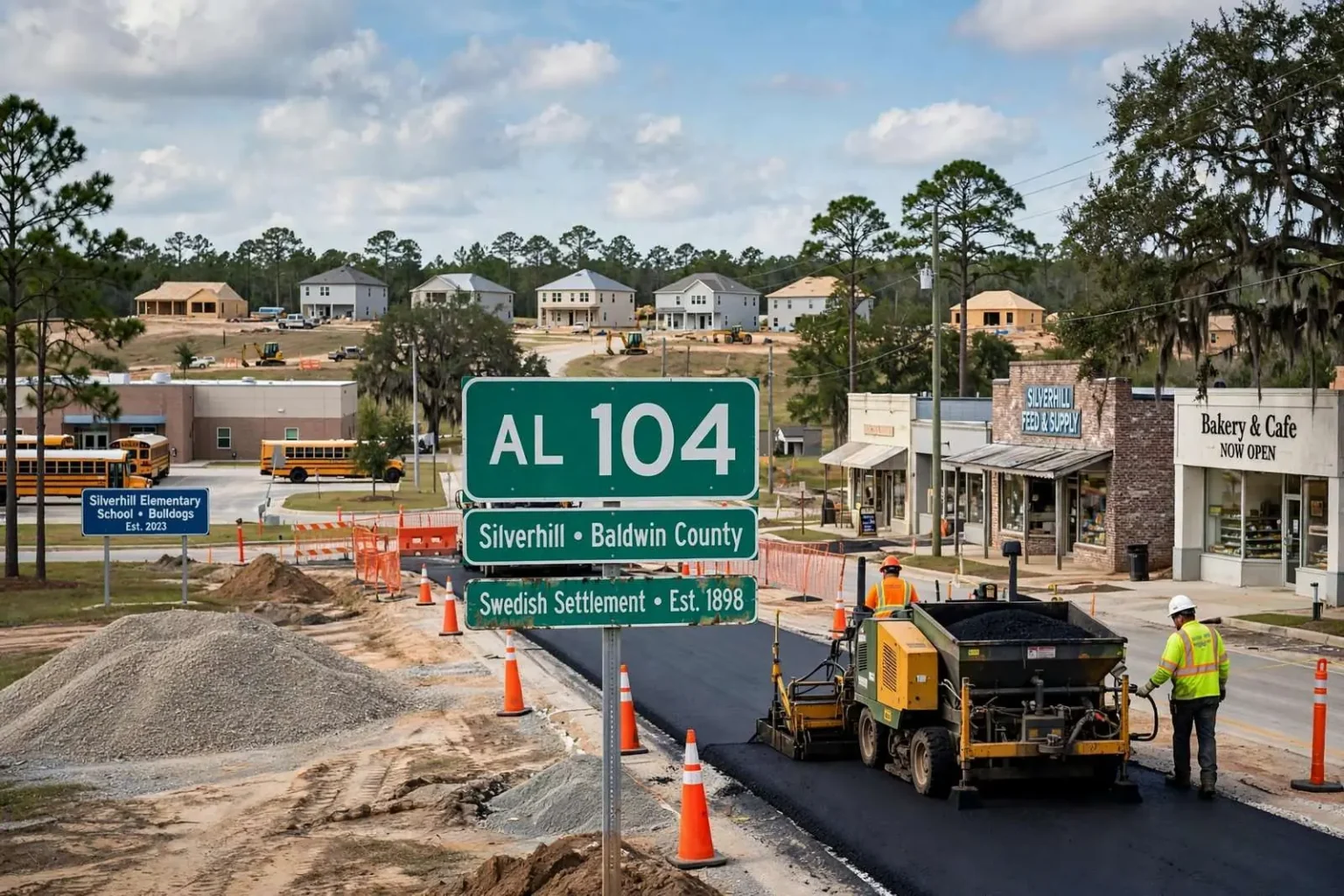
Town leaders in Silverhill are pressing ahead with a series of road resurfacing, widening and paving projects designed to keep pace with a wave of new homes, businesses and school-age families moving into the small Baldwin County community.
Silverhill Mayor Jared Lyles said the town has seen a steady uptick in commercial activity in recent years, with several shops expanding into larger buildings and new businesses opening their doors for the first time. New residential subdivisions and a new elementary school have followed close behind, adding to traffic on streets that in some cases had gone without major work for decades.
“The growth in Silverhill has been the kind of growth we like to see,” Lyles said, pointing to the new storefronts and larger commercial spaces that have popped up around town as evidence of the community’s momentum.
Silverhill sits along Alabama 104 between Robertsdale and Summerdale in the heart of south Baldwin County’s growth corridor, a community of roughly a thousand residents that has long lived in the shadow of its larger neighbors. Its history runs deep in the county’s Swedish immigrant settlement of the late 19th century, and for most of the past century it grew slowly. The recent wave of development — driven by the spread of the Eastern Shore’s population boom outward along the Highway 59 and Highway 104 corridors — has changed the town’s tempo in just a few years.
The new elementary school is both a symptom and an engine of that change. Families follow classrooms, and classrooms follow rooftops; once a community gains a school of its own, subdivisions tend to follow. Each new street of houses adds vehicles to collector roads that were paved for another era’s traffic, and each new storefront draws customers from a wider radius than the town’s original grid was designed to serve.
A quarter century between road projects
That growth is exactly why town officials say road maintenance can no longer wait. Lyles said that before Silverhill received a Rebuild Alabama grant roughly two years ago, it had been about 25 years since the town undertook any major road project. A quarter-century of patching and deferring left the town’s streets in precisely the condition that Baldwin County’s explosive growth punishes hardest.
The Rebuild Alabama Act, passed by the Alabama Legislature in 2019, created a dedicated state funding stream for road and bridge improvements, and it gave small towns like Silverhill a rare opportunity to catch up on deferred infrastructure work. The law raised the state’s gasoline tax for the first time in decades and directed a share of the new revenue back to local governments — money that municipalities and county commissions apply for through annual grant cycles administered with the state Department of Transportation.
For towns with tiny general funds, the program changed what was possible. A small municipality cannot resurface a road network out of its own budget; before Rebuild Alabama, many went decades between paving cycles, exactly as Silverhill did. Since then, the town has used that funding to begin resurfacing, widening and paving streets that were showing their age.
Now, additional help is on the way. U.S. Rep. Jerry Carl, who represents Alabama’s 1st Congressional District, recently secured a $500,000 federal grant to continue that work in Silverhill. The money will not arrive immediately, but town officials say they are already prepared to act once it does.
Silverhill is required to provide a 10 percent local match for the federal funding, and Lyles said the town has that money set aside and ready to go.
“Our 10 percent match is ready. We’re ready to go, so really whenever the funds are available we’ll put out the job for bid and we’ll be ready to do it immediately,” Lyles said.
That readiness matters more than it might sound. Federal grants of this kind come with timelines, and communities that scramble to assemble a local match at the last minute can lose a construction season while paperwork catches up with the money. By banking its 10 percent — $50,000 on a $500,000 grant — in advance, Silverhill aims to move from award to asphalt without the delays that stall small-town projects elsewhere.
The grant also reflects a shift in how South Alabama’s smaller towns fund infrastructure. Carl, who took office representing the coastal district in 2021, has steered federal community project funding toward municipal needs across the district — water systems, public safety equipment and, in Silverhill’s case, roads that carry traffic well beyond the town limits. The state’s 1st District spans everything from downtown Mobile to the Baldwin County beach towns, and its smaller communities have historically lacked the staff to chase federal grants; a congressional office that helps towns apply has changed the equation.
Seven hundred homes and counting
The urgency behind the roadwork is tied directly to what town leaders expect in the coming years. Lyles said developers have already received approval to build at least 700 new homes just outside Silverhill’s town limits, a scale of residential construction that would significantly increase the number of vehicles traveling through town on a daily basis.
The figure is worth pausing on. Seven hundred homes is, in a town of Silverhill’s size, several decades’ worth of previous growth arriving inside a construction cycle or two. Not all approved subdivisions are built on schedule — market conditions decide the pace — but each one that materializes sends morning traffic through the same handful of town streets on the way to the school, the grocery store and the highway.
Combined with the commercial growth already underway, officials say it is only a matter of time before local roads see substantially more traffic. Road engineers think in terms of design life: a street resurfaced today with today’s traffic counts will age much faster if those counts double. Paving ahead of the growth, rather than after it, is the difference between a road that lasts twenty years and one that needs attention in five.
By lining up state and federal funding together, Silverhill officials say they hope to get ahead of that growth rather than react to it after roads become congested or worn down. The town’s approach mirrors a challenge facing many small, fast-growing communities across Baldwin County, where new rooftops and retail development have often outpaced the public infrastructure needed to support them.
How small towns build a road budget
Silverhill’s funding stack illustrates the layering that keeps small-town infrastructure alive in Alabama. The state’s Rebuild Alabama money addresses the regular cycle of resurfacing and repair; the federal grant adds capacity for bigger work, such as widening projects the town could never fund alone; and the local match — drawn from a general fund supported by modest municipal sales and property taxes — signals the town’s own skin in the game. Each layer alone would leave the roads waiting; together they let a thousand-resident town do engineering that would otherwise be a county project.
The bidding process ahead follows the standard municipal routine: once the federal funds are officially released, the town will advertise the job, receive contractor bids, award the work and schedule construction — usually with the Alabama Department of Transportation reviewing the paperwork along the way, since federal money carries federal requirements on bidding, materials and inspection. Town officials have not released a detailed timeline for when construction bids will go out, saying that will depend on when the federal grant funds are officially released.
In the meantime, Silverhill’s town government says it will continue to monitor road conditions and prioritize projects based on need as the community keeps growing. That triage work — deciding which street gets attention first — falls to officials who know every pothole by name, balancing complaints, traffic counts and the practical realities of what can be bundled into a single contract.
Growth’s bill comes due
The broader lesson from Silverhill is one Baldwin County has been learning for two decades: growth pays for itself only if the infrastructure arrives on schedule. New subdivisions generate property tax and sales tax revenue, but the costs — roads, schools, utilities, public safety — come first. A town that paves ahead of the wave spreads those costs across the growth that follows; a town that waits pays more later, in congestion, repairs and the difficulty of doing major work on roads already crowded with traffic.
Silverhill’s bet is that a quarter-century of deferred maintenance can still be undone in time. With Rebuild Alabama funding already at work, a half-million-dollar federal grant secured, and the local match banked, the town has assembled in a few years what it lacked for decades — a way to keep its roads ahead of its growth. Whether the 700 homes just outside the limits arrive on one timeline or five, the asphalt under the town’s future will be laid by the contracts now being prepared.