Six Months On, a Seminole Couple Waits Out Their Sally Rebuild in an RV
A Seminole couple whose Styx River home was ruled uninhabitable after Hurricane Sally is living in an RV in their yard while waiting on FEMA and a rebuild.
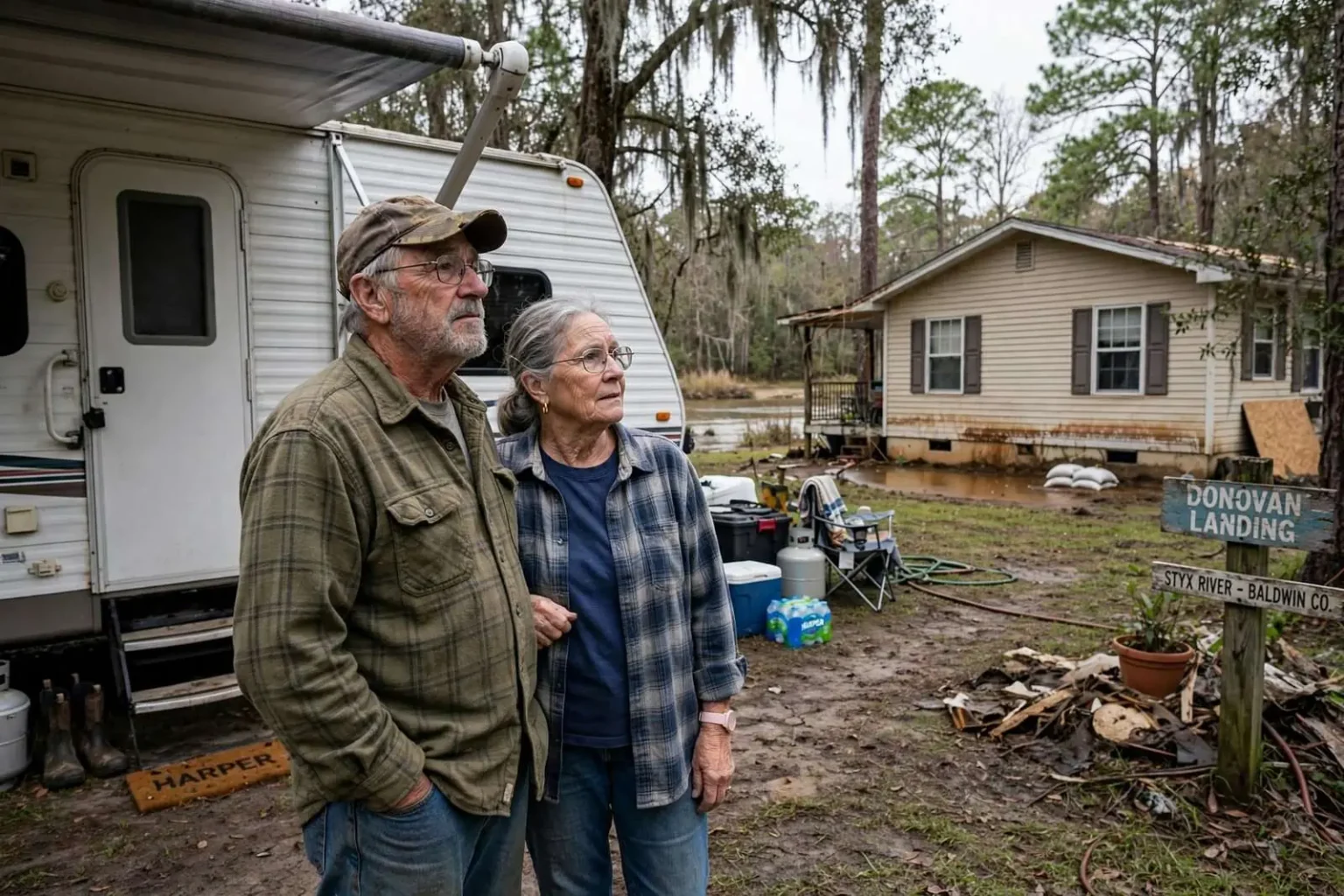
Howard and Donna Harper’s house on Donovan Landing in Seminole still looks like a home from the road. The windows and doors are in place, the walls are standing, and the piles of ruined belongings that once filled the front yard are gone. What the couple cannot do is live in it. Six months after Hurricane Sally came ashore, they are among the hundreds of Baldwin County residents still working through the slow arithmetic of insurance, federal assistance and construction schedules while they wait for their own rebuild to begin.
Their property sits along the Styx River, which reached historic levels during Hurricane Sally. The waterway winds through the heavily wooded country of southern Baldwin County before joining the Perdido River system, and its low banks and surrounding floodplain made the neighborhoods along it especially vulnerable when Sally’s rains and surge pushed water out of its channels in mid-September 2020. For residents of the riverside communities off Alabama State Route 181 and nearby county roads, the flooding did not come from the Gulf directly but from the sluggish blackwater rivers that drain the county toward the state line.
Howard Harper described returning to the property by boat as the water rose. “Went into the house in a boat and when we saw everything we had floating, we knew we were in trouble then,” he said. The image — a homeowner paddling through his own living room — was a common one along the Styx River and its feeder creeks in the days after the storm, as roads flooded and the only way in or out of many properties was by water.
Their insurer declared the house uninhabitable. Harper said rebuilding is only part of the job: the home must also be raised roughly 10 to 11 feet to meet requirements before the family can move back in. The elevation requirement is a consequence of the federal floodplain rules that govern rebuilding in Special Flood Hazard Areas. When a flooded home in a mapped flood zone is substantially damaged — or when improvements exceed a set percentage of its market value — local building officials must require that the structure be brought up to current flood elevation standards before an occupancy permit can be issued.
Waiting in line for FEMA is its own chapter of the story. The Harpers say they are still waiting for FEMA assistance to work its way through a long queue of Baldwin County applicants, and they do not know when construction can begin. In the meantime, home is a recreational vehicle parked in their own backyard. The couple said the four walls are a good deal smaller than what they had, but they are grateful to still have a roof of their own over their heads while the rebuild waits.
Their experience mirrors what played out across Baldwin County after the storm. Sally made landfall near Gulf Shores on September 16, 2020, as a Category 2 hurricane, and while the worst wind damage ran along the coast, the rain and river flooding that followed pushed the disaster’s footprint deep into the county’s interior communities. Weeks after landfall, inspectors were still tagging houses, and residents in places like Seminole, Lillian, Elsanor and Magnolia Springs — communities clustered around the county’s rivers and bayous — were discovering that their damage rivaled anything on the beachfront.
The federal aid process that follows a major hurricane is built in layers, and each layer takes time. Homeowners file claims with their insurers first; private flood insurance, where it exists, covers structural damage up to policy limits. FEMA’s Individual Assistance program then steps in for uncovered losses — temporary housing assistance, home repair grants for essential work, and other needs — but only after applications are filed, inspections are completed and eligibility is determined. When a single storm damages thousands of properties in one county, the inspection and disbursement queue stretches to months, and rebuilding timelines stretch with it.
The floodplain rules behind that requirement date to the National Flood Insurance Program, the federal framework that maps flood-prone land and sets minimum building standards for communities that participate in the program. Baldwin County and its municipalities participate, which is what makes federally backed flood coverage available to local homeowners — and what obligates them to enforce the elevation standards when a damaged house is rebuilt. County permit offices spend much of each post-storm year walking homeowners through those rules, and the paperwork alone can add weeks or months to a project that already starts behind.
Contractor availability compounds the wait. After a hurricane, the same wave of demand hits every flooded community at once, and licensed builders, roofers and foundation crews book up for a year or more. Material prices add another variable; lumber and building supplies rose sharply in the months after Sally’s landfall, stretching budgets that were already strained by deductibles and uncovered losses. For families deciding whether to rebuild, raise or sell, the arithmetic can take months to settle — and the construction clock does not start until it does.
Living in an RV on the property while waiting is a choice many Baldwin County families made after Sally. Staying on the land lets homeowners protect what is left, keep an eye on contractors and salvage work, and avoid the cost of renting elsewhere, but it comes with trade-offs. Recreational vehicles are not built for months of continuous living, hookups are improvised, and Baldwin County’s summer heat, mosquitoes and storm season all press in. Local officials and FEMA representatives have consistently urged families in that situation to keep documentation of their expenses and stay in contact with case workers, since continued eligibility can depend on it.
The elevation requirement the Harpers face adds both time and money to the rebuild. Raising a house 10 to 11 feet means new pilings or an elevated foundation, stairs, and rethinking utilities that were once at ground level. The work is expensive, and grants that help cover elevation costs are limited and competitive. For riverfront neighborhoods where raising a home was once optional, the post-Sally rebuilding rules have made elevation the price of coming back at all.
County and municipal officials have spent the months since landfall repeating the same guidance: document everything, keep receipts, stay in touch with FEMA case workers, and get rebuilding permits in hand before construction begins. Residents who follow that sequence, they say, protect both their aid eligibility and their eventual occupancy certificate. For families in riverside communities like Seminole, that paperwork trail has become as much a part of recovery as hammers and lumber.
A community defined by its waterways
Seminole sits in the southern tier of Baldwin County, near the Florida line, and its identity is tied to the water that surrounds it. The Styx River flows through the area on its way to the Perdido, and the community’s boat launches, river camps and waterfront subdivisions have long drawn families who want the outdoors at their back door. The same geography that makes the area attractive also makes it exposed. When rivers rise, the low lots along their banks take the water first, and the roads that serve them are often underwater before residents realize how high the rivers have climbed.
Hurricane Sally tested that geography in a way few recent storms had. The slow-moving system lingered over the Gulf Coast, wringing out extraordinary rainfall totals across the Florida panhandle and south Alabama, and the rivers of southern Baldwin County responded. Creeks backed up, roads closed, and neighborhoods that had ridden out previous hurricanes with only downed limbs found water in rooms that had never been wet before. Donovan Landing, where the Harpers live, was among the areas hit hard by the river flooding.
The long road back
For the Harpers, the months since the storm have followed the rhythm familiar to thousands of Gulf Coast families: the shock of the initial loss, the insurance inspection, the FEMA application, the estimates from contractors, and then the wait. Each stage has its own paperwork and its own timeline, and none of them move at the pace a family would choose. The couple’s home looks finished from the street because the shell survived — but the interior work, the elevation and the inspections all remain ahead.
Their patience, they say, is anchored by gratitude. The RV in the backyard is small, but it is theirs, and it sits on the land they intend to return to. Across Baldwin County, that mix of frustration and resilience has defined the recovery: families living in campers and rental units, contractors booked months out, and neighbors helping neighbors clear, dry out and rebuild, one permit at a time. Six months on, the Harpers’ story is not an outlier — it is what recovery in a river town looks like while the queue slowly shortens and construction finally moves toward the front of the line.