Skanska Asks Federal Court to Shield It From Bridge Closure Losses
Skanska USA filed five limitation of liability cases in federal court, seeking to avoid paying businesses harmed by the Three Mile Bridge closure.
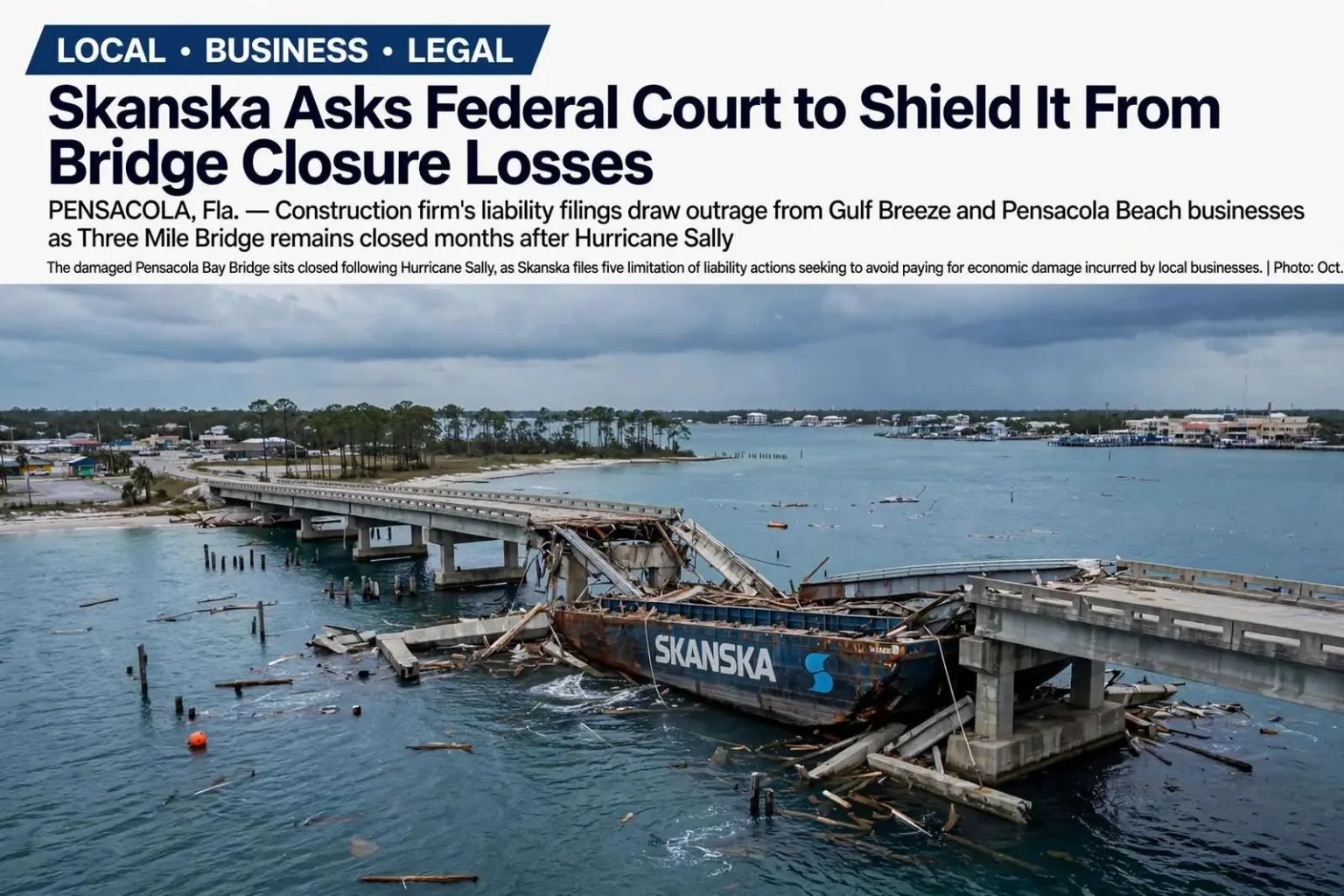
PENSACOLA, Fla. — Skanska USA has gone to federal court arguing it should not be held financially responsible for the economic damage caused by the closure of the Three Mile Bridge, a filing that has drawn an angry response from businesses on both sides of the span.
The bridge has been out of service since Hurricane Sally, when barges belonging to the construction company broke loose and struck it. The crossing — known formally as the Pensacola Bay Bridge and to generations of locals simply as Three Mile — is a main artery linking Pensacola, Gulf Breeze and the beaches, and its loss has forced traffic onto longer alternate routes. For communities that had shared a single workaday crossing for decades, the disruption has rippled through commutes, deliveries and daily commerce since the storm.
The stakes behind the courtroom filing are easy to tally from either end of the span. Restaurants, retailers, bait shops, salons and service businesses in Gulf Breeze and on Pensacola Beach depend on the steady flow of customers who once crossed the bay in minutes. With the bridge closed, many of those customers stopped coming, and the businesses that serve them absorbed the losses month after month.
Five liability filings
Skanska filed five limitation of liability actions Wednesday night, according to attorney Sam Geisler, who characterized the company’s position bluntly.
“They’re seeking total exoneration from any responsibility for paying a penny to any of the businesses harmed by this bridge outage,” Geisler said.
Limitation of liability actions are a maritime legal mechanism that vessel owners can use to cap or eliminate their exposure to claims arising from an incident. Rooted in centuries of admiralty law, the procedure allows a vessel owner to petition a federal court to limit its liability to the value of the vessel and its cargo after a maritime casualty — a rule originally designed to protect the shipping industry from ruinous claims, and one that outsiders often find startling when applied close to home.
In practice, a limitation action consolidates all claims against the vessel owner into a single federal proceeding and forces claimants to prove both that the owner is liable and that the owner lacked knowledge of the condition that caused the harm. If the owner prevails on the limitation question, its exposure can shrink dramatically or disappear entirely. If claimants prevail, the fight over damages proceeds in full.
The filings put Skanska’s barge operations squarely inside that framework, despite the fact that the barges were part of the bridge construction project itself — a detail that has struck many observers as ironic, given that the vessels tied up during the storm were working on the very crossing they then knocked out of service.
Business owners react
Anmarie Wright, who manages Gulf Breeze Bait & Tackle, a shop that has operated in the community for four decades, said the filings were indefensible.
“I think it is completely ridiculous,” Wright said. “It makes me outraged that they’re not doing the right thing by our community. If you look at their core ethics for their company that they stand behind communities they build in — they do not.”
Her frustration echoes what business owners along the corridor have voiced since the bridge closed: the economic pain did not come from the hurricane alone, but from the loss of the crossing that connected their customers to their doors. Every month of closure meant another month of reduced traffic, thinner sales and harder choices about payroll and inventory.
What the bridge means to the region
The Three Mile Bridge is more than a convenience for the Pensacola Bay area — it is the structural link of the local economy. Workers at the beach’s restaurants and hotels commute across it daily. Suppliers deliver goods over it. Visitors funnel onto Pensacola Beach through it, particularly during the summer season when tourism revenue decides how local businesses fare for the year. Its closure forced all of that traffic onto longer routes through other crossings, adding time, fuel costs and frustration to trips that used to take minutes.
When Hurricane Sally came ashore in September 2020, it hammered the Pensacola area with catastrophic wind and a historic storm surge. The bridge construction project was already underway, and the storm’s winds and surge drove barges loose from their moorings and into the bridge itself, damaging spans and forcing the crossing’s closure. What followed was one of the longest and most consequential infrastructure outages in the region’s modern history.
The replacement project the barges served was itself intended to improve that connection — a wider, modernized bridge built to carry more traffic more safely across Pensacola Bay. Instead, the storm turned the project’s own equipment into the agent of the outage, and the repair work that followed kept the bridge closed far longer than any hurricane recovery timeline local businesses had planned around.
The legal road ahead
The company’s court filings set up a fight over who absorbs the losses stacked up by merchants, restaurants and service businesses that depend on traffic across the bridge. On one side stands a multinational construction firm invoking a maritime doctrine that can shield vessel owners from exactly this kind of consequential economic damage. On the other side stand hundreds of claimants — business owners, residents and local governments — who argue that the company whose barges struck the bridge should bear the cost of the damage its equipment caused.
Courts that hear limitation actions must untangle several questions: whether the barges were properly secured before the storm, whether Skanska knew or should have known of any deficiency in their mooring, and whether the maritime limitation doctrine reaches the kind of economic losses local businesses suffered. Claimants will get their chance to contest the limitation petition, and the outcome will shape not only who pays for the bridge outage but how coastal construction firms manage storm risk in the future.
The claims on both sides remain to be resolved in federal court, and the process is expected to be lengthy. Limitation proceedings of this size routinely take years, with discovery, expert testimony and appeals extending the timeline well past the point when affected businesses needed help the most.
What it means for local businesses
For the merchants of Gulf Breeze and Pensacola Beach, the filings carry a hard practical message: recovery for their losses, if it comes at all, will come through a courtroom rather than a settlement check. Many owners spent the closure months burning savings, cutting hours or borrowing to survive the drop in traffic — and now face the prospect of funding a legal fight against a far larger opponent simply to be heard.
The episode has also become a test case in public expectations for major contractors. Skanska’s work is visible across the Gulf Coast, and the gap between a corporate brand built on community partnership and a legal strategy seeking blanket exoneration has not been lost on the people who live with the bridge’s closure. Whether the courts ultimately side with the company or with the businesses, the filings have already settled one thing: the cost of the outage — economic, emotional and reputational — will be argued for years to come.
A familiar legal playbook
Limitation of liability actions have appeared after some of the nation’s best-known maritime disasters, and they almost always provoke the same public reaction: disbelief that a doctrine built for 19th-century shipping still shields modern companies from consequential damages. The doctrine survived because Congress and the courts preserved it as a pillar of admiralty law, and vessel owners routinely invoke it when their equipment causes harm on navigable waters — which is precisely what Skanska has done here.
What makes the Pensacola filings unusual is the setting. The barges were not a passing freighter but the contractor’s own work fleet on a public infrastructure project, tied up ahead of a storm that was forecast for days. To the businesses watching, the sequence — moor the barges, weather the storm, lose the barges, lose the bridge, then ask a federal court for total exoneration — reads as an attempt to walk away from an accident of the company’s own making.
Attorneys for the affected businesses will argue that the limitation petition turns on the mooring question: whether the barges were secured with the care a prudent owner uses when a hurricane approaches, and whether any negligence in that preparation was known to the company. Under the limitation doctrine, an owner who had knowledge of a vessel’s negligent condition or unseaworthiness cannot claim the shield — a threshold issue that will likely consume much of the early litigation.
The bridge recovery timeline
While the lawyers argue, the physical work of restoring the crossing moved at the pace of major marine construction. Damaged spans had to be assessed, debris removed from the bay, sections rebuilt and the structure recertified before traffic could return — a process measured in months even under the best conditions, and one that kept alternate routes crowded the entire time.
The economic damage accrued in parallel. Committees of local officials and business groups tracked the losses, and estimates of the outage’s cost to the regional economy grew with every month the span stayed closed. The eventual legal claims will seek to put a number on all of it: lost revenue, lost wages, higher operating costs and the slower, quieter damage done to businesses that never fully recovered their customer flow after the detours began.
For Wright and the other owners along the corridor, the fight is about principle as much as money. Four decades of serving Gulf Breeze through hurricanes, recessions and every other disruption the coast has produced taught the shop’s operators to absorb hard seasons — but not seasons caused by someone else’s equipment, followed by a court filing asking to pay nothing for it. Their answer will come in federal court, where the limitation actions now await resolution and where the burden of proving the company should be shielded rests with Skanska itself.