Small Plane Lands on Its Belly at Brookley Field After Landing Gear Failure; Pilot Unhurt
A Beechcraft Bonanza landed on its belly at Mobile's Brookley Field after an electrical failure kept the landing gear up; no injuries.
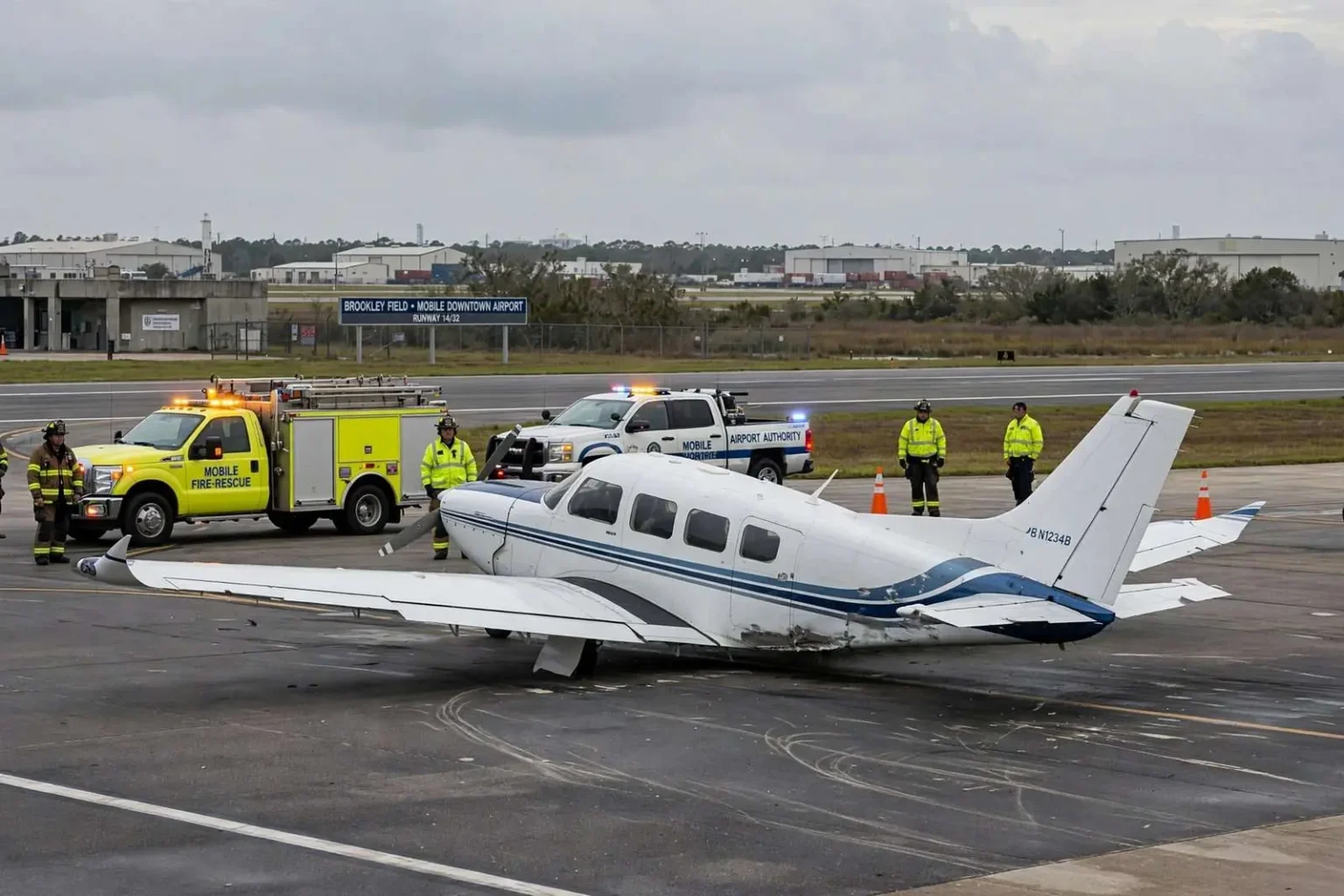
A single-engine plane set down on its belly at Brookley Field on Wednesday morning after the pilot was unable to extend the landing gear, and the pilot — the only person aboard — walked away uninjured, officials said.
Mobile Airport Authority President Chris Curry said the pilot of the Beechcraft Bonanza brought the aircraft down safely despite an electrical failure that prevented the gear from deploying. Emergency crews were on hand at the airfield as the plane touched down on its fuselage, and no injuries were reported. The aircraft sustained damage, but there was no fire and no harm to anyone on the ground. Officials said the incident will be investigated to determine the full scope of the electrical malfunction that triggered the gear failure.
A gear-up landing is among the most studied scenarios in general aviation, and the outcome at Brookley Field is the kind pilots train for in simulators and emergency-procedure reviews: hold the airplane level, kill the fuel and electrical load at the right moment, and let the belly absorb the contact with the runway. Done well, as it appears to have been done here, the procedure damages the airplane but protects the person flying it.
A Morning Without Injuries
The defining fact of the incident is what did not happen. No one was hurt, no fire broke out, and nothing on the ground was touched. Emergency crews positioned at the airfield before touchdown are a standard part of any declared emergency, and their presence is precautionary in most cases. In this one, as in most gear-up landings, the aircraft slid on its belly, came to a stop, and the pilot exited under his own power.
For the airport itself, the episode was disruptive but contained. A disabled aircraft on a runway or taxiway has to be removed before normal operations resume, which typically means crane or equipment support, a careful fuel-draining process, and a closure measured in hours rather than days. Brookley Field’s role as a working airfield means that kind of interruption matters, but the priority in the immediate aftermath is documentation, not speed.
The Airplane: A Beechcraft Bonanza
The Beechcraft Bonanza is one of the most storied single-engine aircraft in aviation history, in continuous production since the late 1940s and recognizable by its distinctive V-tail on early models and by its reputation for speed and range in a light-twin class of performance. Thousands remain in service with private owners across the country, and models of the Bonanza’s vintage commonly rely on electromechanical systems to extend and retract the tricycle landing gear.
That reliance is why an electrical failure is so central to this incident. In a typical gear-up event, the pilot either fails to select gear extension or selects it and the system does not respond. Bonanzas and comparable aircraft carry backup extension systems for exactly this contingency, and pilots drill on the checklist: alternate means of extension, verification that the gear is down and locked, and, if all options fail, a controlled belly landing at a field equipped to handle it. Something in that chain did not work as intended at Brookley Field, and the investigation will establish which link failed and why.
Brookley Field and Its Place in Mobile Aviation
Brookley Field carries one of the deeper aviation histories on the Gulf Coast. The airfield began as an Army Air Corps installation in the years before World War II and grew into a major Air Force logistics and overhaul hub, employing thousands of workers at its peak. The base closed in the late 1960s, and the site was transformed over the following decades into the Brookley Aeroplex, an industrial and aviation complex operated under the Mobile Airport Authority.
Today the airfield functions as the Mobile Downtown Airport, serving corporate aviation, cargo operations, maintenance providers and the aerospace manufacturing that has grown up around it, including major aircraft assembly activity that has made the Brookley area one of the region’s economic anchors. A general aviation pilot bringing a private single-engine aircraft into the field would be a routine visitor there, alongside the business jets and cargo traffic that dominate its schedule.
The Mobile Airport Authority, which oversees both Brookley and the main Mobile Regional Airport, has invested for years in the aeroplex’s infrastructure, from runways and taxiways to the industrial buildings that house tenants. An incident like Wednesday’s belly landing touches that operation only briefly, but it underscores the range of traffic the field handles and the readiness its fire and rescue resources maintain for exactly this kind of event.
How Gear-Up Landings Are Investigated
The announcement that the incident will be investigated to determine the full scope of the electrical malfunction signals a methodical review. Depending on the circumstances, that review can involve the Federal Aviation Administration, and in more serious events the National Transportation Safety Board. A gear-up landing with no injuries often stays at the FAA level, with the aircraft owner’s insurance carrier and a maintenance shop playing central roles, but the questions are the same regardless of who leads: why did the gear not extend, and was the failure mechanical, electrical, or a matter of procedure?
Investigators and maintenance technicians will examine the aircraft’s electrical system first, tracing the failure from the battery or alternator through the relays, wiring and gear motor or actuators. They will pull maintenance records to look for prior squawks, inspect the gear doors and landing gear assembly for damage patterns that show whether the gear moved at all, and interview the pilot about what the cockpit instruments and annunciations showed on approach. The aircraft’s damage, while expensive, actually preserves much of the evidence a reviewer needs, since components remain attached and in their failed state.
Electrical failures that strand landing gear retracted are uncommon but persistent in general aviation, which is why type clubs, flight schools and insurers devote so much training time to the scenario. The consistent lesson from decades of such events is that the outcome depends far more on the pilot’s handling than on the failure itself. A stable approach at the correct airspeed, wings level, and a smooth touchdown on the belly typically results in damage limited to the aircraft — the result at Brookley Field, where the pilot walked away from a wrecked airplane and an otherwise ordinary morning.
What It Means for Local Aviation
For the flying public, incidents like this one rarely signal broader safety problems. General aviation accounts for a small fraction of the region’s air traffic, and belly landings, while dramatic, are survivable events with a long safety record when flown correctly. The aircraft will be repaired or retired based on the insurance assessment, the pilot’s account will feed the investigation, and Brookley Field’s schedule will absorb the disruption the way working airfields always do.
What the incident does show is the value of the layered system around a declared emergency: a pilot who recognized the failure with time to plan, a control environment that could alert fire and rescue, crews who staged before touchdown, and a field equipped to handle aircraft of many sizes. Every layer held, and the outcome was a damaged airplane and an unhurt pilot — the best trade aviation can offer when a machine fails at the worst moment.
Emergency Response at a Working Airfield
The presence of emergency crews on hand before the aircraft touched down reflects the standard choreography of a declared emergency at an airport of any size. When a pilot reports gear trouble, the control facility in contact with the aircraft alerts field fire and rescue units, which stage along the runway with apparatus ready to respond within seconds of touchdown. The intention is to be prepared for the worst — a fire on impact — while the most likely outcome, a slide on the fuselage, ends quietly.
Belly landings on turf or pavement end with the aircraft sliding on skids or on the underside of the fuselage itself. Sparks are possible, and fuel tanks in the wings are positioned above the contact area, which is one reason pilots run the shutdown checklist and why crews foam a runway in some cases. The absence of fire in the Brookley Field event matches the majority of gear-up landings nationally, where the aircraft is damaged and the occupants walk away.
After the aircraft stopped, the response shifts to safety and preservation. Rescue units confirm that occupants are out, check for fuel leaks, and establish a safety perimeter around the aircraft. The airplane is then grounded electrically and inspected before anyone moves it, because a gear-up aircraft cannot simply be towed to a hangar. Recovery usually involves lifting the airframe with airbags or cranes, installing landing gear components or transport dollies, and moving the aircraft under the oversight of the insurance adjuster and, when applicable, federal investigators.
Lessons a Community Airfield Takes From an Event Like This
Incidents like Wednesday’s land at the intersection of machines and judgment. The Bonanza’s electrical system failed in a way that matters, and the pilot made the decision that general aviation training exists to produce: fly the airplane, use the field’s resources, and accept the damage rather than gamble on a riskier alternative. Statistics maintained across decades of accident data consistently show that pilots who commit to a controlled gear-up landing fare dramatically better than those who abandon the aircraft or attempt risky maneuvers while trying to shake the gear loose.
For the Mobile Airport Authority and the tenants at Brookley, the event will prompt a routine review: response times, staging positions, communications with the aircraft, and the recovery operation that followed. Reviews of this kind rarely produce dramatic findings, but they keep a field’s emergency procedures sharp and give the crews who staged on Wednesday morning confirmation that their preparation matched the moment.
For the wider Gulf Coast aviation community, the story will circulate the way these stories always do — as a reminder to fly the gear-extension checklist thoroughly, to know the alternate extension procedure cold, and to treat any abnormality in the electrical system on approach as a reason to plan for the worst. The pilot at Brookley Field flew that plan to its conclusion and walked away from it. The airplane is the loss; the person is the proof the system works.