Sollie Road Brush Fire Rekindles, But Firefighters Keep It Away From Nearby Apartments
A brush fire off Sollie Road in west Mobile rekindled Monday after threatening apartments. About five acres burned, officials said.
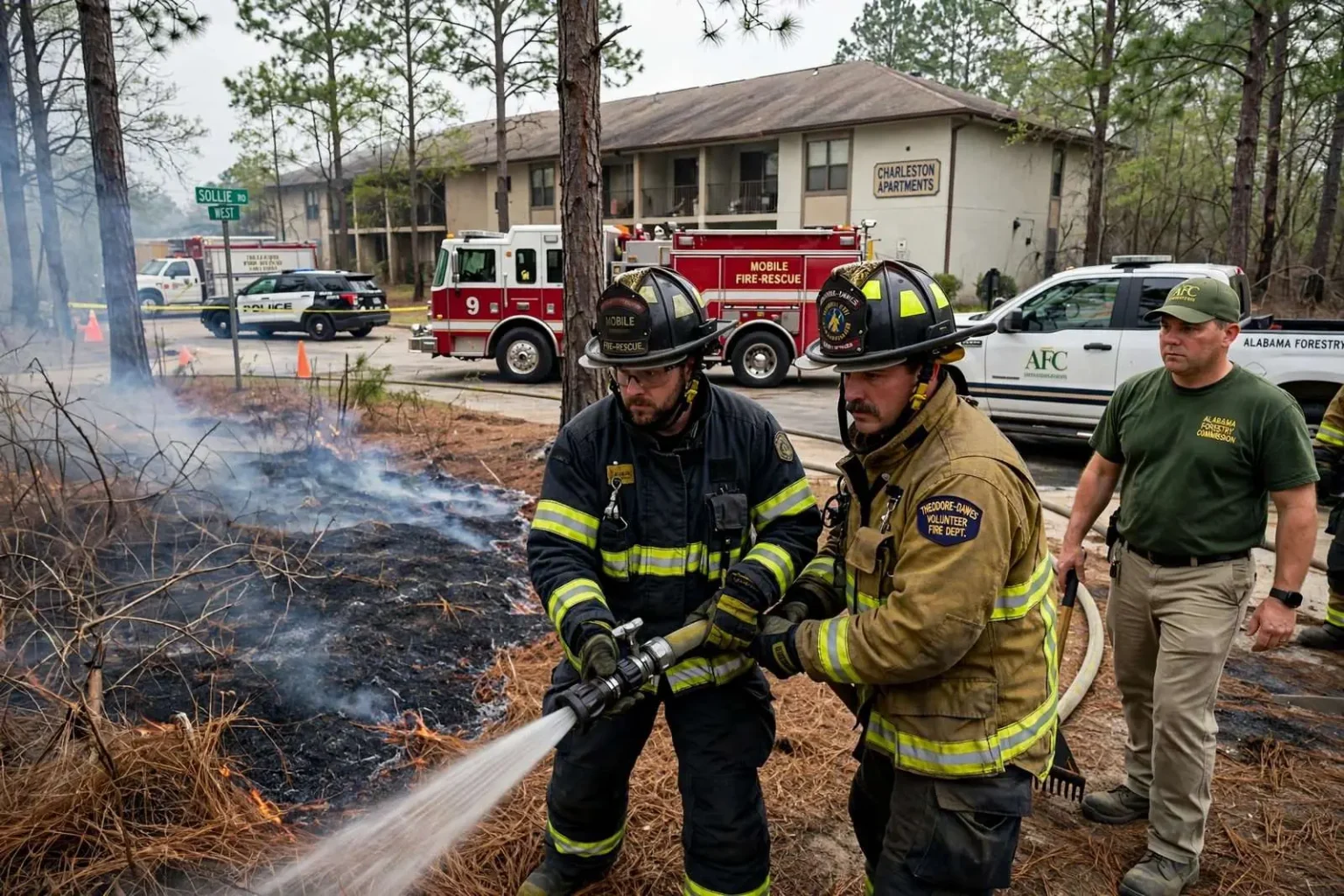
A west Mobile brush fire that firefighters believed they had knocked down came back to life the next morning, sending crews back to Sollie Road for a second straight day of work near a busy apartment corridor. The rekindle turned a routine brush call into a multi-agency operation and served as a fresh reminder of how stubborn late-spring fires in south Alabama can be when dry undergrowth, pine straw and hidden embers combine.
Mobile Fire-Rescue was first dispatched to Sollie Road near the Charleston apartment homes on Sunday night, May 1, for a reported brush fire. When the first units arrived, firefighters found not one fire but two separate wood fires burning in the area, and both were close enough to the apartment complex to pose a genuine threat to the buildings and the residents inside them. Crews worked to contain the flames and knock down the visible fire before wrapping up the incident.
The location mattered. Sollie Road runs through a stretch of west Mobile where wooded lots, drainage corridors and apartment communities sit side by side, and that mix is exactly the kind of environment where a brush fire can climb from the ground into shrubs and trees and then carry flame toward occupied structures. Firefighters on the first night focused on cutting off that path, protecting the exposure to the apartment homes while containing the burning wood and vegetation.
Rekindle Draws Multi-Agency Response
The fire rekindled Monday morning in the same area, and firefighters returned to finish the job. Rekindles are a familiar frustration in the fire service: embers can burrow into piles of debris, root systems, mulch or peaty soil and smolder out of sight for hours, only to flare again when wind and oxygen reach them. That is what appears to have happened along Sollie Road, and it is why fire crews often ask residents to keep an eye on burn areas even after the flames are gone.
This time the response grew considerably. Alongside Mobile Fire-Rescue units, the Theodore-Dawes Volunteer Fire Department responded to assist, as did the Alabama Forestry Commission, the state agency that specializes in wildfire suppression on forested and rural land. Mobile police also assisted, helping manage the scene and keep the area clear so fire apparatus could move in and out safely. The added manpower and equipment reflected the reality that a rekindled fire near an apartment complex is treated as a structure-protection problem, not just a brush call.
Forestry officials estimated that roughly five acres burned in all between the initial fire and the Monday morning flare-up. Five acres is not a catastrophic wildfire by Alabama standards, but it is a significant burn for an urban-interface setting, and the total could have climbed quickly had the wind or the fire pushed toward the apartment buildings rather than away from them.
Despite the rekindle, officials with Mobile Fire-Rescue said the renewed fire did not endanger any nearby residents before it was brought under control. No injuries were reported, and crews were able to fully extinguish the flames on the second day with the help of the partner agencies.
Why Spring Is Fire Season on the Gulf Coast
Early May is traditionally one of the more active stretches for outdoor and brush fires in south Alabama. Spring typically arrives after several weeks of low rainfall relative to the soaking summer pattern, and the dead leaves, pine straw and undergrowth left from the previous year are at their driest just as temperatures begin to climb and afternoon breezes pick up. A discarded cigarette, a controlled burn that escapes or a spark from equipment can ignite that material in seconds.
The Alabama Forestry Commission tracks wildfire activity across the state and maintains burn-permit rules for large controlled burns, precisely because fires that start in woodland fuel can spread quickly on dry, windy days. In Mobile County, the commission’s response role becomes especially important in areas where neighborhoods press up against wooded tracts, because volunteer and municipal departments often do not have the specialized plows and dozers needed to cut fire breaks through rough terrain. Bringing in Forestry Commission equipment, as happened on Sollie Road, gives firefighters the ability to plow lines around a fire and cut off its path rather than simply chasing the flames.
The Theodore-Dawes Volunteer Fire Department, which covers a large service area in western Mobile County, is one of the volunteer agencies that routinely backs up Mobile Fire-Rescue in that part of the county. Mutual aid of that kind is standard practice in the region, where response areas adjoin one another and a single incident can easily span jurisdictional lines.
What Rekindles Mean for Homeowners and Renters
Fire officials repeatedly stress that a fire scene is not truly safe the moment the visible flames disappear. Embers can survive deep inside brush piles, tree stumps, mulch beds and even structural debris for many hours, and overnight winds can stir them back to life. In neighborhoods like the one along Sollie Road, where homes and apartments back up to green space, that lingering risk is why residents near a recent burn are encouraged to report any smoke or hot spots they see, even a day or two later.
There are practical steps people who live near wooded areas can take to reduce their own risk. Fire-safety officials recommend keeping gutters and roofs clear of pine straw and leaves, storing firewood and construction materials away from exterior walls, trimming shrubs so they do not create a ladder from the ground to the roofline, and maintaining a clear zone of defensible space around structures. None of those steps takes heavy equipment, and together they give firefighters a much better chance of holding a fire at the property line.
Apartment communities present their own challenges in a brush fire. More people live in a single complex than on a comparable stretch of single-family lots, which means more vehicles in the way of apparatus, more residents who may not know evacuation routes, and more potential exposure if flames reach a building. Smoke drifting toward occupied units is also a health concern, particularly for older residents and people with respiratory conditions, even when the fire itself never touches a structure.
How Crews Attack a Brush Fire in the City
Fighting a brush fire in an urban-interface setting looks different from fighting a house fire. Instead of stretching hose lines into a building, crews typically work in a pattern: protect any threatened structures first, then attack the fire’s edges, then mop up the interior so heat cannot reignite. Brush trucks and engines carry forestry lines, which are smaller-diameter hoses that can be dragged quickly across rough ground, and firefighters use tools such as rakes, shovels and leaf blowers to strip fuel away from the fire’s path.
When the Alabama Forestry Commission arrives with plows and dozers, the emphasis shifts to cutting fire breaks, which are bare-soil corridors stripped of vegetation that a fire cannot cross. Once a break encircles the burn area, the fire is effectively boxed in and crews can finish the mop-up work at a controlled pace. That is the typical division of labor on a call like the one on Sollie Road: local firefighters protect the exposures and knock down the head of the fire, while Forestry Commission equipment secures the perimeter.
Police assistance, meanwhile, is not just traffic control. A fire scene along a road like Sollie Road draws onlookers, and bystanders who crowd the area slow apparatus movements and can wander into the path of working crews. Keeping the corridor open also preserves access for any additional units that might be needed if conditions changed.
A Reminder Before the Summer Rains Return
The Sollie Road fire ended without injuries and without damage to the apartment complex, but the sequence of events offers a useful lesson for the rest of the fire season. First, a fire is not over when it looks over, and burn areas should be watched for rekindle. Second, fires near occupied buildings draw resources from across the region, and the cooperation between a municipal department, a volunteer department and a state agency is what keeps small fires from becoming large ones.
Third, the people who live closest to the green space bear the least blame for a fire but the most risk, which is why simple yard maintenance and prompt reporting of smoke matter so much in neighborhoods like this one. As hotter weather arrives and south Alabama shifts into its summer storm pattern, the fuel that fed the Sollie Road fire will green up and the risk will ease. Until then, fire officials say the same habits that helped keep this incident from becoming a disaster, vigilance, clear space around structures and fast reporting, are the ones that protect the next neighborhood.
The Agencies Behind the Response
The coordination on display along Sollie Road reflects how fire protection is actually organized across Mobile County. Mobile Fire-Rescue provides career staffing and first-response coverage inside the city limits, operating engine, ladder and rescue companies from stations spread across the city. The Theodore-Dawes Volunteer Fire Department covers unincorporated areas to the west and southwest, where volunteer staffing keeps response times short in communities that would otherwise wait on units coming from farther away. The Alabama Forestry Commission brings statewide wildfire expertise and heavy equipment. Mobile police round out the picture with scene security. An incident that starts as a single brush call can end up touching three or four agencies, and the ability to call them in quickly is a key reason the five-acre burn stayed five acres.
For residents of the Charleston apartment homes and the surrounding streets, the outcome was the one that matters: a threatening fire contained, a rekindle caught early, and no one hurt. Fire officials note that the quickest way to keep future incidents that benign is the same combination that worked here, early reports from people who spot smoke, fast mutual aid, and the heavy equipment to cut a fire off before the wind decides where it goes.