
‘Souls of Mobile’ Mural Brings Community Faces to Downtown Wall
Ginger Woechan's 'Souls of Mobile' mural depicts local residents nominated for their good deeds on Haley's Bar's Jackson Street wall downtown.
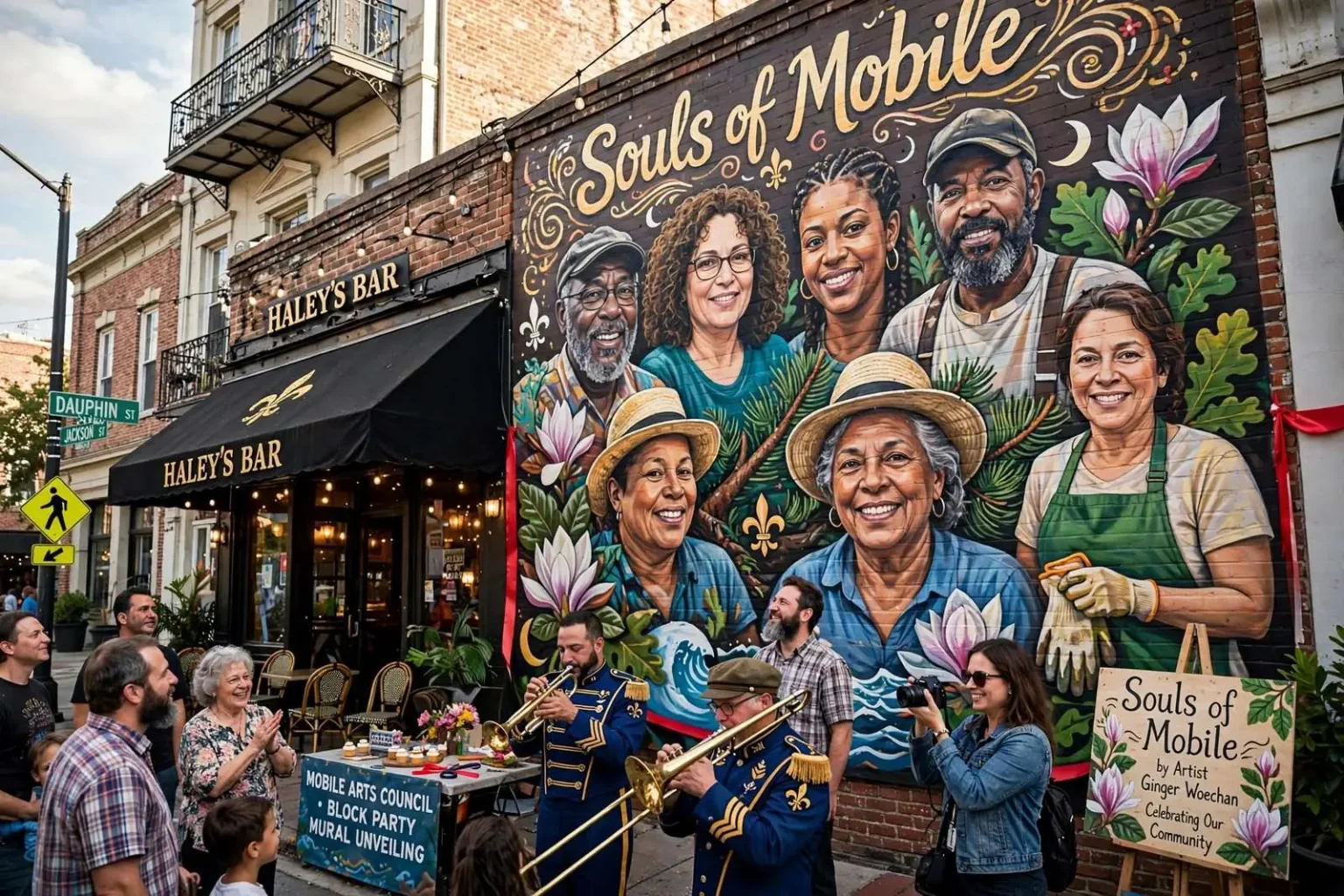
MOBILE — Downtown Mobile has a new piece of public art — and its subjects are the people who make the city better. “Souls of Mobile,” a mural by artist Ginger Woechan, now covers the Jackson Street wall of Haley’s Bar on Dauphin Street, turning a stretch of brick in the heart of the entertainment district into a colorful street scene populated by real residents of the city.
The figures in the mural were not chosen by committee or celebrity. The individuals depicted are people from the community who were nominated specifically because of the good they do for the city — the volunteers, fixtures, and quiet contributors whose faces most Mobilians would recognize from daily life rather than from headlines. That selection process gave the mural its character: instead of a single heroic subject, it offers a crowd, a composite portrait of the city made up entirely of people who serve it.
An artist who found home after Katrina
Woechan arrived in Mobile in 2006 after losing everything to Hurricane Katrina in Ocean Springs, Mississippi. Her story is part of the larger migration the storm set in motion, when thousands of Gulf Coast residents whose homes were destroyed relocated to communities that took them in — in Mobile’s case, often permanently. She has said she found peace through painting while exploring different textures and mediums, rebuilding a creative life in her adopted city piece by piece.
That journey led directly to this celebration of her adopted city. An artist whose own history taught her what it means to be received by a community became the painter of that community’s faces, and the mural reads as both artwork and thank-you note. Woechan’s work across the Gulf Coast has leaned into texture and layered color, and “Souls of Mobile” brings that style to one of downtown’s most visible walls, where patrons leaving Haley’s Bar and passersby on Dauphin Street encounter it daily.
A block party to unveil it
The mural was celebrated the way Mobile celebrates most things — with a party. The unveiling drew a block party to the corner of Dauphin and Jackson streets, featuring music from the Excelsior Band and Harrison McInnis, with a ribbon-cutting kicking off the afternoon. The Excelsior Band, a Mobile institution that has been playing the city’s streets and parades for generations, gave the event a soundtrack rooted in the same local tradition the mural honors, and the crowd of neighbors, nominees, and art lovers filled the block for an afternoon in a way few ribbon-cuttings manage.
The project was sponsored by the Mobile Arts Council, Haley’s Bar, and Our Southern Souls — a collaboration between the city’s arts organization, the business that lends its wall, and the community storytelling project that helped gather the nominees. The sponsorship model has become the standard path for public art in downtown Mobile: a property owner provides the surface, an arts organization provides the coordination and artists, and local businesses and supporters provide the funding that turns a blank wall into a landmark.
Public art in a reviving downtown
The mural marked the fifth public art project coordinated by the Mobile Arts Council that year alone, part of a growing effort to fill downtown walls with locally rooted artwork. The push tracked with the transformation of downtown Mobile itself: as LoDa and the surrounding blocks filled with restaurants, bars, apartments, and evening traffic, the district’s older brick walls — blank for decades — became canvases, and the city’s arts leadership made deliberate choices about what would appear on them.
The philosophy behind the effort favors local subjects. Murals across the country range from abstract installations to commissioned tributes, and Mobile’s leaders have leaned toward work that tells the city’s own stories — its music, its history, and, as in “Souls of Mobile,” its people. Public art of that kind does double duty: it beautifies a wall, and it gives residents a recognizable image of themselves. A visitor seeing the mural learns the city has a community worth painting; a resident seeing it may find a friend’s face on the brick.
Dauphin Street, the main artery of downtown nightlife, is where the city’s public art reaches the most eyes. On any weekend night, thousands of people pass the Haley’s Bar wall, and by daylight the block carries steady foot traffic from offices, churches, and the courts nearby. Few galleries sell that many views, which is why arts organizers describe walls like this one as the city’s most democratic exhibition space — free to see, open at all hours, and encountered by people who never set foot in a museum.
What it takes to paint a neighborhood’s portrait
A project like “Souls of Mobile” begins long before the first brushstroke. Nominations have to be gathered and weighed, subjects approached and consented, the wall secured, materials funded, and the design composed to fit both the architecture and the community’s sense of itself. Woechan’s task was unusual in that her subjects were specific, living people rather than archetypes — each figure had to be recognizable enough to honor the individual while contributing to the mural’s composition as a whole street scene.
The reward for that labor is durability of a kind most art never achieves. A mural on a downtown wall becomes part of the city’s navigation — a meeting place, a photo backdrop, a landmark in the ordinary sense. And for the people depicted, it is something rarer: a public thank-you, painted at full scale, on a corner they can walk past every day.
For Woechan, the project closed a loop that opened with a hurricane. An artist who arrived in Mobile having lost everything painted the faces of the people who make the city better — the ones who received her, and the ones who spend their lives receiving others. Downtown’s walls have held plenty of imagery over the years, but few pieces claim to be, and succeed at being, a portrait of the city itself.
The Excelsior Band and the sound of the unveiling
Choosing the Excelsior Band to soundtrack the unveiling was a statement in itself. The band, formed in the late 19th century, has played Mardi Gras in Mobile for well over a century, and its horns are as much a part of the city’s identity as any building. A mural honoring the souls of the city deserved the band that has carried the city’s soul through its streets for generations, and the crowd that gathered on Dauphin Street for the ribbon-cutting got the pairing of two local traditions — one painted, one played — in a single afternoon. Harrison McInnis’s set rounded out the music, keeping the block party’s atmosphere loose and local from start to finish.
Block parties of this kind have become the standard unveiling for downtown murals, and the format serves the artwork well. A mural is public art in every sense, and the celebration that greets it should be public too: neighbors meeting the artist, subjects pointing themselves out to friends, families taking photographs against the finished wall. By the time the party ended, the mural had already begun the work it was painted to do — acting as a landmark, a gathering point, and a subject of conversation on one of the busiest corners in downtown.
The people on the wall
The choice to depict ordinary residents doing extraordinary good is what separates “Souls of Mobile” from the monument tradition that cities usually reserve for honors. Monuments celebrate the famous; this mural celebrates the reliable — the people nominated by their neighbors for the good they do, whose contributions rarely earn statues. Community members familiar with the local art scene have noted the power of that reversal: a large wall in the center of downtown given over not to a general or a founder, but to the volunteers and quiet pillars who keep a city’s daily life running.
Our Southern Souls, the community storytelling project involved in the mural, brought exactly that sensibility to the collaboration. The project has built its following by profiling the small-town and big-city characters of the Gulf Coast — the musicians, cooks, caregivers, and local legends who give the region its texture — and its role in gathering nominees ensured that the faces on the wall came from the community’s own judgment rather than a curator’s list.
A growing collection downtown
Five public art projects in a single year marked a pace that would have been unthinkable in downtown Mobile a decade earlier, and each new piece changes the calculus for the next. Murals are self-reinforcing: a block that has one tends to attract more, both because property owners see the attention the walls draw and because artists can point to a growing body of work when proposing new projects. The Mobile Arts Council’s coordination gives the effort continuity — matching artists to walls, lining up sponsors, and keeping the quality consistent enough that the collection reads as a deliberate civic project rather than a scattering of one-offs.
The economic logic follows the cultural one. Downtowns that feel alive draw evening and weekend traffic, and distinctive public art gives visitors reasons to walk one more block, linger, and photograph what they find. For the bars, restaurants, and shops of Dauphin Street, a mural-covered wall is a neighbor that works every shift, drawing eyes to the block at no charge.
“Souls of Mobile” now stands at that intersection of art, commerce, and community — a Katrina transplant’s tribute to her adopted city, painted on a bar wall, blessed by a brass band, and filled with the faces of people who never asked to be on it.


