South Alabama Film Festival to Reveal Full Lineup, Poster Winner at Art Walk
The South Alabama Film Festival reveals its full lineup and poster contest winner at downtown Mobile's Art Walk, ahead of its Nov.
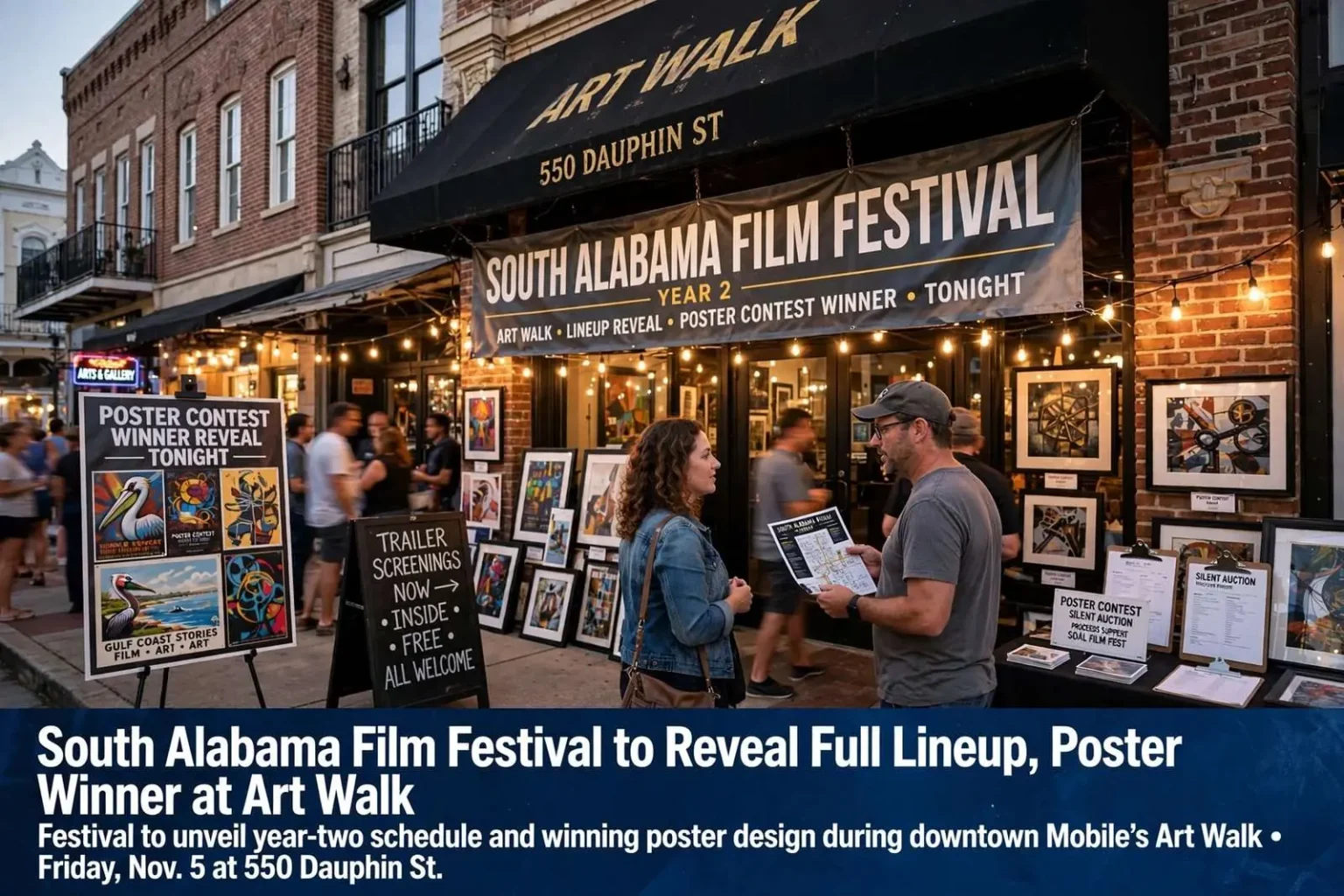
Organizers of the South Alabama Film Festival will unveil the complete schedule for the event’s second year this Friday during downtown Mobile’s Art Walk, marking the young festival’s first official presence at the monthly arts event. The announcement puts the festival in front of the largest regular arts audience in the city, on a night when thousands of residents move through the galleries, studios, and sidewalks of the downtown entertainment district.
SoAL Film Fest is opening its doors at 550 Dauphin St. for the Art Walk crowd, screening trailers from the films selected for this year’s festival as a preview of what’s to come. The venue puts the festival’s presence squarely on the Dauphin Street corridor that anchors Mobile’s nightlife and arts scene, and organizers expect a steady stream of visitors through the evening as Art Walk traffic moves along the block.
Organizers will also announce the winner of the festival’s poster contest at the same event; the winning design will appear on this year’s program booklets, posters and promotional materials. The contest drew entries from area artists, and the winning image will effectively become the public face of the festival, appearing on printed materials distributed across the city in the weeks before the screenings begin.
The remaining poster contest entries won’t go to waste. They’ll be displayed and sold in a silent auction during Art Walk, giving local artists a chance to see their work purchased by festival supporters. Proceeds from the auction support the festival’s operations, and the format gives the non-winning submissions an audience they would never have found in a filing cabinet, a practice consistent with the festival’s mission of celebrating Gulf Coast creativity in all its forms.
A Regional Showcase
Now in its second year, the South Alabama Film Festival is a three-day event built around regional filmmaking. Selections include films made by filmmakers from the coastal states as well as films that feature area writers, cast members or filming locations, giving the festival a distinctly Gulf Coast identity. The regional focus sets the festival apart from larger generic festivals, positioning Mobile as a showcase for stories told by and about the people of the Gulf South.
This year’s lineup leans heavily on documentaries celebrating the achievements and everyday eccentricities of real-life Gulf Coast residents. Documentaries are typically cheaper to produce than narrative features, which makes them a natural strength for regional filmmakers, and the genre’s appetite for true local characters suits a region as rich in personalities as the Gulf Coast. Festival programmers have leaned into that strength, assembling a slate that reads as a portrait of the region’s offbeat, resilient character.
The festival is presented by the South Alabama Film Festival organization in conjunction with the Mobile Arts Council. The partnership with the Arts Council ties the festival into the city’s established arts infrastructure and signals its ambition to be part of Mobile’s cultural calendar for years to come, not a one-season novelty. It kicks off Friday, Nov. 5, in Bienville Square and runs through Sunday, Nov. 7, giving Mobile filmgoers a full weekend of programming in the heart of downtown.
Friday’s Art Walk preview gives residents a first look at what’s screening before the festival opens next month, and organizers are hoping the poster contest and trailer screening help build buzz for the full run. Early momentum matters for a second-year festival, whose audiences are still being built one event at a time, and a strong Art Walk presence gives organizers a month of word-of-mouth before opening day.
Festival Highlights
With the full lineup now set, organizers have highlighted several films audiences can expect to see over the festival’s three-day run. World’s Largest, a documentary about small towns with outsized roadside attractions, screens free of charge at Bienville Square. The film tours the oddball monuments and giant roadside objects that small American towns have built to draw travelers off the highway, a subject that resonates in a region dotted with its own roadside landmarks, and the free outdoor screening is designed as the festival’s most accessible event for casual audiences.
Other selections include Brutal Beauty, which follows Portland, Oregon’s Rose City Rollers roller derby league, and Best Worst Movie, a look at the cult following built around the horror film “Troll 2.” Best Worst Movie is itself a story with Gulf Coast roots in spirit: it documents how a film once dismissed as one of the worst ever made found a second life through midnight screenings and devoted fans, and how its cast came to embrace the notoriety decades later. Both films trade in the affectionate strangeness of American subcultures, a theme that runs throughout the festival’s slate.
Rock-A-Fire Explosion traces the story of a small-town disc jockey, an inventor and the animatronic band he built. The documentary revisits the ShowBiz-era animatronic characters that once entertained generations of children at family pizza restaurants, and the devoted collector whose obsession with the band became a story about memory, nostalgia, and the afterlife of obsolete technology.
American Jihadist profiles Isa Abdullah Ali, an African-American Muslim from Washington, D.C., who fought in Lebanon and Bosnia and has been described by the U.S. Defense Department as a known terrorist despite never having been charged with a crime; the film explores the social and political forces behind religious militancy. The film is the slate’s most provocative entry, and its inclusion reflects a programming philosophy that gives audiences documentary work on difficult subjects alongside lighter fare.
Also on the schedule are Canal Street Madam, about a New Orleans brothel operator rebuilding her life after an FBI raid, and A Village Called Versailles, which follows a Vietnamese American neighborhood in New Orleans as it rebuilds after Hurricane Katrina and fights a proposed landfill nearby. Both films draw on the Gulf Coast’s most recent shared catastrophe, and Versailles in particular documents a community’s fight for self-determination in the storm’s aftermath – a story with obvious resonance for Mobile audiences who lived through the same hurricane seasons.
Woodpecker rounds out the highlighted selections, following birdwatchers searching the Arkansas bayou for a rare woodpecker. The film captures the fervor surrounding reported sightings of the ivory-billed woodpecker, the legendary bird whose presumed extinction and possible rediscovery drew researchers, skeptics, and enthusiasts into the swamp, and treats the search itself as a story about hope and belief.
In addition to the film screenings, the festival will offer seminars and workshops for adults and school children as part of its broader mission to educate the community about filmmaking alongside the entertainment. The educational programming extends the festival’s reach beyond the weekend audience, putting working filmmakers in front of local students and giving area residents a pathway into the industry the festival hopes to cultivate on the Gulf Coast. With the schedule now public and the poster chosen, organizers can turn their attention to the month of promotion that separates Friday’s Art Walk announcement from opening night in Bienville Square.
Why a film festival matters to Mobile
For a city working to diversify its downtown economy beyond restaurants and nightlife, a film festival is more than entertainment. Festivals draw visitors from outside the city on weekends that would otherwise be quiet, put heads in hotel beds and cover tables downtown, and – over time – build a reputation that can attract productions looking for Gulf Coast locations. Cities across the region have used modest festivals as incubators for larger creative economies, and Mobile’s existing assets, from its historic neighborhoods to its waterfront, give local filmmakers material to work with.
The Art Walk partnership also reflects a broader strategy of weaving the festival into the city’s cultural fabric rather than staging it in isolation. Art Walk already delivers the audience the festival needs, and the festival in turn gives Art Walk a new venue and a new reason to stop at 550 Dauphin St. That mutual support is how young cultural events in mid-sized cities survive their fragile first years, and the organizers’ decision to make the announcement there signals an intent to grow with the district.
Second-year festivals face a familiar test: converting the novelty of a first run into an expectation of an annual tradition. The full schedule reveal, the poster auction, and the trailer screening are all pieces of that effort, designed to give residents a sense of ownership before the first film rolls. The quiet work of sponsorships, volunteer recruitment, and venue arrangements has been underway for months; what Friday’s event adds is the public half of the equation. If the strategy works, opening night in Bienville Square will draw an audience already familiar with the lineup – and already planning which of the weekend’s screenings they intend to see. Either way, the festival’s second year will be measured by more than ticket counts.