
South Alabama School Districts Announce Coronavirus Closures: County-by-County List
Mobile, Baldwin, Escambia, Clarke and Washington county districts plus metro city schools announce coronavirus closures beginning March 19, 2020.
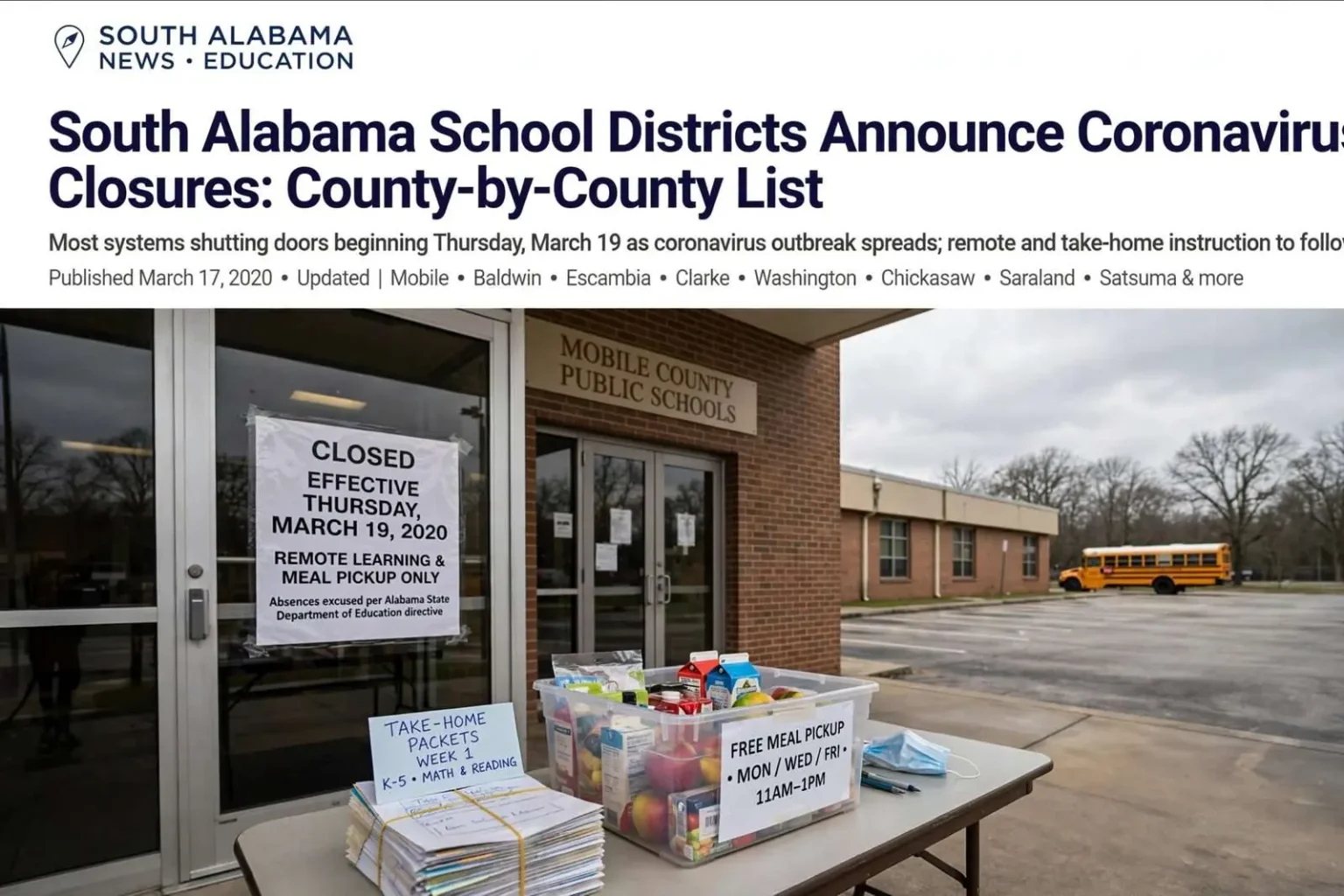
School systems across South Alabama announced extended closures in mid-March 2020 as the coronavirus outbreak spread, with most districts shutting their doors beginning Thursday, March 19 and shifting to remote or take-home instruction. The announcements came in a dizzying stretch of days in which Superintendents across the region worked to move millions of dollars of operations and tens of thousands of students into an entirely new way of doing school — nearly overnight. What had been a distant news story became a local reality in the span of a single week.
State school superintendent Dr. Eric Mackey directed that absences recorded in the days leading up to the closures be excused for any family that chose to keep children home. The directive, issued through the Alabama State Department of Education, gave parents cover to make their own judgments in the days before the formal closures, when some campuses were still holding classes while others had already gone dark. It also signaled that the state expected attendance counts for those days to reflect reality rather than compel families into classrooms.
Mobile and Baldwin Counties
All Mobile County public schools closed for two and a half weeks starting March 19. Baldwin County public schools scheduled three and a half weeks off over the same window. In both systems, the Monday-through-Wednesday stretch before the closure counted as excused absences. Mobile County’s system — the largest in south Alabama and one of the largest in the state, serving communities from Citronelle to Dauphin Island — faced the tallest logistical challenge, with every school in the county needing a plan for students who depended on campus for meals as well as instruction.
Baldwin County’s longer timeline reflected the district’s early caution as cases multiplied along the Eastern Shore. The county’s sprawling geography — from Fairhope and Daphne to Foley, Gulf Shores and Bay Minette — meant any continuation of classes involved long bus routes and large gatherings that health officials were increasingly advising against as the scale of the outbreak became clear.
Private schools moved on their own schedules. Bayside Academy moved immediately to virtual learning. St. Paul’s Episcopal School began its remote transition Monday, March 16, allowing families on campus Tuesday to collect materials before online classes started Wednesday. The head starts these independent schools got came from resources city and county systems had to improvise — devices already in students’ hands, established digital platforms and campus communities small enough to coordinate quickly.
Catholic schools across the Archdiocese of Mobile dismissed at midday Wednesday, March 18 and remained closed through Friday, April 3, with each school running distance learning under its own procedures. The archdiocese, which covers the southern third of Alabama and operates campuses throughout Mobile, Baldwin and the Wiregrass, let individual principals tailor distance plans to their communities — an approach that produced variation but allowed schools with existing technology programs to move fastest.
Mobile Metro City Systems
Chickasaw city schools closed starting March 19, sending students home with resource packets, Google Classroom logins and meal program information. The small city system, which operates its own schools after breaking away from Mobile County’s district, paired its academic materials with food-service planning from the start, recognizing that closing campuses meant closing the cafeteria windows many Chickasaw families counted on.
Saraland city schools began closing Tuesday, March 17; Superintendent Dr. Aaron Miller said absences would be excused and all classes and extracurricular activities were canceled through April 13. Satsuma city schools closed March 17 through April 3, keeping bus service running a normal schedule while e-learning details were finalized. The two newest city systems in Mobile County — both incorporated as school districts in recent decades — moved a step ahead of the county calendar, a flexibility that comes with running small districts whose leaders can make and announce decisions in hours rather than days.
Saraland’s April 13 date was among the longest closures announced in the region at the time, a reflection of the system’s caution about bringing students back to campuses in the middle of the state’s rising case counts. The district’s rapid growth in recent years — it has become one of the metro area’s fastest-growing systems, drawing families to the city’s residential boom — gave it a modern technology infrastructure that eased the pivot to remote instruction.
Wiregrass and Interior South Alabama
Escambia County public schools halted classes March 19 with no return before April 6, excusing any parent-kept absences in the interim. Clarke County public schools adopted the same March 19-to-April 6 timeline. Washington County public schools also closed March 19 through April 6, taking the same precautionary approach as its neighbors across the interior counties. In the small county systems — Escambia centered on Brewton and Atmore, Clarke on Grove Hill and Jackson, Washington on Chatom — the closures covered communities where the school campus functions as the center of civic life, hosting everything from ballgames to church revivals.
Rural districts faced a different set of obstacles than their metropolitan counterparts. Broadband access across south Alabama’s interior counties is limited, meaning take-home paper packets remained the backbone of instruction in many schools rather than online platforms. Bus fleets that normally deliver students became delivery systems for meals and assignments in several districts, and administrators leaned on phone trees and social media to reach families without reliable internet at home.
The closures also landed at the worst moment on the academic calendar — the final quarter, when state standardized testing, course completion and graduation decisions are made. Districts across the region spent the following weeks awaiting guidance from the state department on how grades, credits and spring assessments would be handled, with seniors and their families watching closely to see whether diploma requirements would be adjusted for a semester no one had planned.
What the Closures Meant for Families
For parents across the region, the announcements triggered immediate practical scrambles. Child care arrangements built around school schedules collapsed overnight, and workplaces from shipyards to hospitals to restaurants had to decide within days whether employees with children could work from home, shift hours or stay out entirely. The school closures rippled into the wider economy faster than almost any other measure of the era, because they changed the daily geometry of tens of thousands of households at once.
Meal programs became the most urgent operational concern. Districts that serve breakfast and lunch to a majority of their students — and, in some communities, suppers through after-school programs — had to reinvent distribution within days. Grab-and-go pickup models, bus-route meal deliveries and partnerships with local food banks emerged across south Alabama as the standard response, ensuring that the closure’s food consequences did not fall on the families least able to absorb them.
Students lost more than classes. Spring sports seasons were suspended or wiped out across the region’s high schools, along with band competitions, proms, awards nights and the rituals of senior spring. Athletic associations and school leaders held out hope for restarts into April, but the calendar kept slipping, and the class of 2020’s final semester became a season of postponements that never turned into resurrections.
The Larger Picture
The regional response tracked the state’s escalating measures. Alabama’s first confirmed coronavirus cases had been announced only days before the closures, and state officials moved within a week from guidance to mandates, with the governor ordering schools statewide to cease in-person classes and the education department repeatedly extending the timeline as the outbreak grew. What began in south Alabama as two-and-a-half-week closures ultimately stretched into months, with the 2019-20 school year finishing in remote fashion across the state.
Looking back from the other side of that semester, the mid-March announcements preserved in this list were the hinge moment — the day the region’s schools, from the state’s largest county system to its smallest city districts, set aside business as usual in the name of public health. The logistics were improvised, the technology uneven and the timeline uncertain, but the closures went into effect on schedule and largely without incident, a feat of coordination that teachers, bus drivers, child-nutrition workers and administrators across south Alabama pulled off in a single frantic week.
Families who lived through it remember the details — the packets on the porch, the meal pickups, the Google Classroom logins taped to refrigerators. The county-by-county list above stands as a record of how each system responded, and of how quickly a region’s schools can change when circumstances demand it.
Teachers, meanwhile, were asked to reinvent their profession in a weekend. Elementary instructors recorded read-alouds and assembled paper packets; high school teachers leaned on learning platforms and email; coaches checked in on athletes they could no longer see daily. Professional duties that had never been part of any training — monitoring a virtual classroom, troubleshooting a family’s home internet, delivering meals from a bus window — became the job overnight, and south Alabama’s faculties, by every account, made it work.
The closure lists also revealed the layered structure of the region’s education landscape. Alongside the county systems and private schools, the small city districts of Chickasaw, Saraland and Satsuma each made independent calls on timelines and instruction models, and each communicated directly with its own families. That decentralization produced a patchwork of schedules in March 2020 — and it also meant decisions were being made by people who knew their communities personally, close enough to the ground to adjust quickly.
The excused-absence directive from Montgomery deserves particular note in hindsight. In the days between the outbreak’s arrival and the formal closures, families faced genuine dilemmas: keep children in class as usual, or pull them out and risk unexcused absences and their consequences. Mackey’s directive removed the penalty from the safety choice, and administrators across the region honored it — a small administrative act that, in retrospect, was among the most sensible decisions of the entire rollout.


