South Mobile County Weighs Sewer Expansion Against Risk to Portersville Bay
South Mobile County needs more sewer capacity, but a proposal to discharge treated wastewater into Portersville Bay, or to route new sewer lines down Dauphin Island Parkway or Bellingrath Road, has residents and environmental advocates pushing for land-based disposal alternatives instead.
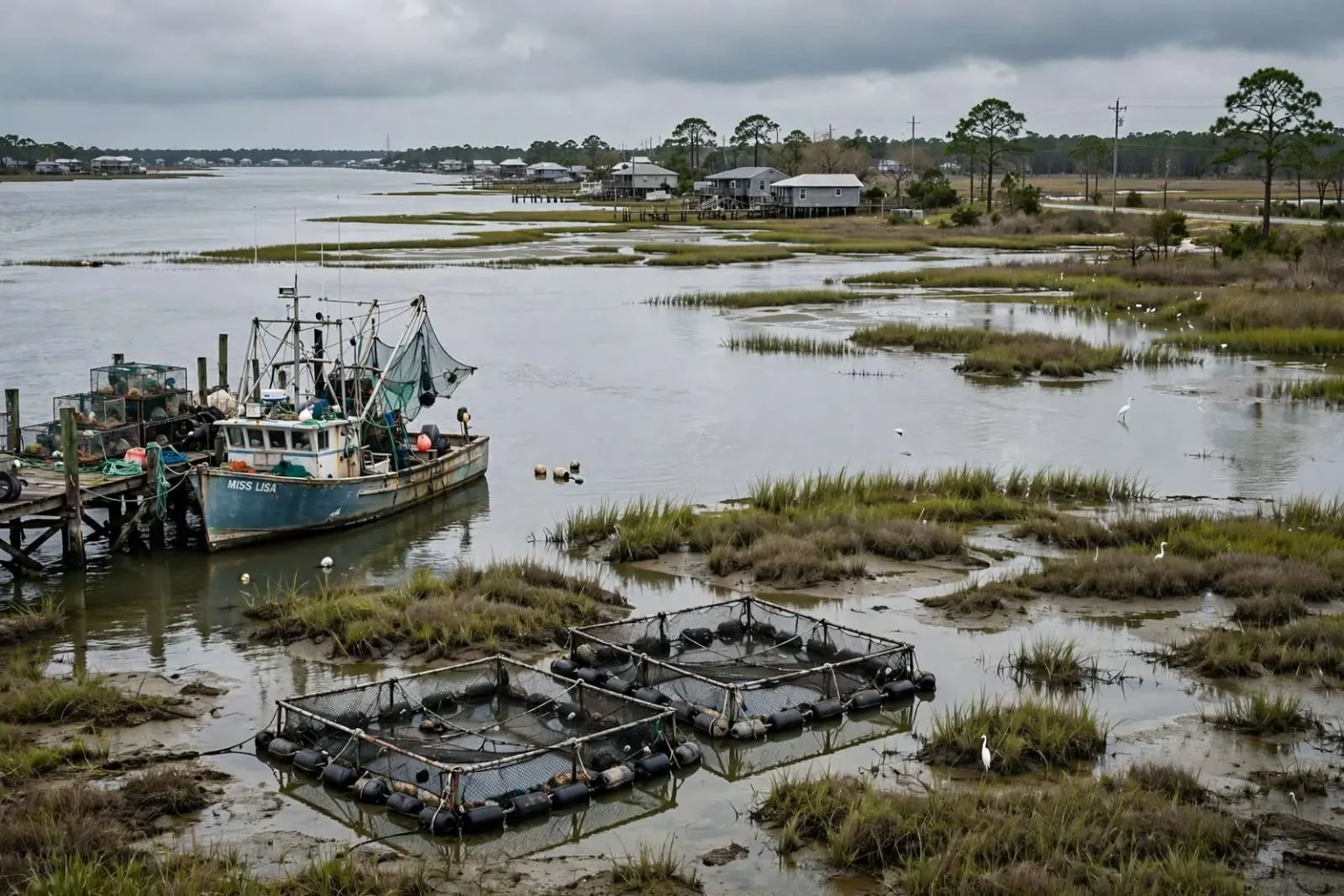
South Mobile County has an acknowledged need for more domestic and industrial wastewater treatment capacity, but how and where that capacity gets built has become a genuine point of local contention. At issue is a proposal that would send partially treated wastewater into Portersville Bay, one of the most productive estuaries on the Alabama coast and a body of water closely tied to the seafood economy of Bayou La Batre and Coden.
The Alabama Department of Environmental Management does not permit wastewater discharges directly into the Gulf of Mexico, a restriction widely regarded as sound environmental policy. Critics of the current proposal argue that this same logic is being applied inconsistently, since estuaries such as Portersville Bay generally have even less capacity than the open Gulf to absorb and dilute treated effluent. If the open Gulf is off-limits because it is too valuable to risk, they ask, why is a shallow bay that supports a working seafood industry an acceptable destination for treated waste?
Estuaries are shallow, semi-enclosed systems where fresh water and salt water mix, and that same shallow, sheltered quality that makes them so biologically productive, supporting oysters, shrimp and finfish, also makes them more vulnerable to nutrient loading and bacterial contamination than deeper open water. Water in a bay like Portersville does not flush out to sea as quickly as water offshore; nutrients that enter the system linger, feeding algae blooms that can strip oxygen from the water column and stress the very species the local economy depends on.
The alternatives on the table
An alternative under consideration would extend sewer lines much farther south, along either Dauphin Island Parkway or Bellingrath Road, to reach more of the unincorporated county. On paper, the approach solves the discharge problem by moving service to residents who currently rely on aging septic systems, many of them installed decades ago in soil conditions they were never designed for.
Opponents of that approach point out a different downside: running municipal sewer service into those corridors would open thousands of acres of currently undeveloped natural habitat to new residential and commercial construction, while ultimately still increasing the total volume of treated wastewater discharged at the head of Mobile Bay. Sewer capacity, they note, is the single most powerful enabler of growth; once trunk lines run down a corridor, the subdivision applications follow, and the low-lying wetlands and pine flatwoods that now absorb storm surge and filter runoff are converted to rooftops and pavement.
Local critics of both options are pushing for planners to more seriously evaluate land-based disposal alternatives, such as spray irrigation or wetland treatment systems, that rely on soil and vegetation to absorb and naturally filter wastewater before it ever reaches a well, stream or bay. Advocates for this approach argue it could reduce the direct discharge burden on sensitive coastal waters while avoiding the sprawl that new trunk sewer lines tend to invite. Land application systems have been used successfully in other fast-growing coastal regions, and proponents say portions of south Mobile County’s sandy uplands could be suitable for carefully sited spray fields.
The septic problem is real
The debate reflects a familiar tension in fast-growing but ecologically sensitive parts of coastal Alabama: aging septic systems in low-lying, high-water-table soil are themselves a recognized pollution source, making some form of centralized treatment attractive. Failing drainfields in the Bayou La Batre, Coden and Mon Luis Island areas can release bacteria and nutrients directly into ditches, tidal creeks and groundwater, and health officials have long warned residents in those communities about the risks of contamination from systems that flood with every heavy rain and king tide.
That reality complicates the arguments of discharge opponents, because doing nothing is not environmentally neutral. Every year that passes with hundreds of marginal septic systems operating in saturated soil adds pollution to the same waters that a new discharge point might threaten. The question, as county planners frame it, is not whether south Mobile County needs better wastewater infrastructure, but which form of it does the least damage and the most good.
What’s at stake for the seafood industry
South Mobile County’s oyster and shrimp harvests, already tested by hurricanes, competition from imported seafood and a shrinking commercial fleet, add urgency to getting the engineering and permitting decisions right the first time. Bayou La Batre has built its identity and economy around the water for generations, and its processing houses, docks and small fleets operate on margins that leave little room for a fishery closure or a sustained decline in water quality. Oysters in particular are filter feeders whose beds can be closed to harvesting for weeks after contamination events, turning a single pollution incident into a direct income loss across the community.
Water quality in Portersville Bay and the surrounding sounds is also monitored in connection with shellfish harvesting areas, and any new discharge permit would be reviewed against those public health standards. State environmental regulators weigh the mixing zones, outfall design, and treatment levels proposed by an applicant, but the cumulative effect of multiple discharges on a small estuary is one of the harder questions in the permitting process, and one that local opponents say deserves scrutiny before any route is locked in.
A decision still ahead
No final route or treatment method has been formally adopted, and the discussion remains active among residents, environmental advocates and county planners as the region works through its wastewater infrastructure options. Public meetings on the issue have drawn residents from communities on both sides of the question, including homeowners who want reliable sewer service and watermen who fear for the resource their livelihoods depend on.
The geography of the debate
Understanding the competing proposals requires a picture of south Mobile County’s geography. The area lies between Mobile Bay on the west and the interstate corridor to the east, a patchwork of small communities — Bayou La Batre, Coden, Mon Louis Island, Grand Bay, St. Elmo and Irvington — connected by two-lane roads and characterized by low elevations, high water tables and soils that drain poorly. Much of the land closest to the bay is tidal marsh and wetland, while development has historically clustered along the ridge lines and major roads.
Dauphin Island Parkway, running south from Mobile toward the island, and Bellingrath Road, angling through the county’s southern reaches, are the two principal corridors that any southern extension of sewer service would follow. Both pass through areas where residential growth has been steady but constrained by the lack of central water and sewer service. Extending lines along either would represent one of the largest infrastructure investments the county has made in its southern end, with costs and service boundaries that would shape growth patterns for decades.
The permitting path
Any discharge option would need a National Pollutant Discharge Elimination System permit administered by ADEM, along with engineering studies demonstrating that the receiving waters can assimilate the treated flow. Land-based alternatives face their own regulatory path, including groundwater monitoring to ensure that spray irrigation or wetland systems do not simply move the pollution into aquifers or adjacent streams. County officials acknowledge that whichever option advances will face years of study, permitting and public review before construction could begin.
Environmental groups active on the Alabama coast have consistently argued that the cheapest treatment option is rarely the cheapest outcome, pointing to the long-term costs of degraded fisheries, closed oyster beds and damaged waterfront property values. They are urging the county to weigh those costs in the same analysis as construction budgets and pipe routes.
What residents should watch
For residents of south Mobile County, the practical questions are straightforward: whether sewer service will reach their street, what it will cost to connect, and whether the water in their bay and bayous will be cleaner or more burdened as a result. The answers depend on decisions that have not yet been made — the route, the treatment technology, the discharge point, and the pace of any build-out.
The engineering challenge is compounded by climate. Coastal Alabama already faces more frequent heavy rainfall events and tidal flooding, both of which stress wastewater systems — washing out spray fields, inundating treatment plant sites and overwhelming collection lines. Engineers evaluating the options will need to account for that future, not just present-day conditions, which is another reason advocates for careful siting argue against rushing toward the least expensive proposal on the table.
Planners say public input remains open as the options are evaluated, and the county has encouraged residents with concerns about septic failures, water quality or proposed routes to participate in the ongoing discussion. The outcome will set the pattern for development and environmental protection in one of coastal Alabama’s most productive and most vulnerable corners for a generation, which is why both supporters and opponents agree the region should take the time to get it right rather than settle for the fastest available option.