SouthSounds 2016 Spotlight: The Blind Mule’s Lineup and Its Hardest-Working Bands
The Blind Mule, at 57 N. Claiborne St. in downtown Mobile, carried one of the longest lineups of the 2016 SouthSounds Music Festival.
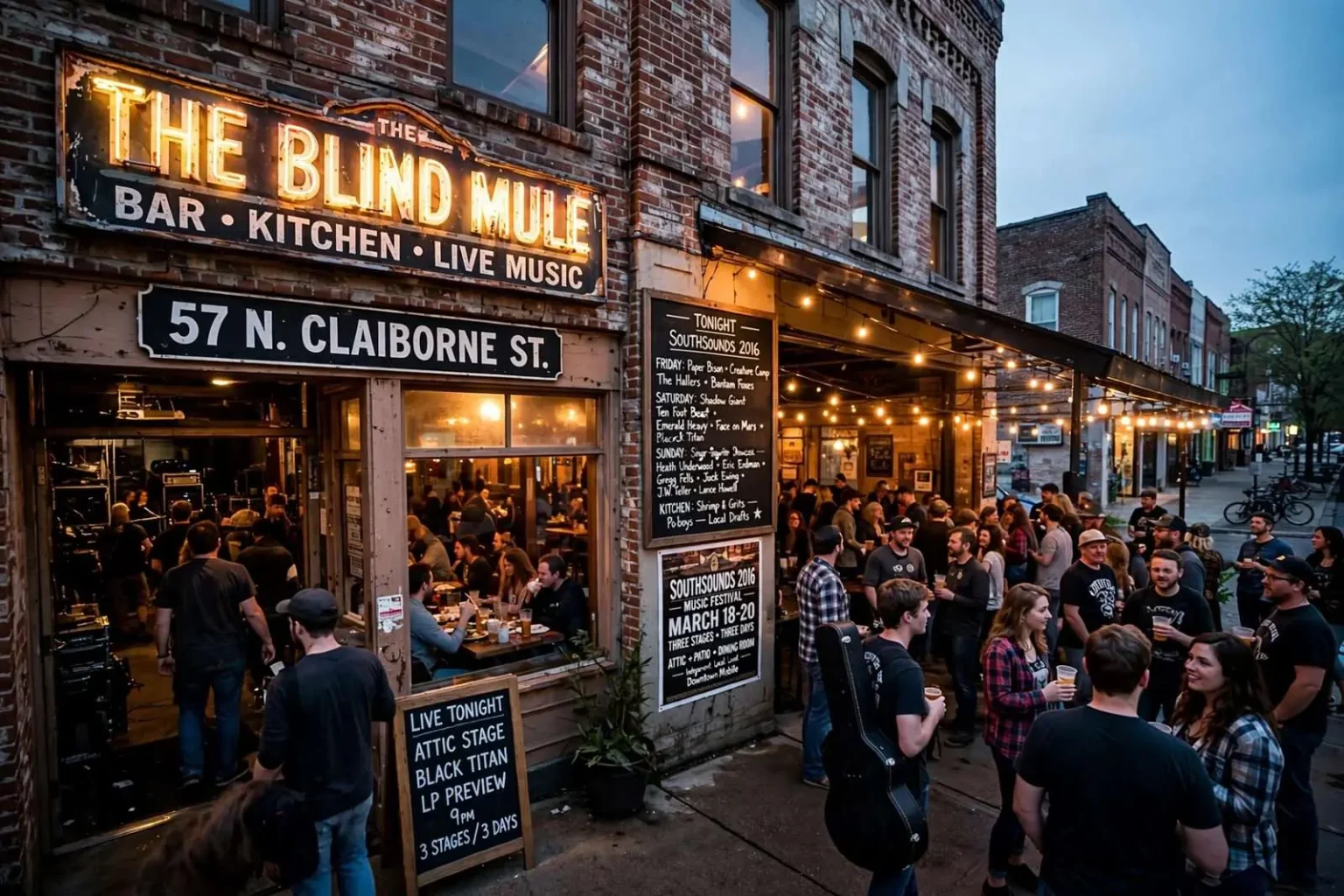
The Blind Mule, at 57 N. Claiborne St. in downtown Mobile, carried one of the longest lineups of the 2016 SouthSounds Music Festival. Its attic stage and downstairs dining room, plus an outdoor patio, have made it a downtown favorite for years — not only as a bar but for a kitchen that regulars praise. When the festival spread acts across venues in and around Dauphin Street, the Mule functioned almost as a festival within the festival, stacking bills in three separate spaces across three days.
SouthSounds, now an annual fixture of Mobile’s spring calendar, exists to surface the next wave of regional talent before the wider world catches on, and its venue choices matter as much as its bookings. A room with character can elevate a young band; a generic one flattens the set. The Blind Mule has spent years cultivating exactly the kind of room that makes festival sets memorable — tight sightlines in the attic, a full-service kitchen downstairs and a patio that absorbs overflow crowds between acts.
A weekend of regional and local acts
Friday’s bill ran from Paper Bison and Creature Camp through The Hallers and Bantam Foxes, an opening-night spread that set the tone for the weekend: guitar-driven, high-energy and thoroughly regional. Saturday anchored with Shadow Giant, Ten Foot Beast, Emerald Heavy, Face on Mars, and Mobile’s own Black Titan — the heaviest single bill of the festival and a deliberate showcase for bands that live on volume and riffcraft. Sunday softened the landing with a singer-songwriter event featuring Heath Underwood, Eric Erdman, Gregg Fells, Josh Ewing, J.W. Teller, and Lance Howell, turning the room over to the writers and acoustic players who round out any healthy music scene.
That three-day arc — rock, heavy, songwriters — is the festival model working as designed. Each night pulled a different slice of audience into the same building, and each band played to listeners who might never have sought it out otherwise. For local acts, a SouthSounds slot in a venue like the Mule is among the most valuable exposure opportunities on the Gulf Coast calendar, watched by fans, bookers and fellow musicians alike.
The bands behind the bill
We spoke with several of the bands about why independent rooms matter. Austin, Texas, power-trio Ten Foot Beast — still hunting for a vocalist to match its intensity — recalled the Mule’s hospitality and its shrimp and grits, a detail that says as much as any review. Touring bands remember the rooms that feed them, and a kitchen that draws praise from road-weary musicians is part of why the same acts keep coming back through Mobile rather than routing around it.
Mobile’s Black Titan, built from a punk and progressive-metal background, was set to anchor Saturday night and preview material from its first LP. For a hometown band, the festival slot carried a different weight: a chance to debut new material in the city that raised the band, in front of the crowd most invested in its success. The Hallers described an indie-rock blend of guitars, keyboards, and backing vocals — the layered, melody-first approach that thrives in rooms like the attic, where every part can actually be heard.
Why the Mule matters
Drummer Brian Dunbar summed up the sentiment that ran through the weekend’s backstage conversations: independent local venues are the lifeblood of Mobile’s music scene, and the Blind Mule plays a major role. Without such businesses, he said, there is simply no place for local music in the city.
It is a blunt claim, and an accurate one. The chain of development for any working band runs through small independent stages: a first show, a first opening slot, a first festival set, a first out-of-town gig booked by someone who saw them play. None of those milestones happen in arenas or amphitheaters. They happen in rooms of a few hundred capacity at most, run by owners who book local acts knowing the bar may do better business that night than the door does. When such venues close, the pipeline closes with them — bands stop forming because there is nowhere to play, and audiences drift to cover bands or stay home.
A venue built three ways
Part of what makes the Blind Mule unusually durable is that it supports itself three ways at once. The dining room brings in a dinner crowd with no interest in the stage; the bar business carries the weeknights; and the attic stage converts weekend traffic into ticket and door revenue for bands. The patio adds a third space for festival overflow. That diversification is why the room can afford to take chances on unsigned acts — the kitchen and bar underwrite the stage, and the stage in turn gives the restaurant a personality that chains cannot copy.
Its Claiborne Street location places it at the edge of the Dauphin Street entertainment district, close enough to catch the weekend foot traffic while sitting in the older blocks that give downtown Mobile much of its character. During SouthSounds, that geography turned the venue into a waypoint: festival-goers moved between official stages and found the Mule holding a full bill in every available corner of the building.
SouthSounds and the festival’s promise
The festival’s name signals its mission: sounds of the South, discovered here first. By design it books acts on the way up rather than the ones already established, and it spreads them across multiple downtown venues so that audiences wander — catching one song in a dining room and three more in an attic before the night ends. For Mobile, the event doubles as a showcase for the city itself, demonstrating to regional bands that Mobile venues treat touring acts well and to fans that the city can support a three-day music event without a stadium.
The 2016 edition’s Blind Mule lineup captured the region’s range in a single venue. Paper Bison and Creature Camp represented the youthful, guitar-forward end of the bill; Bantam Foxes and The Hallers brought polished indie-rock from outside the city; Ten Foot Beast and the Saturday heavy acts showed the volume side of the Gulf Coast scene; and Sunday’s songwriter round — Underwood, Erdman, Fells, Ewing, Teller and Howell — reminded everyone that the same scene produces quiet craft as well as noise. A venue able to host all of that in one building is doing the work of several stages at once.
What the bands took away
For the touring acts, festivals like SouthSounds are where regional reputations are built. Ten Foot Beast’s affection for the Mule — hospitality, shrimp and grits — is exactly the word-of-mouth that convinces other Austin bands to route through Mobile. Black Titan’s Saturday preview of its first LP gave hometown fans a stake in the record before it arrived. The Hallers left with a room that had actually listened to the keyboards and harmonies their songs depend on. Those outcomes are the invisible product of a well-run festival slot, and they outlast the weekend itself.
And for the venue, the weekend reaffirmed the model Dunbar described. The Blind Mule’s three spaces absorbed one of the festival’s biggest lineups without sacrificing what regulars love about it: a kitchen worth praising, a bar that knows its crowd, and stages where live music is the point rather than an accessory. If Mobile’s music scene continues to grow, it will do so on foundations like this one — independently owned rooms that bet on local bands week after week, and festivals like SouthSounds that give those bands a reason to bring their best material home.
The economics of an independent stage deserve as much attention as the bookings. Small venues operate on margins that would frighten most businesses: door splits with bands, seasonal swings in attendance, and the constant overhead of rent, licenses, sound equipment and staff. Rooms survive when the owner treats music as a long game — building a regular audience, grooming the sound of the room, and earning the trust of the musicians who decide where to play. The Blind Mule’s multi-room setup is a hedge against that volatility; when the attic runs light, the patio or dining room covers the night.
For Mobile specifically, rooms like this one also keep the city’s musical memory alive. The Gulf Coast has produced generations of songwriters and bands who had to leave for New Orleans, Atlanta or Nashville to be heard, largely because local stages were scarce. Every year that a venue books original acts instead of tribute bands is another year that local musicians can build careers without leaving home — and another argument for audiences to come out and see them while the cost of a ticket is still the price of a drink.