Space 301 Previews New Downtown Mobile Home Ahead of Public Opening
Space 301 is relocating to a renovated building near Cathedral Square in downtown Mobile, and curator Clayton Colvin offered an early look at the still-under-construction space ahead of its public opening.
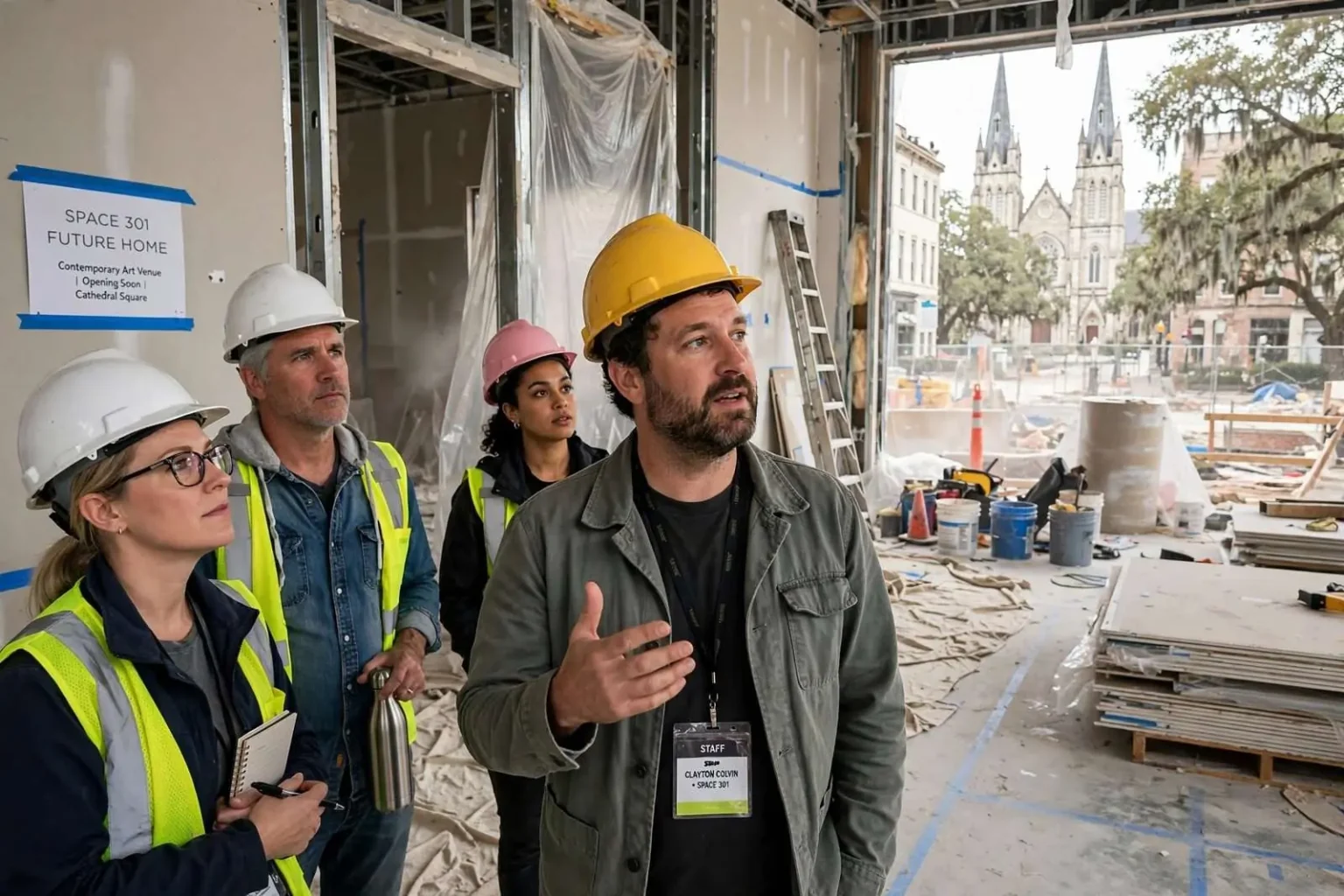
Space 301, the contemporary art venue that has become a fixture of downtown Mobile’s cultural scene, is preparing to move into a new home near Cathedral Square, and an early look inside shows a building still very much under construction.
The walk-through offered a preview of a transition months in the making. The venue, known to Mobile audiences for contemporary exhibitions that pushed beyond the conventions of the city’s more traditional galleries, was trading a beloved raw space for something new — and for the artists and visitors who filled its shows, the move carried both promise and a trace of nostalgia for what was being left behind.
Dust hung in the air and the elevators were not yet running during a recent walk-through, but curator Clayton Colvin guided visitors through the site and outlined plans for the space once the work is complete.
The conditions inside — unfinished surfaces, construction materials, the absence of working elevators — made the contrast with the finished galleries Mobile audiences were accustomed to unavoidable. Colvin’s tour threaded through rooms that existed more as potential than as finished space, describing exhibitions and programming that would fill them once contractors and finish work gave way to art.
The walk-through itself reflected the venue’s approach to its audience. Rather than unveiling a finished product, the organization chose to let supporters and observers see the work in progress, building anticipation for the opening while demonstrating the scale of the investment being made in the new facility. Visitors left with a concrete sense of the building’s dimensions and layout — information that raw square footage figures and architectural plans rarely convey as vividly as standing inside the rooms themselves.
A New Home by Cathedral Square
The new location sits just off Jackson Street, in the shadow of Cathedral Square, one of downtown Mobile’s oldest and most recognizable public spaces.
The setting places the gallery in the historic heart of the city. Cathedral Square, laid out around the Cathedral-Basilica of the Immaculate Conception, anchors a district of historic buildings, museums and cultural attractions within walking distance of the waterfront and the government district. For a contemporary art venue, the address offers both visibility and context: a space for new art housed among some of the oldest architecture in Alabama.
The move also situates Space 301 along the corridor that downtown’s cultural revival has been building around. Within a short walk of the square sit the city’s history museum, galleries, performance venues and the restaurants and bars of the entertainment district — a concentration that makes it possible for visitors to build an entire evening around downtown’s cultural offerings rather than driving from one stand-alone destination to another.
When finished, the renovated building is expected to give Space 301 a more polished, museum-quality feel, a departure from the raw, industrial character that defined its original incarnation. That earlier version of the gallery, prized by many local artists and regular visitors for its unpolished, warehouse-like atmosphere, will give way to a more finished environment more in line with established institutions such as the Mobile Museum of Art in Langan Park.
The trade-off is a familiar one in the art world. Raw warehouse spaces have long been favored by working artists for their scale, flexibility and freedom from the expectations that come with formal institutions — walls can be painted over, floors can take abuse, unconventional installations can be attempted without concern for a finished building. Polished gallery spaces, by contrast, offer climate control, accessibility, professional lighting and a presentation standard that both artists and collectors recognize.
For Space 301, the shift signals an institutional ambition. A museum-quality facility can host traveling exhibitions that a rough industrial space cannot accommodate, can court lenders and collectors who expect conservation-grade conditions, and can present contemporary work to audiences — including school groups and tourists — who may approach a finished gallery more readily than a converted warehouse.
The loss of the old character was acknowledged openly by those who loved the space. The unpolished atmosphere of the original incarnation had become part of the venue’s identity, the setting itself a statement that contemporary art in Mobile did not need institutional permission to be shown. The renovation trades some of that edge for durability and reach.
Part of Downtown’s Broader Revival
The move is part of a broader, gradual reinvestment in downtown Mobile’s historic core, where cultural institutions and small businesses alike have been working to draw both residents and visitors back into the district.
Downtown Mobile’s revival followed decades in which retail and residents migrated to the suburbs, leaving the historic core with vacant upper floors and a nightlife economy that flickered only on weekends and during Mardi Gras. The turnaround, when it came, was incremental: restaurants and bars first, then loft conversions of upper-floor spaces, then the cultural anchors — museums, galleries, venues — that gave people a reason to come downtown for reasons other than dinner.
Cultural institutions have consistently played the leading role in such revivals across American cities. A gallery or museum generates evening traffic, anchors walking routes, and signals to investors and restaurateurs that a district has a future. Space 301’s move toward Cathedral Square concentrated that effect in the city’s most visited historic block.
A renovated, higher-profile home for Space 301 gives the organization more room to expand its exhibition schedule and programming, and adds another draw to a part of downtown that has increasingly positioned itself around arts, dining and pedestrian-friendly streets.
Expanded programming is where the new space’s advantages compound. Additional gallery area allows larger shows and more simultaneous exhibitions; improved facilities support workshops, lectures and artist talks that a raw space could host only with difficulty; and a professional setting makes it easier to recruit exhibiting artists who weigh a venue’s conditions when planning shows. For audiences, the result is a fuller calendar — more openings, more reasons to return, more contemporary art on view at any given time.
The Opening Ahead
Organizers have not yet detailed a full opening schedule for the new space, though the transition is expected to be completed as construction wraps up in the coming months.
The unfinished schedule is typical of gallery relocations, where construction timelines, exhibition planning and the logistics of moving artwork all have to align before a public opening can be announced. Renovation projects of this kind routinely slip past optimistic dates, and organizers’ decision to outline plans without committing to a firm opening reflected the state of the building during the walk-through — promising, but very much a construction site.
For Mobile’s art community, the interim period carried its own questions. Artists who had shown at the original space waited to learn how the new facility’s galleries would be configured, what the submission and selection process would look like in the renovated building, and how the venue’s programming priorities would translate to the larger stage. Curator Clayton Colvin’s role in guiding the transition placed him at the center of those conversations as plans took shape alongside the construction.
What the New Space Means for Local Artists
The arrival of a finished, museum-grade contemporary gallery changes the calculations for artists working in the Mobile area. Local artists gain a professional venue for their work without traveling to New Orleans, Pensacola or beyond — a practical matter for painters, sculptors and installation artists whose work is difficult and costly to move long distances. Collectors and audiences gain a standing place to see new work, and the city’s art calendar gains a flagship venue capable of mounting shows at a scale the community has rarely had access to downtown.
The move also carries an educational dimension. Contemporary art venues that open their doors to school groups and family audiences build the audiences of the future, and a polished, accessible facility near Cathedral Square — steps from the city’s historic district, where school visits already concentrate — makes that programming easier to run and easier for teachers to justify.
A Sign of What Downtown Is Becoming
For now, the gallery’s move stands as one more sign of downtown Mobile’s continued, if incremental, revival — one renovated building and one relocated institution at a time.
The phrase captures the way downtown turnarounds actually happen. No single project remakes a district; the change accumulates through buildings restored one at a time, institutions moving one at a time, and businesses opening one at a time until a critical mass forms. A contemporary art gallery taking residence near Cathedral Square added a cultural anchor to that accumulation, putting new art in one of the oldest quarters of the city.
When the doors open and the dust of the walk-through has settled, Space 301’s new home will stand as both an exhibition space and a statement: that downtown Mobile’s historic core can support contemporary art at an institutional level, and that the district’s revival has the participation of the city’s creative community. For the artists, visitors and neighbors who watched the raw warehouse era end, the new building offers a different kind of stage — larger, brighter and built to last.