Spanish Fort Police Arrested Florida Homicide Suspect in 2008
A 2008 WKRG report covered the arrest in Spanish Fort of a man wanted in connection with a Florida homicide.
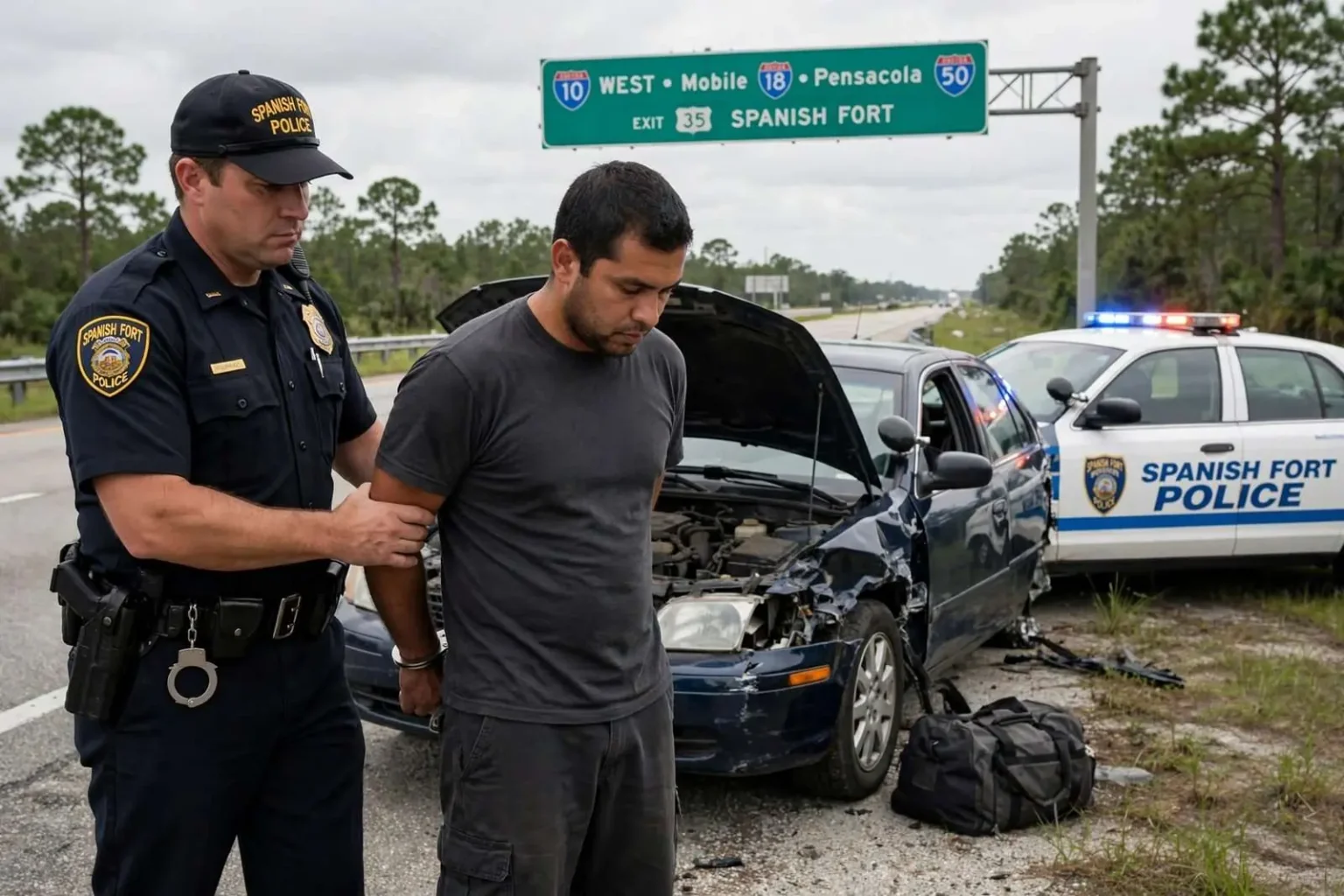
Spanish Fort police arrested a man wanted in connection with a Florida homicide in June 2008, according to a local station, after the suspect’s vehicle broke down along Interstate 10 in the Baldwin County city. Deputies alleged that Luis Vargas had shot and killed his business partner, Mariela Escudero, after an argument in Oakland Park, Florida — a break in the case that ended when the fugitive and his companion surfaced hundreds of miles from the crime scene.
Vargas and his niece were located after their vehicle broke down off Interstate 10 in Spanish Fort, the growing Baldwin County city that sits along one of the Gulf Coast’s principal east-west highways. What might have passed as an ordinary disabled vehicle call instead connected Alabama officers to one of South Florida’s wanted cases.
The Allegations in Oakland Park
According to deputies, the events that led to the manhunt began with an argument in Oakland Park, a city in Broward County just north of Fort Lauderdale. Investigators alleged that Vargas shot and killed Mariela Escudero, his business partner, during or after the dispute. The allegation transformed a business relationship into the central thread of a homicide investigation, with detectives working to establish the circumstances that preceded the shooting.
As is standard in such cases, the account of the killing came from investigators’ allegations at the time of the arrest. The charge Vargas faced — murder — carried with it the full machinery of the Florida criminal justice system, beginning with his expected return across state lines to answer it in court.
The Breakdown on Interstate 10
The break in the case came not from a tip or a stakeout but from a broken-down vehicle. Vargas and his niece were located after their car gave out off Interstate 10 in Spanish Fort, placing them in the path of local police. When officers ran the details of the men and women at the scene, the connection to the Florida homicide case emerged, turning a roadside stop into an arrest on an out-of-state murder warrant.
Spanish Fort’s location explains the encounter’s likelihood more than coincidence does. The city sits directly on the Interstate 10 corridor that runs from Florida’s Panhandle across the Mobile Bay area toward Mississippi, and Baldwin County communities along the interstate routinely handle stranded travelers, traffic stops, and the occasional fugitive passing through.
The Niece’s Role and Charges
Police said the niece who was traveling with Vargas was initially identified as a missing person, a status that added confusion to the early hours of the encounter. Once investigators sorted out the relationship between the two and their movements after the Florida killing, the picture changed: the niece was held in Baldwin County on a charge of hindering the investigation, while Vargas himself awaited return to Florida.
Charges of hindering prosecution apply when someone allegedly helps a wanted person evade capture — through concealment, false information, or assistance in flight. Such cases turn on what the accused knew and when, and they are adjudicated separately from the underlying offense. The niece’s case, like Vargas’s, would proceed through the Baldwin County court system.
Extradition and the Road Back to Florida
Vargas was expected to return to Florida to face a murder charge, a process governed by the interstate extradition framework that moves accused fugitives from the state of arrest to the state that holds the warrant. In practice, that means an initial appearance before an Alabama judge, arrangements between the two states’ governors’ offices, and transport by authorities from Broward County to South Florida.
For the Oakland Park investigation, the arrest in Spanish Fort meant the case could move forward — from a manhunt to a prosecution. Investigators in Florida would have worked to assemble the evidence supporting the murder charge, while the defendant’s legal process began with counsel, arraignment, and the long timeline that homicide cases follow through the courts.
Spanish Fort in 2008
The arrest landed in a city that was, at the time, one of the fastest-growing communities in Alabama. Spanish Fort, perched on the east side of Mobile Bay, had transformed over the previous two decades from a quiet crossroads into a retail and residential hub anchored by its shopping centers and its position along Interstate 10. Its police department had grown with the city, handling everything from suburban property crimes to the unexpected — like a fugitive from a South Florida homicide stranded at the edge of town.
Baldwin County as a whole sits along the routes that connect Florida’s Panhandle to the rest of the Gulf South, and its law enforcement agencies are used to the traffic that flows through. Interstate 10, U.S. 98, and the beach highway corridors put a steady stream of out-of-state vehicles in front of Baldwin County officers, and cases like this one illustrate how local police work can intersect with investigations that begin far away.
Business Partner Homicides and Their Investigations
Homicides between business partners occupy a distinct category in criminal investigation. Unlike random violence, these cases involve a documented relationship, financial entanglements, and a history that investigators can reconstruct through records, interviews, and the accounts of those who knew both parties. Detectives typically examine the business’s finances, recent disputes, and communications between the partners to build a picture of what led to the killing.
Deputies alleged that an argument preceded the shooting of Mariela Escudero in Oakland Park, and establishing the substance of that dispute would have been central to the state’s case. Florida prosecutors treat such killings with the same seriousness as any homicide, and a suspect’s flight from the state is typically presented as evidence of consciousness of guilt.
Fugitive Cases and Interstate Cooperation
The path from a Broward County homicide to a Baldwin County arrest runs through the cooperation networks that link American law enforcement. Wanted bulletins circulate through state and national databases, so that when an officer anywhere runs a name, a warrant from another state appears. That system is what allowed a routine encounter with a disabled vehicle in Spanish Fort to become an arrest in a Florida murder case within moments.
Once the connection was made, the mechanics took over: confirmation of the warrant with Florida authorities, detention in the Baldwin County jail, and the extradition process that would carry the defendant back south. Cooperation between agencies in different states is routine in fugitive cases, but each one depends on the local officer’s attention to detail — the check that turns a stranded motorist into a suspect in custody.
A Historical Account
This account reflects the law-enforcement allegations and charges reported in 2008, as covered by a local station at the time. It does not state final court outcomes, and readers should understand that allegations and charges are not findings of guilt. The criminal justice process that followed — extradition, court proceedings, and any resolutions — occurred in the years after the arrest and in the forums where such determinations are made.
What the episode documented at the time was the moment of capture: a suspect in a Florida homicide, located with his niece after their vehicle broke down off Interstate 10 in Spanish Fort; a woman initially identified as a missing person, held in Baldwin County on a hindering charge; and a man expected to return to Florida to answer a murder allegation in the death of his business partner, Mariela Escudero, in Oakland Park.
How Missing-Person Identifications Unravel
The niece’s initial identification as a missing person reflects a common feature of fast-moving fugitive cases. When someone disappears in connection with a crime — willingly or not — police enter that person as missing until the circumstances clarify. The status triggers a wider net of attention, from patrol officers to media appeals, and it often produces the first leads in a case.
In this instance, the missing-person status ended once investigators determined the relationship between the woman and Vargas and her role in the days after the Oakland Park killing. The shift from missing person to defendant happened quickly, and the hindering charge filed in Baldwin County reflected prosecutors’ judgment about her alleged participation in the flight from Florida.
The I-10 Corridor’s Role in Gulf Coast Crime
Interstate 10 shapes law enforcement across the Gulf South. The highway carries millions of travelers through the Panhandle, across Mobile Bay, and onward toward Mississippi, Louisiana, and Texas, and it funnels fugitives, smugglers, and ordinary motorists alike through the jurisdictions that line it. Police departments along the corridor, Spanish Fort among them, train for the encounters that result — from traffic stops that uncover contraband to breakdowns that uncover fugitives.
Baldwin County’s position just across the state line from Florida makes it the first Alabama stop for anyone fleeing westward from the Pensacola area or deeper into Florida. Deputies and municipal officers there maintain close working relationships with their Florida counterparts, and cases that cross the line in either direction move through those channels routinely.
Remembering the Victim
Accounts of fugitive arrests inevitably center on the capture, but the case itself revolved around Mariela Escudero, the business partner whose killing in Oakland Park set everything in motion. Homicide investigations exist, first and foremost, for victims and the families left to seek accountability through the courts. The argument deputies alleged, the flight that followed, and the arrest in Alabama were all chapters in the response to that loss.
The arrest in Spanish Fort in June 2008 ensured that the case against Luis Vargas would be resolved in a courtroom rather than ended by an unsolved file. Whatever the courts ultimately determined, the episode stands as a record of how a killing in South Florida, a broken-down car on Interstate 10, and the work of Baldwin County officers converged on a single day.