
Speeding stop in Elsanor leads to meth, counterfeit money arrests
A speeding stop in Elsanor led Baldwin County deputies to 3.2 pounds of meth, counterfeit cash and a fugitive from Georgia.
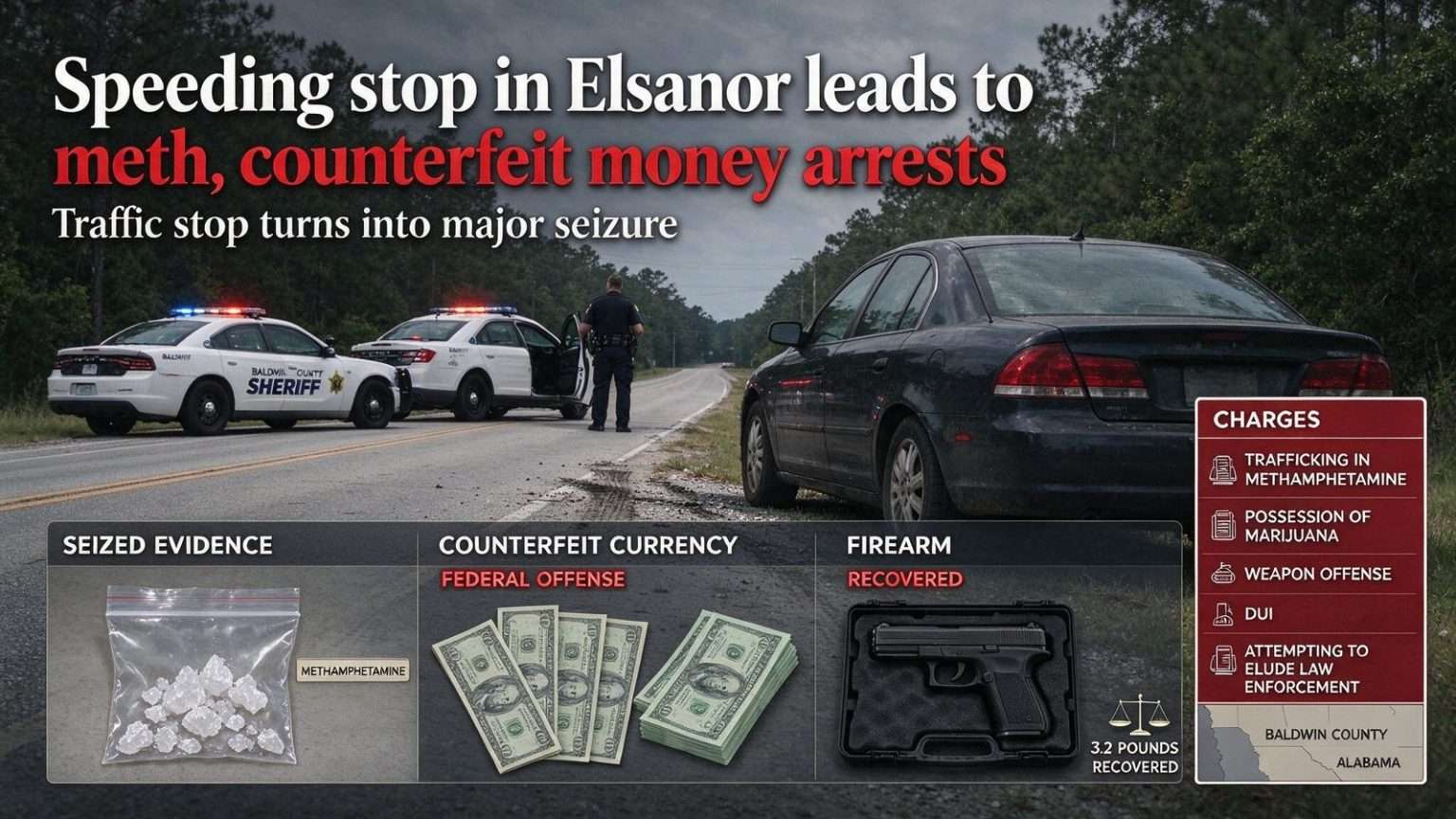
A routine traffic stop in the Baldwin County community of Elsanor turned into a major arrest Wednesday after a driver refused to pull over, setting off a pursuit that ended with more than three pounds of methamphetamine, counterfeit cash and a loaded pistol out of circulation. According to the Baldwin County Sheriff’s Office, deputies tried to stop a driver for speeding when the man took off, transforming what begins as one of law enforcement’s most ordinary encounters into one of the county’s larger drug seizures of the season.
The man was identified as Christopher Garett of Cartersville, Georgia, a north Georgia city northwest of Atlanta. Deputies initiated the stop for speeding along the Elsanor community, a small settlement in southern Baldwin County near the Florida line, where U.S. Highway 98 carries commuter and beach-bound traffic between the inland communities of the county and the Perdido Bay area. Instead of yielding, Garett accelerated and a pursuit began, deputies said.
The chase ended not in a crash or a barricade but at the side of the road with a dead engine: Garett’s vehicle developed engine trouble, leaving him no choice but to stop. Deputies took him into custody without further incident and turned to the search that followed, which quickly revealed the run was about far more than speeding. A search of the car turned up 3.2 pounds of methamphetamine, counterfeit currency, marijuana and a pistol, according to deputies.
From traffic stop to trafficking case
The methamphetamine find alone transforms the case’s legal landscape. Under Alabama law, trafficking in controlled substances is triggered by quantity — possession of a specified weight of methamphetamine moves a case from simple possession into trafficking territory, a felony that carries much steeper potential prison time than possession charges. At 3.2 pounds, the amount recovered in Elsanor sits far above the statutory threshold, and quantity of that scale typically signals distribution rather than personal use — the kind of load, investigators note, that moves along the interstate corridors connecting Gulf Coast drug markets with cities across the Southeast.
The counterfeit currency adds a federal dimension. Counterfeiting is a federal offense investigated by the U.S. Secret Service, and the agency’s writ covers both the manufacture and the passing of fake bills. Garett’s federal warrants for counterfeiting and drug conspiracy mean that even as Baldwin County prosecutors handle the state charges, federal authorities have their own claims on him — a common arrangement in cases that cross the line from local possession into organized currency fraud and narcotics networks spanning state lines.
The other recovered items round out a picture that prosecutors will present as a mobile distribution operation. The marijuana supports a first-degree possession charge, Alabama’s more serious possession offense, which applies to larger quantities or certain aggravating circumstances. The pistol — allegedly carried without a permit, as Alabama’s permit requirement stood at the time — pairs with the drugs under statutes that treat armed drug activity as an aggravator. And the charges of driving under the influence and attempting to elude law enforcement flow directly from the events of Wednesday afternoon: the impaired driving that allegedly prompted the original observations and the flight that turned a roadside stop into a pursuit.
Garett faces charges including trafficking in methamphetamine, first-degree possession of marijuana, possession of a concealed weapon without a permit, driving under the influence and attempting to elude law enforcement. He also has federal warrants for counterfeiting and drug conspiracy and is being held at the Baldwin County Correction Center, the county jail in Bay Minette that houses defendants awaiting trial as well as inmates serving county sentences. His federal warrants mean he may ultimately be transported to federal custody or answer federal charges in Alabama’s Southern District before state proceedings resume — a sequencing question prosecutors coordinate through detainers.
Elsanor and the geography of Gulf Coast interdiction
The location of the stop is worth understanding. Elsanor sits in the southern reaches of Baldwin County, one of Alabama’s fastest-growing counties and a long, mostly rural stretch between Mobile Bay and the Florida state line. The community lies along the U.S. 98 corridor, a highway that runs from the Mobile area through Fairhope, Daphne and the county’s southern communities before crossing toward Pensacola. That corridor — combined with the region’s broader road network of Interstates 10 and 65 — makes Baldwin County a regular pathway for narcotics moving between the Gulf Coast ports, Atlanta, New Orleans and Florida’s population centers.
Sheriff’s deputies in Baldwin County patrol that territory with an eye toward exactly this kind of encounter. A speeding violation is among the most common justifications for a traffic stop, and stops of that kind have historically produced a substantial share of the region’s drug interdictions, since couriers moving large loads tend to accumulate the minor violations — speeding, lane changes, expired tags — that first draw an officer’s attention. The difference between the two outcomes usually comes down to the driver’s decision at the moment the blue lights come on.
When a driver flees instead, the calculus changes for everyone on the road. Pursuits through the two-lane stretches of southern Baldwin County pose risks to oncoming traffic, to the deputies running them and to the fleeing driver — which is why agency pursuit policies govern when a chase continues and when it must be abandoned. In this case, the pursuit resolved itself when the vehicle’s engine gave out, sparing the county the more dangerous endings that pursuits sometimes reach.
What happens next
Garett’s case now moves through the intake process at the Baldwin County Correction Center, where he will remain held pending an initial appearance before a district court judge on the state charges. Bond for trafficking-level methamphetamine charges is set by a judge rather than a schedule, and the presence of federal warrants complicates release decisions — a defendant with federal detainers typically will not be released on state bond while the federal system asserts its claim.
The counterfeit currency component also triggers a routine that local agencies know well: notifying the Secret Service field office with jurisdiction over the Alabama Gulf Coast and turning over the recovered bills as evidence. Fake currency recovered in a local arrest often connects to a larger passing operation — bills moved through retail stores, gas stations and individual sellers — and federal investigators use those recoveries to map networks that no single county can reach alone.
For residents of Elsanor and the surrounding communities, the arrest is the visible half of a workload that continues after the news cycle. Deputies complete evidence processing, file reports that prosecutors will build charges from, and coordinate with the district attorney’s office on the trafficking prosecution. The methamphetamine recovered will be destroyed after analysis, the pistol held as evidence, and the counterfeit bills sent onward to federal experts who can compare them against known bogus issues.
The case is also a data point in the longer story of methamphetamine’s grip on the region. The Gulf South has battled meth markets for two decades, and the drug now most commonly arrives in the area in wholesale quantities from Mexican trafficking organizations rather than in local home labs, which enforcement largely dismantled years ago. Quantities like the 3.2 pounds recovered in Elsanor reflect that shift — loads sized for redistribution across multiple counties, moved by drivers passing through on the region’s highways.
The arrest also illustrates the resource math behind rural drug enforcement. A single traffic stop can consume hours of deputy time — the pursuit itself, the vehicle search, evidence inventory, transport and booking — and cases of this size bring lab analysis demands that stretch across weeks. Sheriffs’ offices along the Gulf Coast have responded by pairing road patrol with drug interdiction training, so that the deputy who notices the nervous driver on U.S. 98 knows exactly what to document, what questions to ask and what steps preserve the case for prosecutors. Those details matter: trafficking prosecutions rise or fall on the legality of the stop, the search and the chain of custody, which is why the uneventful-looking paperwork that follows an arrest like Wednesday’s often determines the outcome more than the dramatic moments on the highway.
Law enforcement officials across Baldwin County regularly ask residents to report suspicious activity, noting that tips about trafficking, drug sales and counterfeit currency have repeatedly fed cases that begin or end on the county’s highways. As for the stretch of U.S. 98 where the pursuit began and ended, it goes back to being what it usually is: a quiet connector between small communities, patrolled by deputies whose routine traffic stops occasionally turn into something much bigger.
Garett’s state charges will be presented to the Baldwin County District Attorney’s office for prosecution, and his appearance in federal court on the counterfeiting and drug conspiracy warrants will follow the coordination between the two systems. Until then, the traffic stop that a Cartersville, Georgia, driver tried to flee stands as a reminder that the smallest decisions — a foot on the accelerator at the wrong moment — can determine whether a case ends as a speeding ticket or as a trafficking prosecution.