Collier Signs the Bayou La Batre Contract, Citing a Gas Hub and 400 Construction Jobs
State Rep. Spencer Collier signed a one-year, $52,000 contract to coordinate economic development for Bayou La Batre and said he was already working on a natural gas storage hub that could bring 400 jobs.
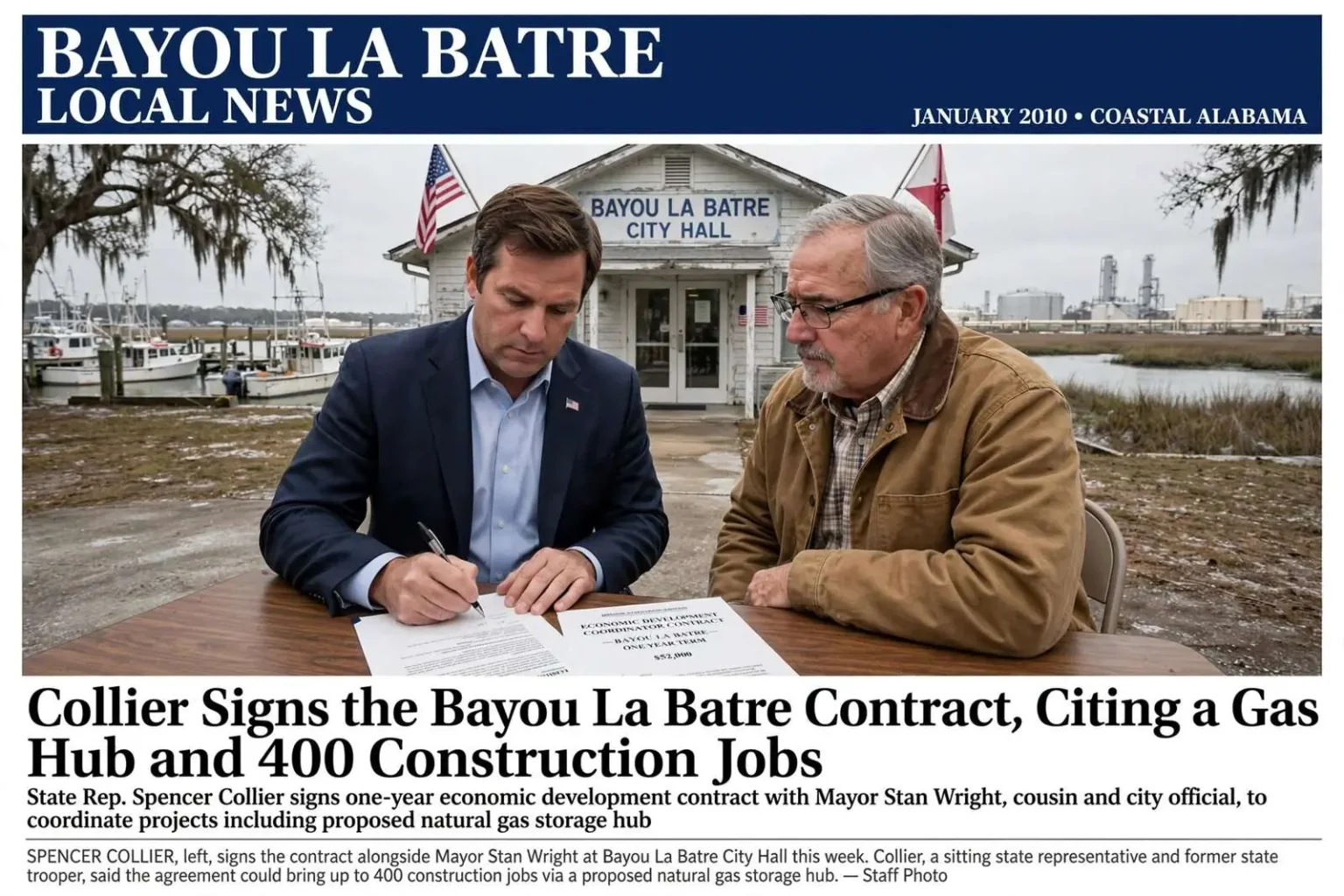
State Rep. Spencer Collier signed a one-year contract this week to coordinate economic development for the city of Bayou La Batre, formalizing an arrangement that had been reported in outline in the closing days of December. The contract pays $52,000 a year. For a small city with a small budget, it was a significant line item — and for the legislator taking the job, it was the beginning of a year that would be examined more closely than either man expected.
The Bayou La Batre City Council authorized Mayor Stan Wright last month to solicit the work, and Wright selected Collier. The two men are cousins. The relationship was acknowledged from the start, and it framed every question the contract raised: a mayor hiring a kinsman who also happened to be the district’s representative in Montgomery, for a position the mayor had been authorized to fill as he saw fit.
The projects
Collier said he was already at work on several projects, and he named one: a natural gas storage hub that he said could produce as many as 400 construction jobs beginning in the spring. Underground natural gas storage — typically in salt domes, of which coastal Alabama and Mississippi have several — is capital-intensive infrastructure that employs a large workforce during construction and a much smaller one afterward. The salt formations beneath the Gulf Coast geology are among the most favorable in the world for the purpose, which is why the region has long drawn storage and petrochemical investment other places cannot match.
For a town of a few thousand people whose principal industry was in decline, several hundred construction jobs for a season was not a small proposition. That distinction between construction employment and permanent employment is one that coastal Alabama had learned repeatedly. Bayou La Batre had spent the four years since Hurricane Katrina watching federal recovery money build houses and infrastructure, and watching the crews leave when the money ran out.
The city’s seafood industry — the fleet, the processing houses and the boatyards that had made Bayou La Batre famous as the “Seafood Capital of Alabama” — had taken Katrina’s full force in 2005, and the recovery that followed rebuilt some of it while leaving the underlying economics of the trade battered. Any prospect that promised to diversify the town’s employment base, even temporarily, was welcome at City Hall; the question was what, if anything, would remain standing when the construction season ended.
A gas storage hub would have fit a pattern the coast knew well. The industrial corridor that runs from Pascagoula through Mobile Bay had grown up on exactly this kind of facility — big projects, big construction payrolls, and permanent operating crews measured in dozens rather than hundreds. Whether that trade was worth making was the town’s decision to make, and the contract put Collier in the position of making the town’s case.
Leaving the law firm
Collier had been employed as a legal investigator for the Mobile firm of Cunningham Bounds, one of the best-known plaintiffs’ firms in the state. He said he and the firm were parting on good terms and that he would continue managing his cases until a replacement was hired. The move took him out of private employment entirely and into a single public-sector contract — the cleanest available version of the outside-employment question a part-time legislator faces.
He had spoken in recent months about the competing demands of the Legislature and outside employment — the standing dilemma of a body that is nominally part-time, meets for months at a stretch, and pays too little to live on. Alabama’s legislative salary made a second income a necessity for most members, and every member resolved that necessity differently: some kept businesses, some kept clients, and some, like Collier now, took positions with public entities in their own districts.
The council’s role in the hire was part of the public record from the beginning. By authorizing Wright to solicit the coordinator position rather than voting on a named contractor, the council left the choice to the mayor’s discretion — a common structure in small cities, where the council sets the terms and the mayor fills the role. It also meant that the cousin relationship, known to everyone involved, passed through the process without any formal check, because the law of the time provided none.
Bayou La Batre’s recovery politics were shaped by the same scale. Federal disaster money had flowed through the city in quantities the town’s own budget could never approach, but it arrived through channels — FEMA programs, community development block grants, state-administered recovery funds — that required applications, matches and advocates. A town without professional staff relied on whoever could work those channels, and the coordinator contract was, in essence, the city purchasing that capacity full time.
The seafood economy it was meant to supplement had its own timeline. Processing houses that survived Katrina operated on thinner margins, the fleet that remained was older, and the town’s workforce had dispersed as reconstruction jobs drew workers to better-paying trades. Every seasonal construction payroll, whether from a storage hub or a dredging project, pulled workers out of the packinghouses and made the town’s core industry harder to staff — one of the quieter tensions in any diversification scheme the coast attempted.
The contract’s one-year term also fit the way such arrangements were typically judged: by what could be shown after twelve months. A named project with a groundbreaking, a grant awarded, a prospect landed — these were the deliverables a town could point to. The structure put pressure on the coordinator to produce visible wins quickly, and it gave the council a natural decision point at renewal: keep the advocate if the pipeline showed results, or let the arrangement lapse quietly if it did not.
The questions the contract raised
A sitting legislator taking a paid position with a municipality in his own district, awarded by a mayor who is his cousin, invited obvious scrutiny. Nothing in Alabama’s ethics law as it then stood clearly barred the arrangement. Legislators routinely held outside jobs, including with public entities, and the practice had a well-worn nickname in Montgomery — the kind of arrangement members described as “double-dipping” and defended as harmless, usually in the same breath.
That framework was about to be dismantled. In a December 2010 special session, a newly Republican Legislature — with Collier among its members — passed an ethics package that sharply restricted legislators’ ability to hold public employment and tightened rules on lobbying and outside income. The arrangement Collier signed in January 2010 belonged to the last year of the old system, and its passage into history was one of the very reforms its signatory would vote for.
The irony was noted at the time and has been noted since: the man whose contract illustrated the old rules’ looseness helped write the new rules that would have prevented it. Supporters of the new law pointed to exactly such arrangements as the case for change — public payrolls quietly employing legislators, with the legislature’s own members the only judges of the conflict. The Bayou La Batre contract became, in small, the argument for the special session.
Collier’s trajectory
Collier, a former state trooper representing House District 105 in south Mobile County, was in the final months of his second term. Within eighteen months he would be appointed director of the Alabama Department of Homeland Security by Gov. Robert Bentley and would go on to lead the Alabama Law Enforcement Agency — a post from which his dismissal in 2016 would set in motion the events that ended Bentley’s governorship.
In January 2010, though, he was a legislator from the Bayou, taking a job in the Bayou, in a town that needed someone in Montgomery to answer its phone. The later career — the cabinet posts, the investigations, the role he played in the governorship’s collapse — lay ahead of him, unknowable to the council that authorized the hire and to the mayor who made it.
What the city was buying
The value of a development coordinator with a seat in the Legislature was not mysterious. Grant applications, appropriations, permitting, and the attention of state agencies all move faster when a member of the House is making the call. Whether that is a virtue of the arrangement or the problem with it was, and remains, a matter of opinion.
For Bayou La Batre, with a shrinking tax base, a battered seafood industry and a hurricane still visible in its streets, the calculation was not complicated. The city had spent years competing for attention in a state budget process crowded with larger cities and louder needs, and its recovery had depended on exactly the kind of advocacy a legislator-coordinator could provide. A $52,000 contract bought the town a full-time advocate with a direct line to the agencies that controlled the money — and, in the bargain, illustrated everything both right and wrong about how Alabama’s small towns had learned to get things done.
By year’s end the contract would expire on its own terms, the ethics law would change around it, and Bayou La Batre would still be a small town on the bay trying to replace an economy the water had taken. The gas storage hub, the grants and the rest of the coordinator’s agenda became part of that continuing story — a story in which, for one year, the town’s advocate and its representative were the same man.