Spring Hill Avenue Church, Still Repairing Hurricane Damage, Plans Easter Celebration at Home Base
Spring Hill Avenue United Methodist Church, displaced since Hurricane Sally, returns to its Mobile building for an Easter Egg-stravaganza and sunrise.
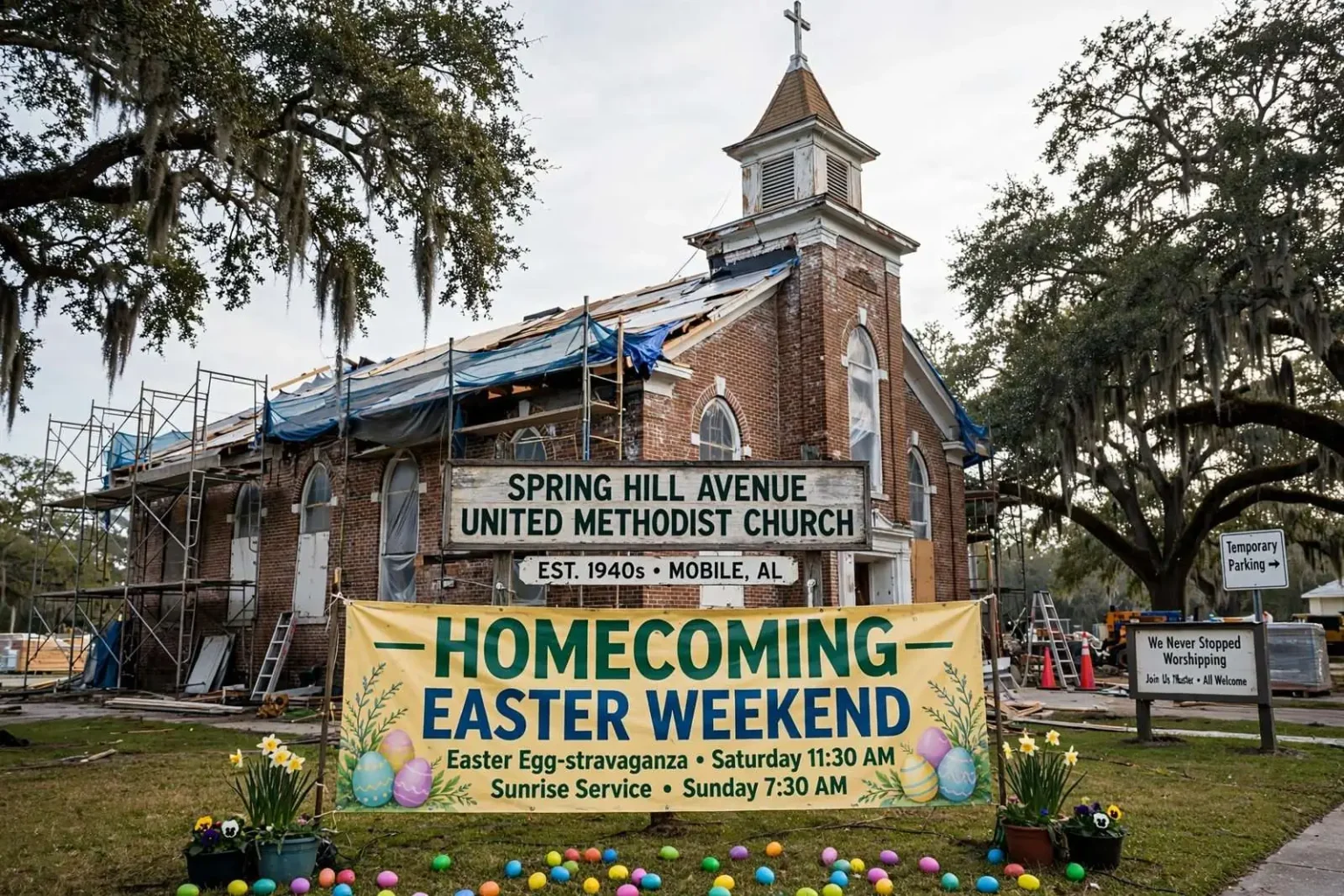
MOBILE, Ala. — More than a year and a half after Hurricane Sally tore shingles from its roof, Spring Hill Avenue United Methodist Church is still working out of a temporary location — but the congregation plans to return to its historic building this Easter weekend. For a church whose members have spent the better part of two years watching repairs crawl forward, the homecoming carries a significance that goes well beyond a change of address.
The church’s building dates to the 1940s, according to the Rev. Micah Wright. Structures of that era have weathered plenty of Gulf Coast storm seasons, and when Sally swept through in 2020, church leaders surveyed the grounds, spotted missing shingles but no obvious structural harm, and filed an insurance claim expecting a routine repair. At first glance, the storm’s signature on the property seemed minor — the kind of damage that would be resolved with a roofing contractor and a few weeks of scheduling.
Hidden Damage Revealed
Then Hurricane Zeta struck just weeks later, and contractors began uncovering how extensive the hidden damage really was. Wright said wind worked its way beneath the structure and lifted it just enough to crack the building itself. The discovery transformed a routine claim into a major restoration project: damage that was never visible from the yard turned out to run through the bones of a building that had stood on Spring Hill Avenue for decades.
The experience is one that Gulf Coast property owners know well. Hurricanes frequently cause damage that does not present immediately — wind-driven moisture, uplift stress on framing and foundations, and structural shifting that only reveals itself as repairs progress. For a building of the church’s age, each opened wall or replaced section can expose new questions about what the storms moved and what it will take to put right.
While the exterior damage appeared minor at first glance beyond rattled single-pane windows, the underlying problems have multiplied during repairs. Construction has hit repeated setbacks, though current estimates point to completion in August. In the meantime, the congregation has continued meeting at a temporary site, holding services, classes and its regular life of ministry away from the property where most of its members were used to gathering.
An ‘Egg-stravaganza’ to Come Home For
With repairs dragging on, church leaders decided to make Easter weekend a full-scale homecoming. The festivities begin Saturday with an “Easter Egg-stravaganza” at 11:30 a.m., followed by an Easter Sunrise Service Sunday at 7:30 a.m., both at the church’s Spring Hill Avenue property. The Saturday event is aimed squarely at families and neighbors — the kind of community celebration churches across Mobile use each spring to open their doors wide — while the sunrise service draws on one of the oldest traditions in Christian practice, held in the early light of the most significant morning on the church calendar.
Choosing to hold both events on the church grounds, rather than at the temporary site, is itself a statement. The property may still show the scars of the two hurricanes, but returning to it for the congregation’s most important weekend of the year makes the recovery visible. Members will worship in the place where funerals were held, children were baptized and generations of Easter Sundays have been marked, even while work continues around them.
Wright said the message behind going all-out is simple: the congregation is still here, still loves its community, and wants neighbors to be part of everything the church offers during the recovery. That framing turns the Easter celebration into something more than an internal milestone. It is an invitation to the Spring Hill neighborhood to see the church not as a construction site with a congregation attached, but as a living institution that never stopped operating through one of the more disruptive stretches in its history.
A Long Road for Gulf Coast Churches
The church’s ordeal is a familiar one for houses of worship along the Alabama and Florida Gulf Coast. Hurricanes Sally and Zeta arrived within weeks of each other in 2020, and both left behind damage that insurers, contractors and congregations spent years sorting out. Roof repairs in particular proved slow across the region, as demand for contractors surged, material costs climbed, and insurance claims grew more complicated once adjusters looked beyond surface-level damage. Churches that deferred maintenance or discovered hidden structural issues often found themselves worshipping in fellowship halls, borrowed sanctuaries or temporary quarters while funding and schedules caught up with the scope of the work.
For congregations, the disruption reaches beyond the sanctuary. Church buildings host weeknight programs, community meetings, preschools and food ministries, and every month spent in a temporary location ripples through those activities. Congregations that weather such stretches successfully tend to be the ones that keep their community rhythms going regardless of the address — a pattern Spring Hill Avenue United Methodist Church has clearly tried to follow.
The Easter weekend plan reflects another reality of church life: the calendar does not wait for construction. Easter is the anchor of the Christian year, and for a congregation displaced since 2020, celebrating it on its own grounds — even amid scaffolding and unfinished work — restores a sense of place that no temporary site can quite replicate.
What Neighbors Can Expect
Both events are open to the community, and the church has framed the weekend as an opportunity for neighbors who may not have a church home to see what the congregation does. The Saturday “Egg-stravaganza” begins at 11:30 a.m., giving families a midday activity, and the Sunday sunrise service begins at 7:30 a.m. on the church’s Spring Hill Avenue property. Attendees should expect the weekend to carry the tone Wright described — gratitude for the congregation’s survival, confidence in its future, and a welcome extended to the surrounding neighborhood that has watched the repair work drag on for more than a year and a half.
If the current estimate holds and construction wraps in August, the Easter homecoming will serve as a preview of a fuller return: regular services back in the historic sanctuary, programs back in their usual rooms, and a 1940s-era building restored for whatever storm seasons come next. For now, the congregation is content to mark the weekend where it belongs — home.
Two Storms, Weeks Apart
Understanding how a missing-shingles claim became a structural restoration requires looking at the sequence of the 2020 hurricane season. Hurricane Sally came ashore near Gulf Shores in mid-September as a slow-moving Category 2 storm, and its prolonged winds peeled roofing material across a wide swath of coastal Alabama — Mobile included. When church leaders walked the grounds afterward, the evidence they could see was confined to the roofline: missing shingles, rattled single-pane windows, nothing that suggested the building underneath had been compromised. The insurance claim they filed reflected exactly that picture.
Hurricane Zeta then struck just weeks later, in late October, cutting across the New Orleans area and raking southeastern Louisiana and coastal Alabama on its way inland. For a building whose roof had already been stripped, Zeta’s winds had a direct path into the structure. Wright said wind worked its way beneath the structure and lifted it just enough to crack the building itself — the kind of movement that no exterior survey would have caught, but that contractors uncovered as they began the repair work the congregation had expected to be routine.
That discovery changed everything about the project’s scale. What began as a shingle replacement became an effort to address structural cracks, and each stage of the repair revealed additional work that had to be completed before the next could begin. Repeated setbacks followed — the cumulative effect of hidden damage, contractor availability, material costs and the ordinary delays of restoring a decades-old building to code and condition.
Ministry Without a Building
Through it all, the congregation has kept meeting. The temporary site has hosted worship and the church’s ongoing programs while the sanctuary on Spring Hill Avenue sat in various states of repair, and the continuity matters to members who joined the church not for a building but for the community inside it. Churches across the Gulf Coast that survived major storms often point to exactly this stretch — the long middle between the storm and the reopening — as the period that tests whether a congregation holds together.
Wright’s emphasis on inviting neighbors into the recovery fits that experience. A church that spends a year and a half in temporary quarters can either go quiet or stay present, and Spring Hill Avenue United Methodist Church has chosen the latter, using the Easter weekend as both a celebration and a public declaration that the disruption is temporary while the congregation is not. With completion currently estimated for August, the “Egg-stravaganza” and sunrise service will be the first events held on the property as the end of the repair saga finally comes into view.