St. Luke’s Episcopal School Brings Students, Parents Together for ‘Dangers of Vaping’ Talk
St. Luke's Episcopal School in Mobile hosted pulmonary specialists and DA Ashley Rich's warning about teen vaping at a required student-parent event.
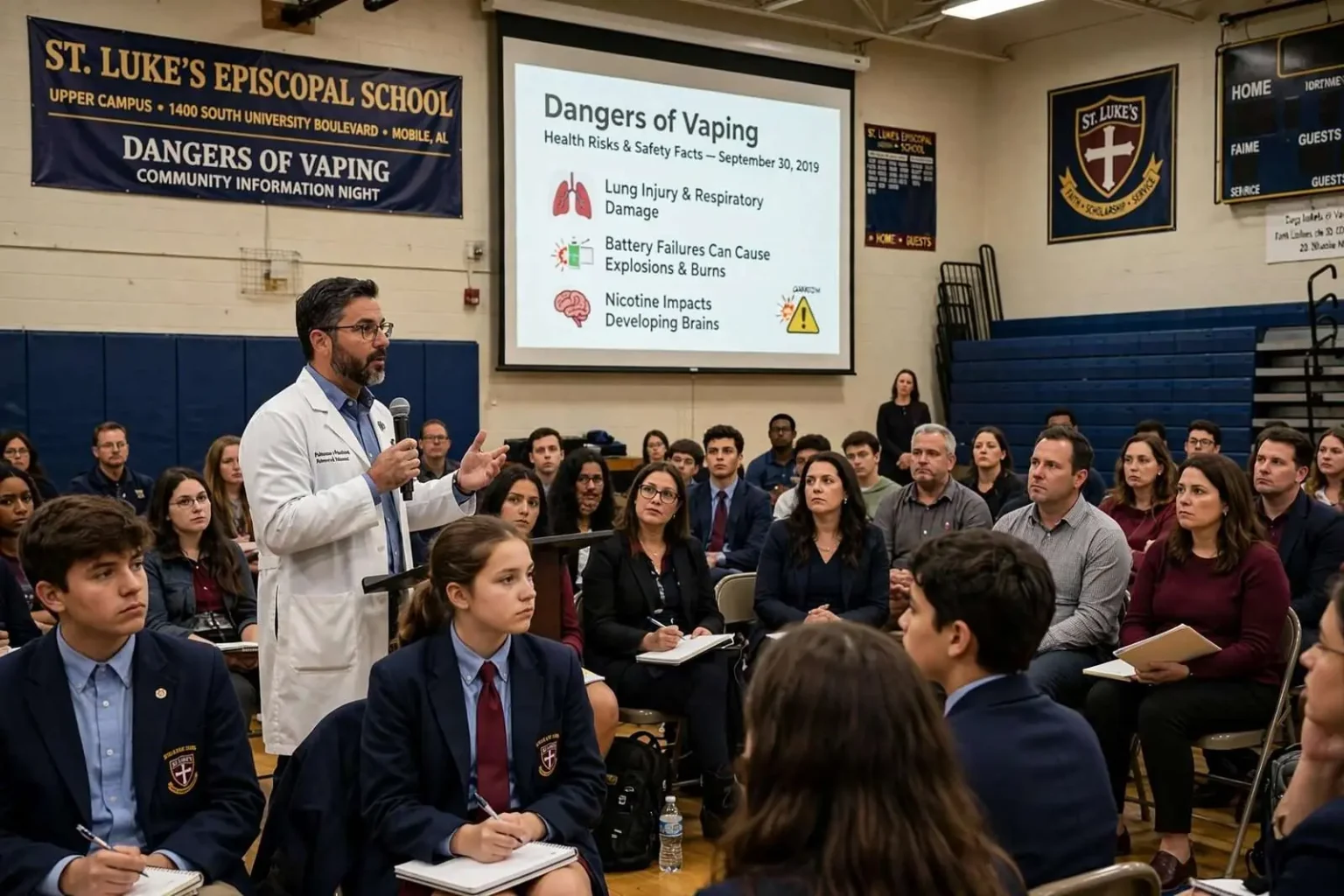
MOBILE, Ala. — St. Luke’s Episcopal School gathered students and parents on the evening of Sept. 30, 2019, for a presentation called “Dangers of Vaping,” as concerns about teenage e-cigarette use swept across the Gulf Coast and the country. Medical professionals from Pulmonary Associates led the discussion at the school’s upper campus at 1400 South University Boulevard.
Attendance was required for all ninth- through 12th-graders, and parents of middle school students were encouraged to come along. The format put the people who prescribe for damaged lungs in front of the people most at risk of developing the habit — and made the evening as much a conversation between generations as a lecture.
The timing was no accident. By the autumn of 2019, e-cigarette use among American teenagers had surged to the point that federal health officials were tracking a national outbreak of severe lung injuries tied to vaping, and schools across Mobile County and the rest of Alabama were scrambling to respond. Devices had changed faster than the adults around them could keep up: sleek, pocket-sized, flavored, and in many cases designed to be mistaken for everyday objects. A private school on Mobile’s west side deciding to require its high schoolers and their parents to sit through an evening on the subject reflected how quickly the concern had moved from national headlines to local hallways.
‘If they really understood, they would stop’
For the students in the room, some of the night’s most lasting impressions came from facts that had not made it into the rumors that circulate among teenagers. Seventh-grader Megan McDonough said one fact from the presentation stood out to her.
“I did not know that vapes exploded, and that scares me a lot,” she said. “If they really understood what could happen to them, they would stop.”
Her comment about explosion risk touched on one of the less-discussed dangers of the devices. E-cigarettes run on lithium-ion batteries — the same class of battery that has periodically made headlines when it overheats — and faulty devices, damaged batteries, or improper charging have caused burns and fires. For a middle schooler, the idea that a device could catch fire in a pocket or a backpack was evidently more persuasive than any abstract warning about long-term health effects.
The second half of her remark — that students who really understood the risks would stop — is the bet every prevention program of this kind makes. School officials and presenters alike have long observed that scare tactics without information tend to bounce off teenagers, while concrete, specific facts about what a device does to the body tend to land. The Pulmonary Associates professionals who led the evening brought the perspective of physicians who see lung disease up close, and could describe in plain terms what inhaled aerosols, nicotine, and the chemicals in vaping liquids do to airways that are still developing.
The district attorney in the room
Among the parents in the room was Mobile County District Attorney Ashley Rich, who said she had no role in organizing the event but was glad it was happening. Her presence underscored that the vaping question in Alabama is not only a medical issue but a legal one, with enforcement dimensions that reach deep into the schools.
“If you don’t know what’s in it, it shouldn’t be ingested into your body,” Rich said.
Her warning captured one of the central frustrations that health officials and law enforcement leaders voiced during the 2019 wave of concern: many vaping products on the market carried labels that gave little real information about what they contained, and the national lung-injury outbreak had made the consequences of that uncertainty vivid. A district attorney sees the problem from a different angle than a pulmonologist — the ease of access, the marketing, the way the products move through the underage economy — but on the evening’s central point, the two perspectives agreed.
Rich warned that vaping was reaching students far younger than high school. “We’re seeing as early as elementary and middle school young people beginning to vape,” she said, pointing to how easily the devices are obtained and how well they disguise themselves — “it looks just like an Apple Watch, and it is a vape.”
Devices designed to hide
The comparison Rich drew — a vaping device that “looks just like an Apple Watch” — pointed to the challenge that made 2019 the year schools across the country rethought their approach. The newest generation of e-cigarettes had been engineered, whether by intent or by market pressure, to be unobtrusive: slim bodies, matte finishes, USB charging, and none of the telltale cloud of vapor that gave earlier devices away. Teachers trained to spot a cigarette lighter or a pack of cigarettes found themselves unable to distinguish a nicotine device from a flash drive or a piece of jewelry.
For parents, that meant the warning signs they had been taught to watch for were largely obsolete. A student could carry a device through a school day, use it in a bathroom or a bedroom, and leave no odor of smoke behind, because e-cigarettes produce an aerosol rather than smoke and many flavored liquids leave little scent. Prevention educators spent much of 2019 teaching adults what the devices actually look like — the night at St. Luke’s being exactly that kind of exercise — because a parent who cannot recognize the product cannot intervene in time.
The ease of obtaining the devices compounded the problem. Rich’s observation that the products reached students “as early as elementary and middle school” reflected what school resource officers and prosecutors around Mobile County were reporting: despite age restrictions, the devices circulated through social circles, resold or given away by older teens, ordered online, or purchased from retailers willing to look the other way.
Where the law stands in Alabama
She also reminded families where the law stands in Alabama: it is illegal for anyone under 19 to possess a vape, and illegal for stores to sell to anyone under that age. Alabama’s threshold runs higher than the 18-year-old standard most states used for tobacco at the time, a distinction that matters for enforcement in a state where prosecutors have generally leaned on education and diversion for young offenders but do treat underage possession as an offense.
For retailers, the sale prohibition puts the responsibility at the counter. Clerks are required to verify age before selling any vaping product, and stores that sell to underage buyers face penalties. For students, the possession prohibition means that a device found in a backpack is not merely a matter for a principal’s office — it can involve law enforcement, particularly in a county where the district attorney’s office has made youth vaping a stated concern.
That legal backdrop is also why the district attorney’s presence at a school event carried weight. Enforcement alone has never been able to keep a product out of teenagers’ hands, as generations of tobacco enforcement showed; the officials involved in the St. Luke’s evening were effectively arguing that the combination of law, medical information, and parental awareness is what moves the numbers.
Why schools hold these nights
St. Luke’s decision to require its ninth- through 12th-graders to attend — and to invite the parents of middle schoolers — reflected a deliberate strategy. High school students are the demographic with the highest vaping rates, but the habits often begin earlier, which is why the school aimed the encouragement at middle school parents as well. An evening presentation that puts both groups in the same room ensures that the families of students who have not yet encountered the devices hear the same information as the families of students who already have.
The pairing of medical professionals from Pulmonary Associates with a question-and-answer format gave parents access to expertise they would otherwise need an appointment to consult. Questions that circulate anxiously among parents — what the devices contain, whether they are addictive, what the symptoms of vaping-related lung injury look like, how to talk to a teenager who insists the products are harmless — were addressed directly by physicians who treat respiratory disease for a living.
McDonough’s takeaway — that she had not known vapes could explode, and that the fact frightened her — was precisely the kind of outcome the organizers were after. Prevention programming rarely produces a dramatic moment; its success is measured in the accumulation of facts that change a student’s next decision. A seventh-grader leaving the gym knowing more than she did when she walked in is the intended product of the evening.
The broader picture
The St. Luke’s event took place amid a national reckoning over e-cigarettes. Health officials had reported a rising toll of severe lung injuries associated with vaping, the federal government was moving to tighten regulation of flavored products, and lawsuits and investigations were multiplying across the industry. Mobile County’s experience mirrored the national one: devices marketed as a safer alternative for adult smokers had instead found their most enthusiastic market among teenagers who had never smoked at all.
Against that backdrop, an evening at a west Mobile school can look small. But the local version of the national response happens one gymnasium at a time — a pulmonologist with a slideshow, a district attorney with a warning, a seventh-grader with a new fact to carry home. St. Luke’s required the students to be there; the hope, in the words of the student who summed up the evening, is that “if they really understood what could happen to them, they would stop.”