State Rep. Napoleon Bracy Named Co-Chair of Mobile County Legislative Delegation
State Rep. Napoleon Bracy Jr. of Prichard has been elected co-chair of the Mobile County Delegation, sharing leadership of the group with Rep. Victor Gaston as lawmakers head into a new legislative session in Montgomery.
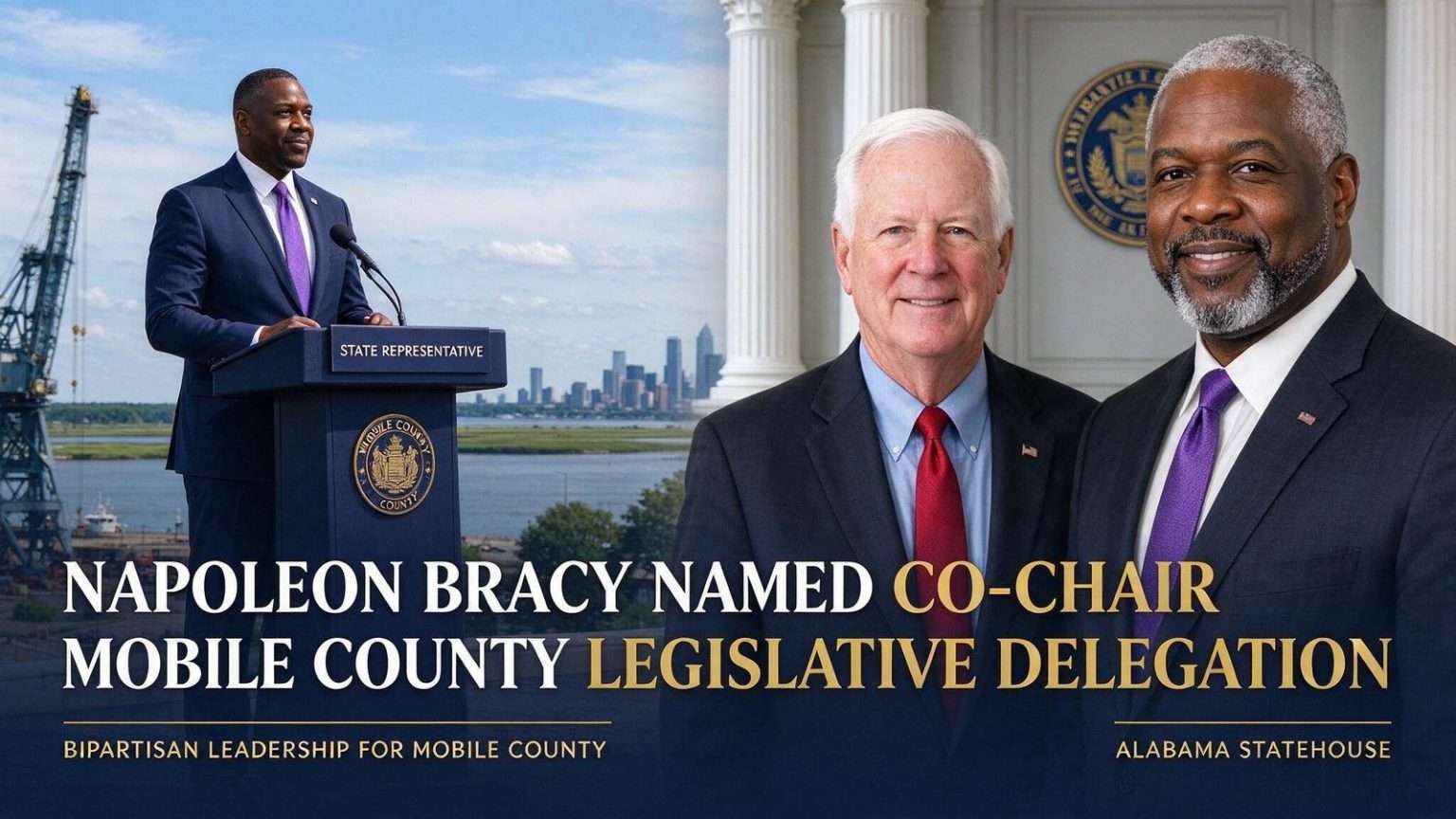
State Rep. Napoleon Bracy Jr. has been elected co-chair of the Mobile County Delegation, the group of state legislators who represent Mobile County in the Alabama House of Representatives and Senate.
Bracy, a Democrat from Prichard, will share leadership of the delegation with Rep. Victor Gaston, a Republican from Mobile, giving the county’s legislative representatives bipartisan leadership heading into the new session in Montgomery. “I’m honored to serve the delegation and citizens of Mobile County in this key role,” Bracy said after the vote. “When we work together as a cohesive delegation, we are most effective for our citizens. I appreciate my colleagues’ confidence in me and look forward to helping guide our area’s legislative priorities to ensure our communities are well represented in Montgomery.”
The election of two co-chairs from opposite parties is more than a ceremonial arrangement. County delegations in Alabama wield real power, particularly over local legislation, and a delegation that speaks with a divided voice can see its hometown priorities stall in the Statehouse. Pairing a Democrat from one of the county’s largest cities with a Republican veteran of the House signals to the rest of the Legislature that Mobile County’s representatives intend to negotiate as a bloc rather than as rival camps.
It also mirrors the county itself. Mobile County’s political map stretches from the heavily Democratic precincts of Prichard and urban Mobile through the fast-growing Republican suburbs west of the city and into rural communities along the Mobile River delta. A delegation leadership team drawn from both parties is, in a sense, a portrait of the electorate — and a practical acknowledgment that no bill serving the county gets far without votes from both sides.
What a county delegation does
The county legislative delegation typically meets ahead of and during each legislative session to coordinate on local bills, county funding requests and other matters that affect Mobile County specifically before those measures head to the full Legislature. Having co-chairs from both major parties is intended to help the delegation build consensus among its members, who represent a politically diverse cross-section of the county, from urban Mobile and Prichard to more rural and suburban districts.
The coordination matters most on local bills — measures that apply only to Mobile County or its municipalities. Alabama’s tradition of local legislation means that the delegation’s endorsement is often the gate a proposal must pass before it reaches the floor, and disagreements within a delegation can quietly kill a bill that a majority of the Legislature would happily pass. County funding requests, from road projects to port improvements to economic development incentives, follow the same path: they move fastest when the delegation has already agreed on them.
The co-chair structure distributes that convening work. Bracy and Gaston will set meeting agendas, broker disputes among members, and serve as the delegation’s public face when county priorities come up for debate — a workload that is heavier than it looks, given the number of municipalities, school systems and agencies the delegation’s members answer to.
Bracy is a lifelong resident of Prichard and was serving his third term in the Alabama House of Representatives at the time of his election as co-chair. He has represented House District 98, which includes parts of Prichard and Mobile, and has been active on issues including economic development, criminal justice and education funding during his time in the Legislature.
His district sits at the heart of some of the county’s most persistent challenges. Prichard, once a thriving industrial city, has spent decades working to recover from the loss of manufacturing jobs and the population decline that followed, and its fiscal struggles have made national news. Representing that community has made Bracy a consistent voice in Montgomery for the needs of cities whose tax bases no longer match their obligations — a perspective that county-level infrastructure and economic development legislation directly affects.
Gaston, his co-chair, is a longtime member of the House who has represented Mobile-area constituents for decades and has previously held other leadership posts within the delegation and the broader Alabama House. That institutional experience is its own kind of asset: senior members know which committees handle which bills, which senators must be persuaded, and when a local measure needs to move to survive the calendar.
The pairing gives the delegation both continuity and reach. Gaston’s relationships in the House and Bracy’s standing with his caucus mean the county’s priorities can be advanced simultaneously on both sides of the aisle, and their shared leadership suggests the delegation’s members concluded that the coming session’s agenda required exactly that combination.
A full calendar ahead
Their joint leadership of the Mobile County Delegation comes as lawmakers prepare to return to Montgomery for the next legislative session, where the county’s wish list will once again compete with every other region’s for attention and dollars.
Mobile County’s recurring priorities are familiar to anyone who follows the delegation: funding for roads and bridges strained by growth and by heavy industrial traffic, support for the Port of Mobile as it expands, resources for public schools and workforce training, and legislation that affects how the county’s municipalities can raise and spend revenue. Each session also produces surprises — a courthouse project, a hospital issue, a dispute between municipalities — that tests whether the delegation can respond as one body.
The county’s growth gives its legislators leverage. Mobile County is one of the largest in the state by population, and its combination of port industry, aerospace and shipbuilding employment makes its economy a significant share of Alabama’s. When the delegation is united, that economic weight translates into influence in budget negotiations; when it fractures, other regions fill the vacuum.
Bracy’s rise to co-chair also carries a symbolic weight for his home city. Prichard’s representatives have historically been junior members of the delegation, and elevating one to shared leadership brings the city’s concerns — from infrastructure to public safety to economic revival — closer to the table where county priorities are set.
For residents, the delegation’s internal politics are more than abstractions. The body decides which local bills advance to change everything from municipal boundaries to occupational taxes, which requests for state money make it into the budget, and how the county speaks with one voice when a crisis — a storm, a plant closing, a funding shortfall — demands a response from Montgomery.
The session ahead will offer early evidence of how the new arrangement works. Members will test whether the bipartisan co-chairs can hold the delegation together on contested local bills, and observers will watch for the telltale sign of a functioning delegation: county measures moving through the Statehouse without last-floor amendments or quiet deaths in committee.
County delegations also serve as the staging ground for bigger ambitions. Members use the body to build coalitions for statewide legislation, to test ideas with colleagues before filing them, and to line up support when one of their own seeks a leadership post in the House or Senate. A delegation seat at the leadership table raises the profile of every member who shares it, which is part of why the co-chair contest can be competitive.
The mechanics of the delegation’s work are unglamorous but consequential. Meetings in the months before a session sort the county’s requests into a manageable list, assign sponsors, and settle disputes before they reach the floor. During the session itself, the delegation reconvenes in Montgomery — often weekly — to track local bills through the process and to make sure a measure stalled in one committee does not quietly die for lack of attention.
Residents who want a voice in that process have a well-worn path: local legislation is typically discussed in delegation meetings that are open to the public, and municipal councils, school boards and civic groups regularly bring their requests to the members directly. The co-chairs set that agenda, which is why the post carries more influence than its title suggests.
For Prichard and the neighborhoods in Bracy’s district, the new post offers a practical channel for long-standing requests — drainage and infrastructure needs chief among them — that in past years depended on junior-member persistence to advance. Whether those requests fare better now will be one of the visible tests of the new arrangement.
Bracy, for his part, framed the assignment in exactly those terms — cohesion as the precondition for effectiveness. The delegation’s members will return to Montgomery representing districts with different interests and different voters, but carrying the same label on the county’s legislation. If the co-chairs can keep that label meaning one thing, Mobile County’s priorities will arrive in the Statehouse with the weight of its entire legislative voice behind them.
The vote that made Bracy co-chair took seconds. Whether the arrangement delivers for Mobile County will be measured over the months of lawmaking that follow — in the bills that pass, the dollars that come home, and the county’s standing in a Statehouse where every delegation is competing for the same finite attention and money.