State Troopers Identify Bay Minette Man Killed in Christmas Eve Crash on US 31
ALEA troopers identified 18-year-old William D. Brooks as the driver killed in a single-vehicle crash on US 31 north of Bay Minette.
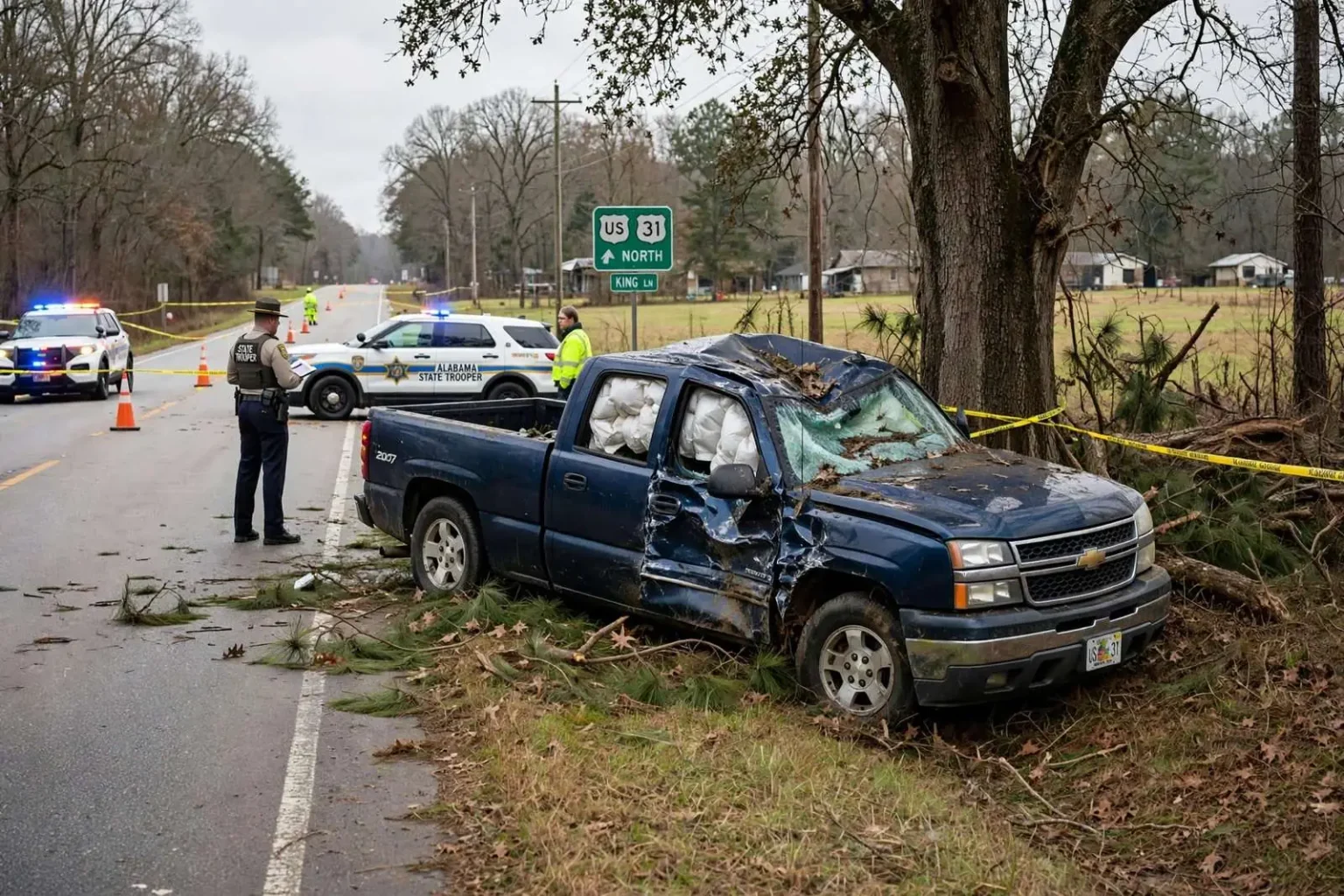
Alabama state troopers have identified an 18-year-old Bay Minette man who died in a single-vehicle crash on US 31 north of Bay Minette on Christmas Eve. According to the Alabama Law Enforcement Agency, William D. Brooks was driving a 2007 Chevrolet Silverado northbound near King Lane shortly before 12:30 p.m. Tuesday, Dec. 24, when the truck left the roadway for reasons investigators have not determined, overturned and struck a tree. Brooks, who was not using a seat belt, was pronounced dead at the scene. A restrained passenger, 19-year-old Sawyer McCullough, also of Bay Minette, was injured and airlifted to a hospital for treatment. Troopers continue to investigate the cause of the crash.
The crash occurred on a holiday afternoon along a corridor that carries a steady mix of local and through traffic. US 31 is the older north-south highway that parallels Interstate 65 through Baldwin County, threading through the heart of Bay Minette before continuing north toward the Interstate 65 interchange and on toward Montgomery. The section north of town near King Lane is a stretch where the roadway passes a mix of homes, small farms and wooded parcels, with driveways and side roads feeding in at intervals.
Because the truck was northbound and the wreck happened just before 12:30 p.m., the crash unfolded in full daylight, which investigators note is typical of the information-gathering stage rather than a final accounting of what happened. Determining why a vehicle leaves the roadway — speed, a mechanical problem, a medical event, driver distraction or roadway conditions — can take weeks, and ALEA’s Highway Patrol Division generally does not announce a contributing cause until its investigation is complete.
The Crash Sequence
What troopers were able to confirm in the hours after the wreck is the physical sequence. The Silverado left the roadway, overturned, and struck a tree. Rollover crashes are among the most dangerous a vehicle can be involved in, and pickup trucks are particularly susceptible to them in certain departure scenarios because of their higher center of gravity compared with passenger sedans. A 2007 Silverado predates the electronic stability control systems that became standard on new vehicles in later model years, technology that has been credited with sharply reducing single-vehicle rollover fatalities nationally.
Striking a fixed object such as a tree after a rollover concentrates the crash forces into a single impact, and those impacts are frequently fatal for occupants who are not restrained. Federal crash data has consistently shown that the majority of occupants ejected in rollover crashes are unrestrained, and that ejection dramatically raises the risk of death. Investigators will examine the truck itself, the roadway, and any available evidence to determine what set the sequence in motion.
The restraint contrast between the two occupants is a detail troopers document in every such case. The driver was not using a seat belt and died at the scene; the passenger was restrained, survived the initial impact, and was airlifted for treatment. Seat belt use has been mandatory in Alabama since 1999 for front-seat occupants, and the state’s primary enforcement law allows officers to stop a vehicle for that violation alone. Baldwin County Sheriff’s Office deputies and municipal officers across the county participate in regular seat belt enforcement waves, particularly around holiday travel periods.
Emergency Response
A crash of this type on US 31 draws multiple agencies. First responders from the local area handle roadway access and initial patient care, and an air ambulance was used to move the injured passenger to a hospital. Air medical transport is routine in Baldwin County for trauma patients because of the distances involved — the nearest Level I trauma center resources are in Mobile, across Mobile Bay, and helicopter transport can cut a trip that might take more than an hour by ground into a fraction of that time.
Bay Minette sits at the northern end of Baldwin County and serves as the county seat, a community of roughly 9,000 residents where US 31 and US 287 meet and where travelers heading between Interstate 65 and the county’s southern beaches often pass through. Christmas Eve traffic on the corridor is typically lighter than a normal weekday in some respects but heavier in others, with residents making final holiday trips and travelers passing through on the way to family gatherings. The crash closed or constrained a portion of the roadway while investigators documented the scene and crews cleared the wreckage, a process that can take several hours in a fatal rollover.
Fatal crashes on rural segments of US 31 have been a recurring concern for Baldwin County officials. The highway predates modern interstate design standards, with at-grade intersections, varying shoulder widths, and speed limits that allow highway-speed travel through stretches that also see farm equipment, school buses and local traffic. The parallel stretch of Interstate 65 absorbs most long-distance volume, but US 31 remains a working road, and its crash history has been part of ongoing state and regional conversations about upgrading older corridors.
Holiday Travel and Crash Risk
Christmas Eve falls within one of the busiest travel windows of the year, and Alabama law enforcement agencies customarily increase patrols around the holidays. ALEA’s holiday enforcement periods typically emphasize impaired driving, speed, and occupant restraint — the three factors that appear most often in fatal crash reports statewide. State and national statistics have long shown that fatal crashes cluster around major holidays, when travel volume rises, trips run longer, and evening and nighttime driving increases.
For 18- and 19-year-old drivers, crash risk is elevated regardless of the calendar. National data consistently ranks crashes as a leading cause of death for teenagers and young adults, and the first years of licensed driving carry the highest per-mile risk of any age group. Graduated driver license laws in Alabama phase in night driving and passenger restrictions for newer drivers, though those restrictions apply to the earliest licensing stages. Safe driving advocates in the state use crashes like this one to renew calls for consistent seat belt use, noting that restraint laws only work when they are actually used on every trip.
The Investigation Ahead
ALEA’s Highway Patrol Division handles crash investigations across the state, with Serious Crash Units called in for fatal wrecks. The work ahead for investigators in this case includes documenting the vehicle’s path off the roadway, examining the truck for mechanical issues, looking at speed and any potential distractions, and interviewing witnesses who may have seen the Silverado before the crash. Findings in such cases are often summarized only when the investigation closes, and criminal charges, if any were ever warranted, would be a separate decision from the factual reconstruction.
For the families involved, the process moves more slowly than public attention does. A crash report with final contributing circumstances can take weeks to be released, and hospital treatment for the injured passenger may extend well beyond the news cycle. Community members in Bay Minette typically rally around affected families in cases like this, and the Christmas Eve timing adds a particular weight to a loss that the town will mark for years.
Any driver who witnessed the Silverado in the moments before the noon crash near King Lane and has not spoken with investigators can contact ALEA, as tips from passing motorists frequently help resolve questions about a vehicle’s movements before a crash. In the meantime, the confirmed facts remain those the agency released: a northbound Silverado left US 31 near King Lane, overturned and struck a tree shortly before 12:30 p.m. on Dec. 24; the 18-year-old driver, unrestrained, died at the scene; and his 19-year-old restrained passenger was airlifted to a hospital, while troopers continue working to determine why the truck left the road at all.
What Drivers Can Take From It
Crashes like this one rarely have a single tidy lesson, but they do highlight habits that safety officials repeat every holiday season. The first is the simplest: a seat belt on every trip, for every occupant, on every road. The contrast in outcomes between the restrained passenger and the unrestrained driver in this crash is the kind of outcome investigators see repeatedly in rollover cases, where remaining inside the vehicle is the single most important factor in survival. The second is speed discipline on older corridors like US 31, where a moment of inattention leaves less recovery room than a divided interstate does. The third is holiday-specific — building in extra time so that the last miles of a trip are not driven in a rush.
Vehicle age matters as well, though it is not a factor owners can change quickly. The 2007 Silverado involved predates standard-fit stability control, and Baldwin County’s truck-heavy vehicle population includes many vehicles of similar vintage. Owners of older trucks can at least verify that tires, brakes and steering components are in good order, since mechanical failures are among the causes investigators consider in every single-vehicle departure. Alabama’s annual inspection requirements are limited, which places the responsibility for maintenance squarely on owners.
For now, the crash remains under investigation by state troopers, and the section of US 31 near King Lane has returned to the ordinary rhythm of a Baldwin County highway. The confirmed account — an overturned truck, a tree, one young man who did not survive and another recovering from his injuries — stands as the factual record while investigators complete their work and the community absorbs the loss.