Family of Stephanie King Rallies Opposition Ahead of October Parole Hearing for Her Killer
Nearly 38 years after the 16-year-old's murder, her family is again organizing letters and emails to the Alabama Bureau of Pardons and Paroles ahead of Edward Russell Dubose's fifth parole review.
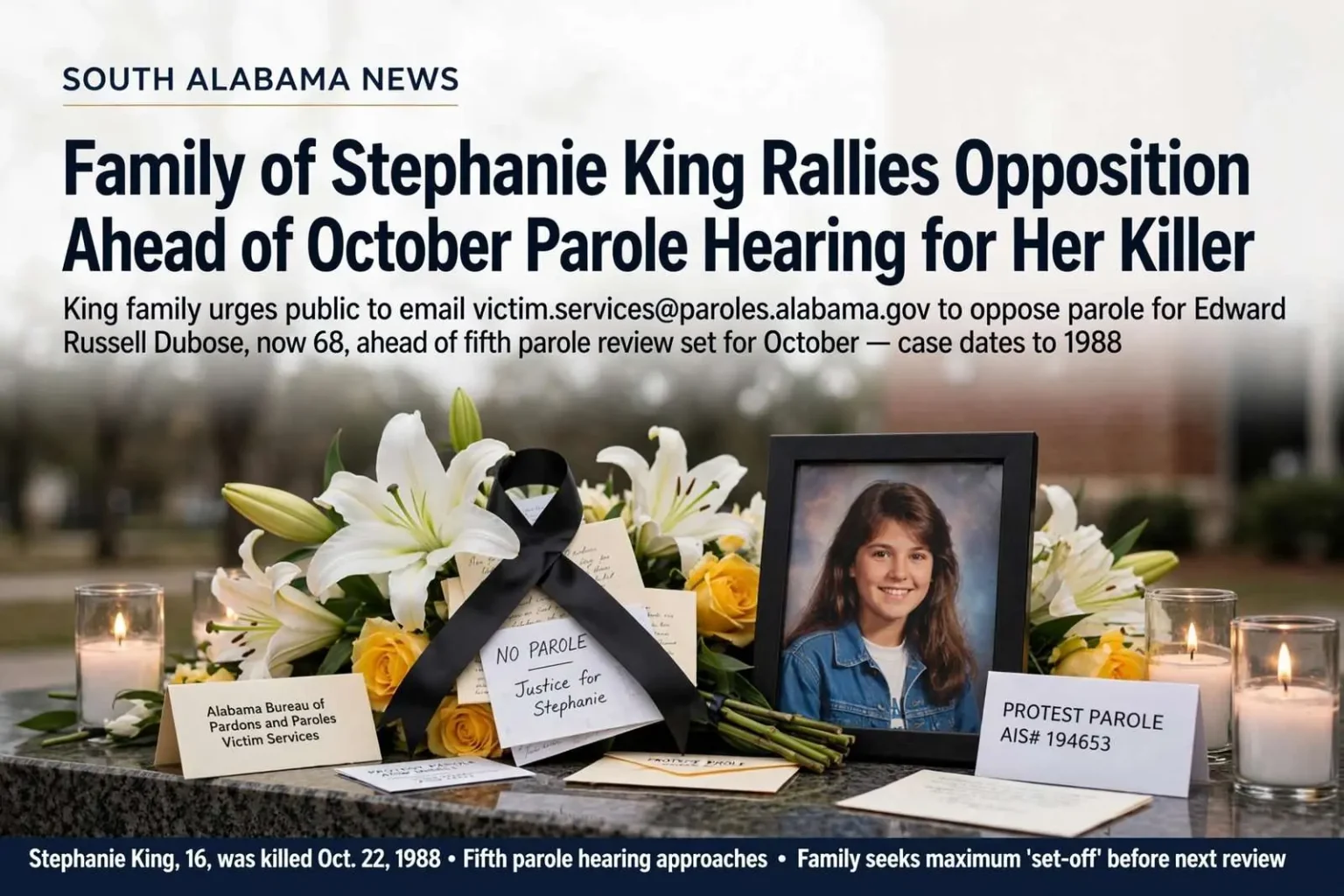
Stephanie King’s family is again asking for public support to oppose parole for the man convicted of killing her, ahead of a hearing scheduled for October.
A Case Nearly 40 Years Old
King was 16 years old when she was killed on Oct. 22, 1988. Murder charges against Edward Russell Dubose were not filed until December of that same year.
It took nearly 18 months for a jury to receive the case and find Dubose guilty. He was sentenced to death at the conclusion of the trial in 1990.
That ruling was overturned in 1995 on appeal, on grounds related to his attorney’s inability to hire DNA experts. Two years later, Dubose pleaded guilty to the murder and received a sentence of life in prison with the possibility of parole.
Dubose, now 68, was 37 when that life sentence was imposed. He has spent nearly 38 years behind bars.
Four Previous Hearings
The possibility of parole has returned to the King family repeatedly over the decades.
Dubose has been before the parole board for review four times: on Nov. 1, 2004; July 20, 2010; in July 2015; and on June 30, 2021. The next hearing is set for October, according to information released by King’s family.
Ahead of each of those hearings, family and friends have organized — signing petitions, sending letters and making phone calls in an effort to persuade the board to keep Dubose incarcerated. Those efforts have succeeded every time, and the family hopes for the same outcome again.
The Weight of a Recurring Hearing
The structure of a life-with-parole sentence means that for a victim’s family, the case is never fully closed. Each review reopens it — requiring the family to organize again, to restate the facts of the crime again, and to wait for a decision again, often years after the last one.
Four hearings across roughly two decades means the King family has mounted this effort four separate times since 2004, with a fifth now approaching. For families in that position, the interval between hearings is not a period of resolution so much as a countdown to the next one.
How the Family Is Asking People to Help
The family has set up a straightforward way for supporters to register opposition with the state.
An email to the Alabama Bureau of Pardons and Paroles Victim Services office is the mechanism the family is asking people to use. Emails should be sent to [email protected].
The message should include the phrase “Parole Protest AIS# 194653” — the inmate identification number that allows the office to route the correspondence to the correct case file.
The family has circulated a sample message reading, in part: “I wish to protest the release of Edward Russell Dubose AIS#194653 back into society,” followed by a request that the board “impose the maximum sentence allowed in Alabama before he would be considered again.” The family’s protest language describes the crime as a kidnapping from King’s church followed by rape and murder.
Anyone sending a message is asked to include a signature before sending. Unsigned correspondence is generally given less weight, since the board cannot verify who submitted it.
What “Set-Off” Means
The family’s request that the board impose the maximum period before the next consideration refers to what the parole system calls a set-off — the interval the board sets before an inmate becomes eligible for review again after a denial.
That interval is why the family’s framing matters as much as the denial itself. A short set-off means returning to this process again within a few years; a longer one buys the family time before the next round of organizing.
How Parole Protests Are Considered
The Alabama Bureau of Pardons and Paroles accepts input from victims and victims’ families, from law enforcement, from prosecutors and from members of the public. Victim Services exists specifically to receive and route that correspondence.
The board weighs that input alongside institutional records, the nature of the original offense, and the inmate’s conduct and programming while incarcerated. Public opposition is one factor among several rather than a determinative vote, but organized victim-family opposition is among the most consistently influential categories of input in serious violent cases.
Ahead of October
No specific date within October had been released in the information circulated by the family. Those wishing to participate are advised to send correspondence well ahead of the hearing month, since submissions must be processed and placed in the file before the board convenes.
South Alabama News will report the board’s decision when it is issued.