
Stimpson Takes Mayoral Campaign to Alabama Music Box as Voter Drive Signs Up Nearly 100
Sandy Stimpson and Greg Vaughan took their 2013 Mobile campaigns to the Alabama Music Box, where a voter registration drive signed up nearly 100 new voters.
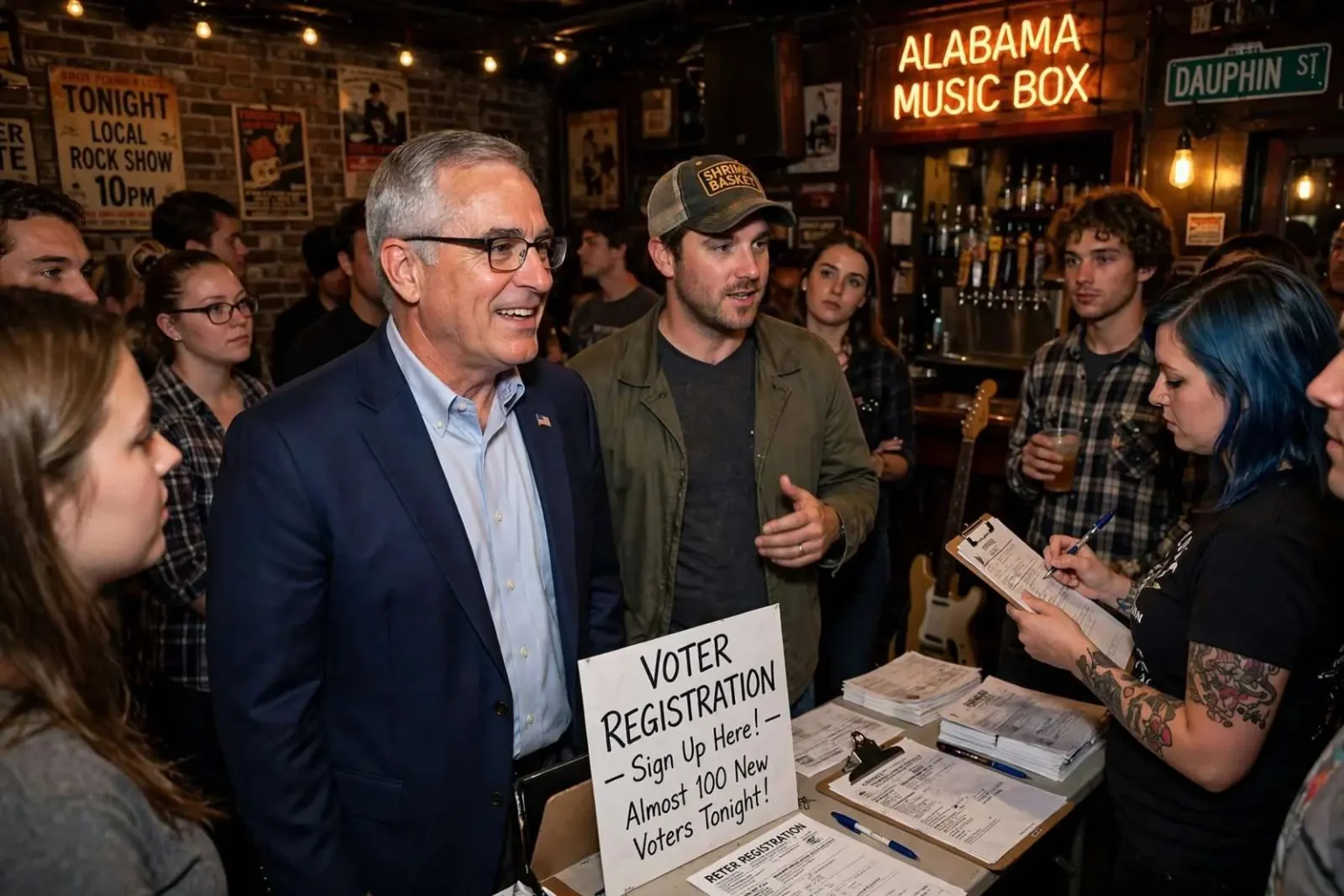
Mobile mayoral candidate Sandy Stimpson and City Council District 2 candidate Greg Vaughan made an unusual campaign stop on Friday, Aug. 9, 2013: the Alabama Music Box on Dauphin Street, where they addressed a late-night crowd of young musicians, artists and bar patrons during a voter registration drive. For a candidate building a campaign on reaching every corner of the city, the stop was as deliberate as it was unexpected.
The Alabama Music Box occupies a particular place in downtown Mobile’s cultural landscape — a music venue and bar on Dauphin Street that books live acts and draws the young, creative crowd that the city’s downtown revival depends on. It is not a traditional campaign venue. Politicians courting votes in Mobile more typically work civic clubs, church gatherings and business luncheons; a noisy bar full of musicians at midnight is another kind of audience entirely, and a harder one to win.
The occasion was a voter registration drive, an effort with clear stakes in a summer when the August municipal election was approaching. By the end of the night the drive had signed up almost 100 new voters, with more registering even after the speeches ended — a tangible result that gave the evening’s politics a practical payoff beyond the handshakes.
Vaughan pitches downtown ideas
Vaughan, a Mobile native whose family runs the Shrimp Basket restaurant group, spoke first. He told the crowd he wanted to use his business experience to encourage growth in midtown and downtown, floating ideas including more food trucks lining downtown streets and closing all of Dauphin Street to traffic during busy weekend hours.
Both ideas came straight from the playbook of cities that have revived their downtown nightlife. Pedestrian-only weekend street closures — a staple in New Orleans, Pensacola and other Gulf Coast cities — turn a corridor of bars and restaurants into an open-air district where crowds flow between venues on foot. Food truck lineups, similarly, have become a signature of youth-oriented urban revitalization, drawing late-night crowds and giving entrepreneurs a low-cost way into the market. For a restaurateur’s son, the proposals were also a statement of credentials: Vaughan was pitching the street-level instincts of someone who has run food businesses, not managed them from a boardroom.
He acknowledged he did not know Stimpson personally but supported what his campaign was trying to accomplish — a telling detail in a race where endorsements were still forming, and where a downtown council candidate and a mayoral challenger found themselves aligned more by ideas than by history.
Stimpson kept his remarks brief — addressing a noisy bar crowd being what it is — but pointed. He thanked Vaughan, the Alabama Music Box, David Mathews, John Serda and the organizers of the voter registration drive, which signed up almost 100 new voters over the course of the night, with more registering even after the speeches ended.
The father of children in their twenties and early thirties, Stimpson told the crowd he understood the concerns of young Mobilians and wanted to foster an atmosphere where they could build successful lives in the city. The argument was aimed at a complaint as old as Mobile’s downtown revival itself: that the city’s young talent leaves for Birmingham, Atlanta, New Orleans or beyond because the opportunities — and the civic energy — feel stronger elsewhere. A candidate promising to make the city a place where young people can build lives was promising to reverse that current.
Stimpson stayed for photos, accepted a patron-bought shot with a joke about his bedtime, and worked the room before leaving. The scene — a businessman candidate in his sixties taking a tequila shot at a rock venue — was worth more than any staged event could have produced, and the crowd that night registered voters, took photos and told the story for him afterward.
Why the stop mattered
The visit stood out for a few reasons. Stimpson had repeatedly cited St. Petersburg Mayor Rick Baker’s book “Seamless City” — the idea that a mayor should be able to walk comfortably into any part of his city — as an influence, and the AMB crowd was not a room most politicians courted. A candidate who preaches seamless governance and then shows up at a late-night bar full of musicians is at least testing his own thesis in public.
The venue choice also carried a sharper edge. Critics noted that the City Council had passed Entertainment District regulations affecting venues like the Alabama Music Box without ever visiting them, while the mayor’s office stayed out of the fight. The Entertainment District framework — designed to let patrons carry drinks through designated downtown zones — was intended to energize the corridor, but venue owners and patrons had aired grievances about how the rules reached their businesses. Stimpson’s presence at one of the affected venues, meeting the people the regulations touched, implicitly drew a contrast with an incumbent who had not made the same visit.
For the young crowd in the room, the evening offered something municipal politics rarely does: candidates who showed up where the audience already was, late at night, on the street where they actually spend their weekends. Municipal elections are traditionally decided by older, more reliable voters, and campaigns court them accordingly. A voter registration drive aimed at bar patrons is a bet on the opposite strategy — that enough new young voters, registered and motivated, can shift the math in a city election.
The numbers from a single night offered some proof. Nearly 100 registrations at one venue, with sign-ups continuing after the speeches, suggests an audience that wanted to participate but had not been asked. Multiply that across a summer of similar drives and the race’s electorate changes shape — a fact not lost on campaigns watching precinct-by-precinct turnout histories.
Downtown Mobile in 2013 was itself a referendum in progress. The Dauphin Street corridor had spent a decade clawing back from disinvestment, with venues like the Alabama Music Box anchoring a nightlife scene that civic leaders touted as the city’s future. The entrepreneurs, musicians and artists who populated that scene had a direct stake in city hall’s decisions — from the Entertainment District rules to policing to infrastructure — and they had learned to be skeptical of officials who spoke about downtown without ever standing in it late on a Friday night.
The Seamless City test
Stimpson’s repeated invocation of “Seamless City,” the book by former St. Petersburg Mayor Rick Baker, gave the evening its theme. Baker’s argument is that a mayor’s presence in every part of a city — comfortably, and as a regular rather than a spectacle — changes how government sees its people and how the people see their government. The idea resonates in a city like Mobile, where neighborhoods north, south, east and west of downtown have historically felt varying levels of attention from city hall.
By that standard, the Alabama Music Box stop was a small event with a clear meaning. Stimpson was not merely campaigning in a room most politicians skip; he was demonstrating the governing style he proposed, in front of the exact audience that judges it most cynically. Bar crowds do not applaud on command, and the room’s warm reception — voters registered, photos taken, a shot bought by a patron — was a genuine data point for a campaign arguing it could represent all of Mobile.
And in a city often described as divided along racial and cultural lines, the sight of a mayoral candidate working a young, artsy downtown bar crowd was its own statement ahead of the August 2013 election. Mobile’s civic conversations have long run through that divide — between old Mobile and new, between the city’s established institutions and its emerging creative class, between neighborhoods that feel heard and those that do not. A candidate standing in a rock venue surrounded by young voters of every background was making a visual argument that his campaign intended to blur those lines rather than campaign along them.
Whether the strategy moves numbers is the question every unconventional campaign stop must answer. The drive’s nearly 100 registrations offered one measure. The crowd’s reception offered another. And the mix of attendees — musicians, artists, bar patrons, the council candidate and the mayoral candidate himself, laughing over a shot — offered the kind of imagery that a campaign cannot buy and an opponent cannot easily match.
The road to the August election
The stop came in the closing stretch of a race that had been building all summer, with the August election weeks away. Stimpson had spent the campaign framing his candidacy around the city’s untapped potential — a message that paired naturally with the young crowd he faced at the Music Box, the constituency with the longest stakes in Mobile’s future. Vaughan, running for the District 2 council seat covering much of the downtown core, had his own reasons for being there: the room was, quite literally, his district.
The evening ended the way campaign nights rarely do — with the politicians staying past their speeches, working the room, and leaving only after the photos were taken. For the voter registration organizers, the night delivered its practical goal. For the candidates, it delivered something harder to measure: credibility with a crowd that has little use for politics as usual, and a story that traveled through downtown Mobile the next day on its own.
As election season pressed on, the Alabama Music Box stop stood as an example of what the campaign’s “Seamless City” talk looked like in practice — a candidate who says a mayor should be able to walk comfortably into any part of his city, actually walking into the one most politicians never do.