Student Struck by Backing Car in Denton Middle School Parking Lot
A Denton Middle School student was struck by a backing car in the parking lot; EMS evaluated her at the scene and she was not hospitalized.
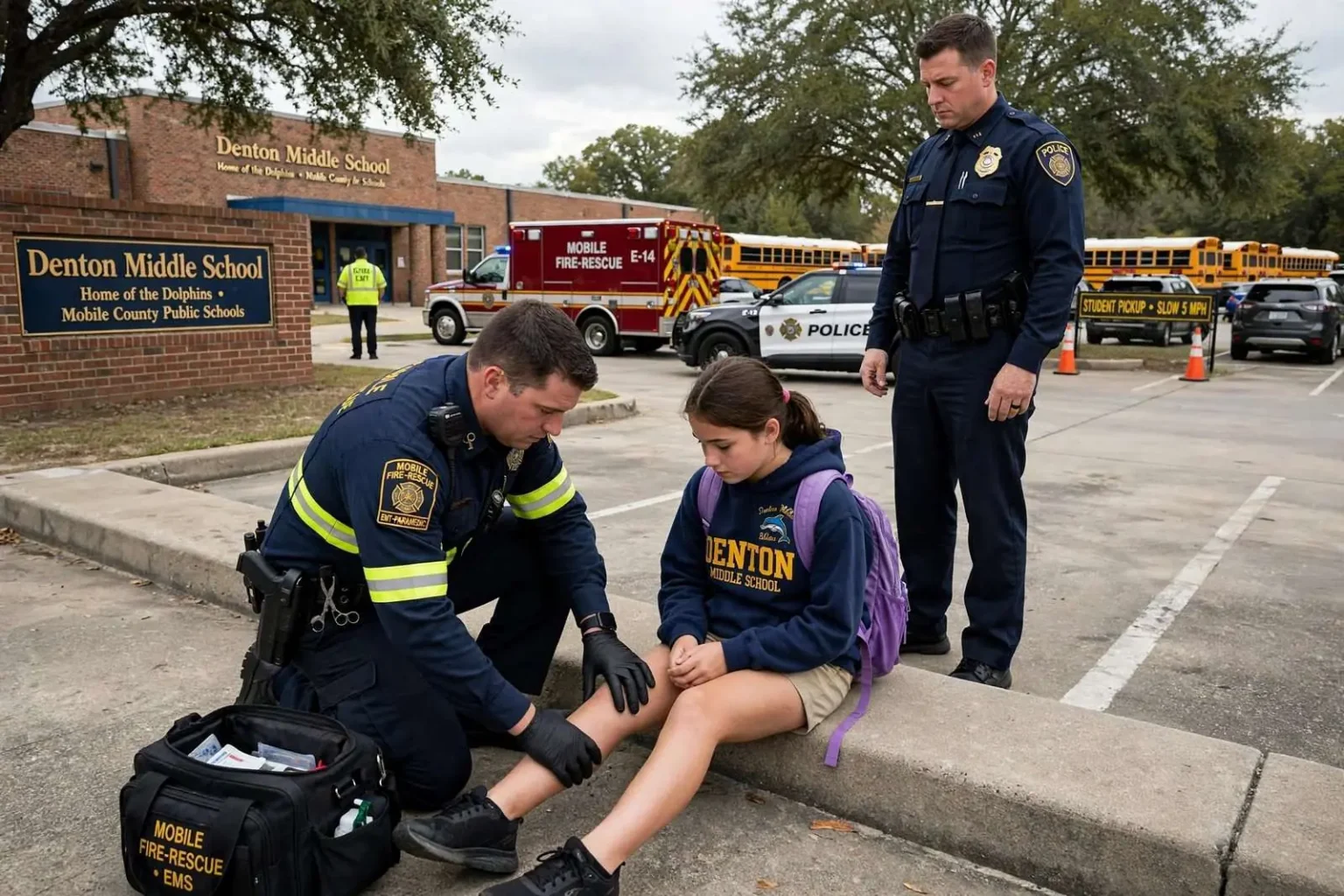
MOBILE, Ala. — A student was struck by a car in the parking lot of Denton Middle School, prompting a response from Mobile Fire-Rescue and Mobile police, but the girl was evaluated at the scene and did not require transport to a hospital.
According to Mobile Fire-Rescue, the girl complained of a leg injury after being hit by a vehicle that was backing up in the school’s parking lot. When crews arrived and assessed her, however, she showed no visible sign of injury. EMS evaluated her at the scene, and she was not transported to a hospital.
The incident, quickly resolved from a medical standpoint, still drew a full first-responder response — a standard approach for any call involving a child struck by a vehicle, regardless of how minor the situation appears on arrival. School parking lots present a combination of hazards that makes caution essential: dozens of vehicles maneuvering in a confined space, young pedestrians whose height makes them hard for drivers to see, and pickup traffic that concentrates in narrow windows at the start and end of the school day.
Why backing vehicles are a persistent risk
Backing-up collisions are among the most common vehicle-pedestrian incidents in school zones and parking areas. Rear visibility from many vehicles — particularly taller SUVs and pickup trucks popular across the Gulf Coast — leaves a large blind zone directly behind the bumper, and children are especially vulnerable because of their size. A small child standing behind a reversing vehicle can be completely invisible to the driver until it is too late.
Federal safety regulators have addressed the problem in recent years by requiring rearview cameras in new vehicles, a mandate phased in under rules adopted in 2014 and applied to all new light vehicles since 2018. But cameras supplement rather than replace careful driving, and older vehicles without them remain common in school pickup lines. Safety advocates continue to urge drivers to walk behind their vehicle before reversing, back into parking spaces when arriving so they can pull out with forward visibility, and roll down windows to listen for children in congested lots.
The girl’s complaint of a leg injury followed by no visible sign of injury is a familiar pattern in low-speed pedestrian contacts. Vehicle impacts at parking-lot speeds often produce nothing more than a jolt, but adrenaline can mask symptoms and complaints of pain are taken seriously by EMS crews precisely because soft-tissue injuries and hairline fractures are not always apparent on a quick visual check.
How EMS evaluates a child on scene
When Mobile Fire-Rescue crews assess a child struck by a vehicle, they follow a standard evaluation: mechanism of injury, a physical exam checking for deformity, swelling and tenderness, vital signs and a neurological check. The speed of the vehicle, the height of impact on the child’s body and whether the child was knocked down all factor into the assessment, since those details predict the likelihood of internal injury even when external signs are absent.
Parents or guardians are advised of the findings and typically participate in the decision about further evaluation. Crews err on the side of transport whenever the mechanism suggests risk, but in low-energy contacts with a normal exam, on-scene evaluation with a recommendation for parental follow-up with a pediatrician is a recognized outcome. Refusal of transport — or a determination that none is needed — is documented in the EMS record.
The presence of both fire-rescue and police at the scene reflects standard practice. Fire-Rescue handles the medical evaluation, while officers document the incident, speak with the driver, and determine whether any traffic citation or report is warranted. School administrators are typically notified as well, and Mobile County Public Schools’ transportation and safety staff track parking-lot incidents as part of their oversight of pickup and drop-off procedures.
Denton Middle School and its campus traffic
Denton Middle School serves students in west Mobile and is part of the Mobile County Public School System, the largest district in Alabama. Like most middle schools built in the era of neighborhood campuses, its grounds were designed decades before the volume of modern parent drop-off traffic, and its parking lot functions as a shared space for staff vehicles, parent pickups, buses and student pedestrians in tight sequence during morning and afternoon peaks.
That mix is why parking lots, rather than the streets outside them, account for a meaningful share of the vehicle-pedestrian incidents around schools. The street approaches to campuses are usually marked with school zone signage and reduced speed limits during arrival and dismissal windows, enforced with fines that double in many Alabama jurisdictions. Inside the lot, however, enforcement is limited and safety depends on the behavior of each driver — checking mirrors, creeping through the pickup lane, and yielding to students crossing between rows.
Schools across Mobile County reinforce those behaviors through arrival and dismissal plans published to parents each year, designating specific lanes, entrances and supervised crossing points. Administrators periodically review those plans after incidents, and parking-lot episodes like this one typically prompt reminders to families about slow speeds, phone use and the supervised crossings students are expected to use.
A reminder for drivers
The incident serves as a reminder for drivers to use extra caution in school parking lots and pickup zones, where students on foot can be difficult to see from a reversing vehicle. Safety specialists recommend a set of habits that apply to every school campus: drive at walking speed or slower inside the lot, never back up while students are moving through the lane, use a spotter when reversing is unavoidable, and assume every movement between cars could put a child behind the bumper.
Distraction is a compounding factor. Pickup lines are notorious for drivers checking phones, and the low-speed environment breeds complacency — drivers assume that at 5 miles per hour nothing serious can happen. In fact, the vast majority of child pedestrian injuries in school areas occur at low speeds, where a fraction of a second of inattention is often the difference between a near miss and a contact.
Vehicle technology continues to improve the odds. In addition to mandated rearview cameras, many newer models include rear cross-traffic alerts and automatic emergency braking that can stop a reversing vehicle when a sensor detects movement. But those systems are calibrated to detect moving objects at certain speeds and heights, and they are not a substitute for the driver’s own scan of the area behind the vehicle before the wheels turn.
What happens after a school-incident call
Once the medical side of a call like this concludes, the paperwork begins. Fire-Rescue documents the response and evaluation in its patient care record, police document the circumstances of the contact, and the school records the incident internally. If the driver involved is a parent or staff member, the school may address the situation through its own procedures as well. In most low-speed parking-lot contacts with no injury, the outcome is a documented incident and a renewed emphasis on lot safety rather than charges of any kind.
School districts also track these events cumulatively. A pattern of near-misses or contacts in a particular lot can lead to physical changes: reconfigured lanes, added crosswalk striping, new signage, barriers separating the pickup lane from the parking rows, or a re-timed dismissal to thin out the traffic peak. Districts across Alabama have made such changes after safety reviews, often at the urging of parent organizations who see the morning and afternoon crunch firsthand.
The fact that the student was evaluated and released the same day is the best available outcome for an incident of this type. Emergency crews responded to a report of a child struck, completed their assessment, and cleared the scene without a trip to the hospital — a resolution that stands in contrast to the more serious pedestrian injuries that occur outside schools each year across the region.
Pedestrian safety around Mobile County schools
Mobile County’s school system spans more than 90 schools across the county, from inner-city campuses to suburban and rural schools, and each presents its own traffic geometry. The district’s transportation department coordinates bus routes, crossing guard placements and campus traffic plans, while individual principals manage the daily operation of their own lots. County and city public works departments handle the street-level infrastructure — signs, signals, crosswalks and speed feedback displays — that frames each campus.
Safety campaigns run alongside that infrastructure. Alabama’s school zone traffic law raises fines for speeding violations in marked zones during active hours, and officers periodically run enforcement details at the worst campuses during the opening weeks of the school year, when families are still settling into routines. Fire-Rescue and school resource officers also deliver pedestrian safety instruction in classrooms, teaching students to look both ways, use designated crossings and stay off phones while walking through lots.
For parents, the practical guidance from safety experts is consistent year to year: arrive early enough to avoid rushing, keep phones down while moving through the lot, follow the school’s published traffic pattern even when it seems slower than improvising, and never wave children across lanes between cars. The moments students spend walking from a car to the building door are among the highest-risk minutes of the school day, and they depend on the discipline of every adult in the line.
In this case, the system worked as intended: a report of a child struck brought a rapid response, the evaluation found no visible injury, EMS cleared her at the scene, and no transport was needed. The reminder stands for every driver who will pull into that lot tomorrow morning — check twice, move slowly, and treat every backup as if a student is behind the vehicle.