Suspect Fleeing Police Custody Steals Mobile Fire-Rescue Ambulance, Leads Officers on Chase Through Midtown
A man being taken to a Mobile hospital under police guard slipped away from his ambulance transport and stole a Mobile Fire-Rescue vehicle instead, leading officers on a brief chase through Midtown before he was taken back into custody.
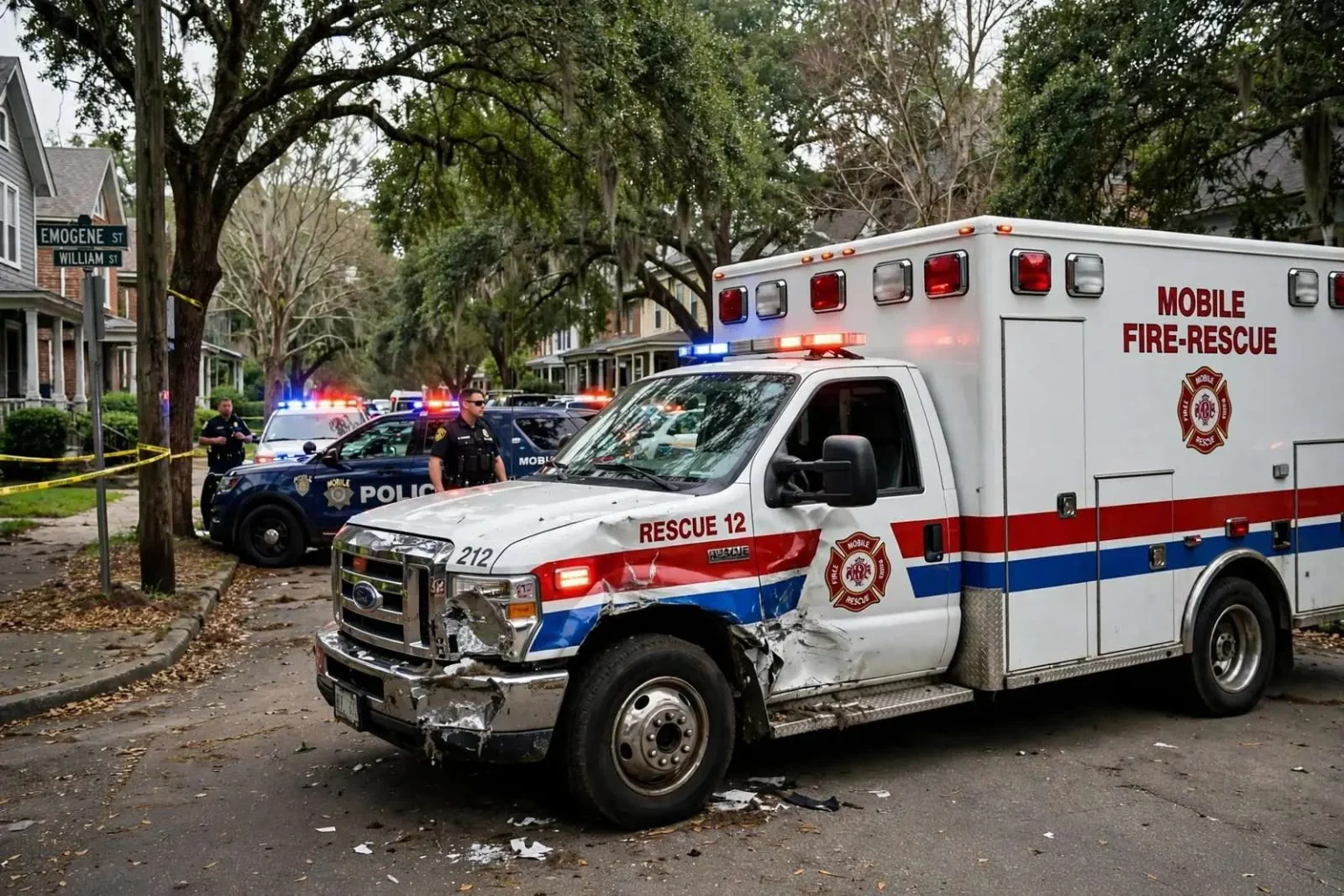
A man being escorted to a Mobile hospital under police guard slipped away from his private ambulance transport Friday morning and made off with a Mobile Fire-Rescue ambulance instead, setting off a brief but chaotic pursuit through the city’s Midtown area.
According to the Mobile Police Department, the man had been detained and questioned earlier in the morning in connection with an attempted break-in at a Subway restaurant on Springhill Avenue. Investigators determined the incident amounted to a misdemeanor, and the man was placed in a private ambulance operated by Lifeguard Ambulance Service to be taken to Mobile Infirmary for evaluation.
At some point during that transport, the man got out of the Lifeguard unit and climbed into a nearby Mobile Fire-Rescue rescue vehicle that was unoccupied at the time, according to police and fire officials. He then drove off in the ambulance, prompting officers to give chase.
The escape and theft unfolded in the blocks around Mobile Infirmary, the 700-bed hospital campus near Springhill Avenue and Center Street that anchors Midtown’s medical district. The area around the hospital sees constant ambulance traffic — private services like Lifeguard alongside Mobile Fire-Rescue units — and the morning of the theft offered the unlikely combination of circumstances: a detained patient, an unoccupied fire-rescue vehicle idling nearby, and no officer immediately at its wheel.
A Chase Through Midtown
Mobile Fire-Rescue Public Information Officer Steven Millhouse said the ambulance sustained what he described as moderate-to-major damage during the incident and was being taken to the city’s impound lot so investigators could fully assess the extent of the harm.
“It could’ve been a lot worse,” Millhouse said. “He could’ve flipped it or hit a building or something.”
Mobile police said officers pursuing the stolen ambulance fired at least one shot during the chase before the vehicle came to a stop. Officers were able to bring the ambulance to a halt in the area of Emogene Street and William Street, where the man was taken into custody without further incident.
The pursuit route carried the ambulance through the tree-lined residential streets of Midtown, one of Mobile’s oldest and most densely built neighborhoods, where homes sit close to the curb and the streets are narrow. An ambulance running from police at speed through such blocks poses obvious dangers — to pedestrians, to parked cars, to oncoming traffic — and officers work to bring such pursuits to an end quickly.
Custody, Charges and the Hospital
The man was then transported to the hospital, where he remained under police guard, according to the department. Officials said he is expected to face additional charges once he is released from medical care and formally booked into jail.
No other injuries were reported in connection with the chase, and no bystanders or property along the pursuit route were reported struck.
The charge structure in a case like this typically grows quickly. The man already faced the misdemeanor break-in charge from the Springhill Avenue restaurant, and the ambulance theft adds offenses ranging from unauthorized use or theft of an emergency vehicle to fleeing or attempting to elude police, along with any traffic offenses committed during the pursuit. The discharge of an officer’s weapon during the chase also triggers standard review procedures, both within the department and by district attorneys, to determine whether the shooting complied with policy and state law.
Mobile police protocol places officers on administrative duty pending such reviews when shots are fired, a process that runs parallel to the criminal case against the suspect. Neither the department nor fire-rescue officials released the man’s name while he remained under medical care and police guard at the hospital.
How an Ambulance Becomes a Target
Emergency vehicles are stolen more often than most residents realize, and fire departments across the country have adapted with policies designed to prevent exactly this scenario: units locked when unattended, keys removed or secured, and apparatus parked away from detainees. The circumstances Friday morning — a private ambulance transport, a hospital district crowded with emergency vehicles, a suspect being moved between units — created the opening that fire-rescue policies are meant to close.
A stolen ambulance is a particularly dangerous vehicle in a pursuit. Units are heavy, carry medical equipment that becomes projectiles in a crash, and are built to move through traffic in ways ordinary cars are not. An untrained driver at the wheel of one is a hazard to everyone around, which is why officers and fire officials alike described the outcome — a stopped vehicle, a suspect in custody, no injuries — as a best-case ending to a worst-case morning.
Millhouse’s assessment of the damage — moderate to major — will determine whether the unit can be repaired and returned to service or must be replaced, a cost borne by the city and pursued, ultimately, through the courts.
The Morning’s Timeline
The sequence began when officers detained and questioned the man over the attempted break-in at the Subway on Springhill Avenue, one of the commercial corridors that runs through Midtown. Investigators concluded the offense amounted to a misdemeanor, the least serious class of criminal charge, and arranged for the man’s transport to Mobile Infirmary for a medical evaluation — a routine step when a detainee’s condition warrants assessment before booking.
Private ambulance services like Lifeguard contract with jurisdictions across the Gulf Coast to handle interfacility transports and some 911 response volume, and detainee transports are among their routine calls. The man was placed in the Lifeguard unit for the trip to the hospital. Somewhere between the transport’s start and its arrival, he got out of the private ambulance, reached the nearby unoccupied Mobile Fire-Rescue rescue vehicle, and drove away in it.
The dispatch of the alarm set off a pursuit that ended at Emogene and William streets, a residential pocket of Midtown a short distance from the hospital district. Officers stopped the ambulance and took the man into custody without further incident, closing out an episode that had unfolded over only a fraction of the morning.
What Comes Next
The district attorney’s office will weigh the full set of charges once the man is medically cleared and booked, and the police department’s review of the officer-involved shooting will proceed on its own track. The fire department, meanwhile, assesses its vehicle and reviews how an unoccupied rescue unit came to be within reach of a detainee being transported a short distance away.
Fire Chief and police officials have both emphasized in past incidents that coordination between the two agencies on detainee transports and emergency scene security is an ongoing effort. Friday’s events — a suspect losing custody inside a private ambulance, then finding an unoccupied fire-rescue vehicle — give both departments a case study in how quickly routine procedures can come apart.
For Midtown residents, the morning left little trace beyond the damage to the ambulance itself: no injuries, no damaged property along the route, and a suspect under guard at the hospital. The sounds of the pursuit faded quickly, but the questions about how it happened — and how to prevent the next one — will last longer in the halls of the police and fire departments than the sirens did on the streets.
Pursuit Policies and Public Safety
Vehicle pursuits are governed by strict departmental policies that balance the need to catch a suspect against the danger a chase poses to the public. Officers weigh the seriousness of the underlying offense, traffic conditions, the speed of the pursuit and the presence of pedestrians before continuing, and supervisors can call off a chase at any point. In this case, the pursued vehicle was an ambulance — slow to accelerate, heavy and conspicuous — which likely contributed to the decision to maintain the pursuit until officers could bring it to a stop in the residential area near Emogene and William streets.
The discharge of at least one shot during the chase will be examined in detail by investigators. Mobile police, like departments nationwide, require a full report whenever an officer fires a weapon, including the justification, the angle of fire, the risk to bystanders and the outcome. That review occurs separately from the criminal charges against the suspect, though the findings can inform each other.
The episode also highlights the close working relationship between Mobile police and the fire department in the Midtown medical district. Fire-rescue stations sit blocks from the hospital campuses, and emergency vehicles from both services crowd the same few streets throughout the day. When a police detainee is being transported through that environment, the two agencies’ vehicles and personnel share the same small geography — which is precisely why Friday’s unusual sequence could occur there and why both departments will study it.
The Aftermath for the Agencies Involved
For Mobile Fire-Rescue, the loss of a rescue unit — even temporarily — removes an ambulance from the city’s response fleet while repairs are assessed, a real operational cost in a system where every unit matters for response times across the city’s districts. The damaged vehicle’s trip to the city impound lot marks the start of an insurance and investigation process that will document the damage and determine the unit’s fate.
For Lifeguard Ambulance Service, the escape of a detainee during transport raises questions of custody procedures that the company and its police partners will review. Private ambulance crews generally are not trained or equipped to restrain combative patients beyond basic transport protocols, and departments typically assign officers to accompany detainees when circumstances warrant. The circumstances that led the man to be in a position to exit the unit — and whether an officer escort was present — will be part of the review.
The man, once medically cleared, will face the accumulation of charges from a morning that began with a misdemeanor break-in attempt and ended with a stolen fire-rescue ambulance, a police pursuit through Midtown and an officer’s shot fired — a chain of events the departments involved are already working to make sure never repeats.