Suspect Search Prompts Secure Perimeter at Dawes Intermediate School
Mobile County deputies used K9 units and drones to search for a suspect who fled, prompting Dawes Intermediate School to go on a secure perimeter as a precaution.
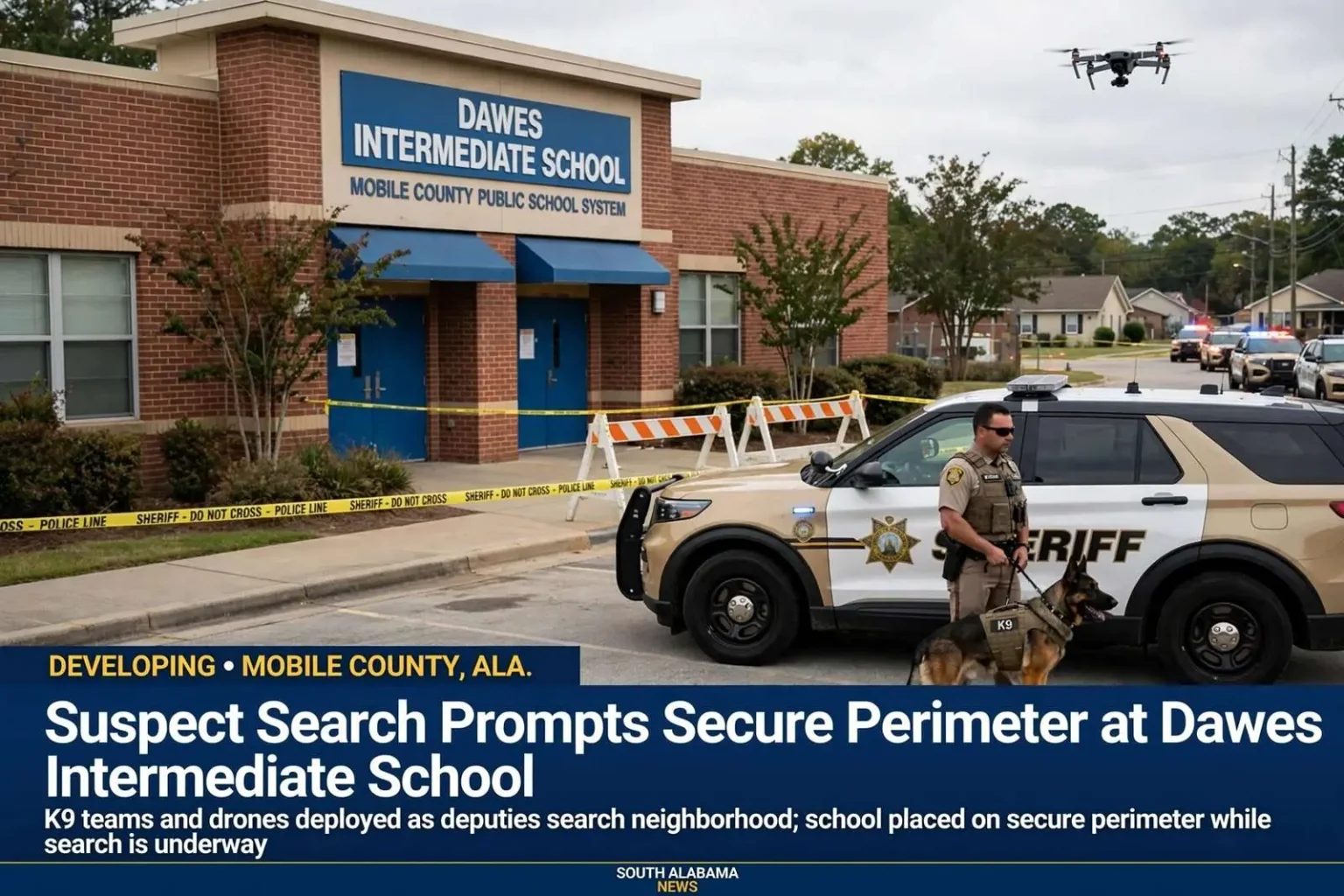
MOBILE COUNTY, Ala. — Mobile County Sheriff’s Office deputies are searching for a suspect who ran from them, prompting a nearby school to go on a secure perimeter as a precaution while the search unfolded in the surrounding area, officials said.
Dawes Intermediate School was placed under a secure perimeter while deputies searched the neighborhood around the campus, according to the Sheriff’s Office. The move came after a suspect ran from deputies during an encounter whose origin has not been publicly described, sending K9 teams and drone operators into the residential area that surrounds the school.
The Sheriff’s Office said K9 units and drones have been deployed to help locate the suspect in the area. The combination is standard for a ground search of this kind: dogs can track a scent trail from the point where a suspect was last seen, while aerial drones scan yards, wooded lots, and drainage paths from above, covering in minutes the ground that a line of deputies would take hours to walk.
Details about the suspect, including what led to the initial encounter with deputies, have not been released. The Sheriff’s Office has not said whether the person was wanted on existing warrants or became a suspect during the encounter itself, and no description had been provided to the public at the time of the initial reports.
What a Secure Perimeter Means
A secure perimeter is a standard safety measure schools use when there is activity nearby that isn’t considered a direct threat inside the building. Under the protocol, classes typically continue as normal, but exterior doors are locked and no one is allowed to enter or exit the campus until the situation is resolved.
The distinction between a secure perimeter and a lockdown is the heart of the protocol. A lockdown responds to a threat inside or immediately at the building — students hidden in secured classrooms, lights off, instruction stopped. A secure perimeter responds to danger outside the fence line: the school seals its doors and controls its entrances, but the educational day continues, with recess and outdoor activities suspended and movement between buildings kept indoors.
For parents, the protocol can be confusing from the outside — a school that will not release students or admit visitors looks like a school in trouble. Districts and schools communicate the reason in real time where possible, and the message underlying a secure-perimeter call is consistent: the situation is with law enforcement outside the campus, and the safest place for the students is inside, on their normal routine.
The decision to place Dawes Intermediate under the perimeter reflects the school’s position in the landscape. A campus sits in a fixed location while a police search moves around it, and when the search area overlaps the school’s surroundings, the perimeter is the tool that keeps the school out of the search equation entirely — no students walking out to buses, no visitors arriving, until deputies give the all-clear.
Dawes Intermediate and Its Setting
Dawes Intermediate serves the Dawes Road corridor in west Mobile County, an area of suburban subdivisions, schools, and commercial strips that has grown steadily over the past two decades. The school is part of the Mobile County Public School System, the state’s largest district, and its campus sits amid the residential neighborhoods where Monday’s — and in this case the afternoon’s — search activity was concentrated.
West Mobile’s growth has made its schools a familiar presence in the county’s safety planning. Campuses in the Dawes area sit close together with residential streets threading between them, meaning police activity in the neighborhood can come near school property even when the school itself is never the focus. Secure perimeters are the standard response in those circumstances, used whenever deputies are pursuing someone on foot or searching an area within sight of a school’s property.
The timing of such searches matters for schools. When a manhunt unfolds during school hours, the perimeter remains in effect through dismissal until the Sheriff’s Office resolves the situation or confirms the search area has moved away — a coordination between school administrators and law enforcement that determines whether buses run on schedule and whether parents arriving at pickup are allowed through.
K9 Units and Drones in a Ground Search
The Sheriff’s Office deployment of K9 units and drones represents the modern standard for locating a fleeing suspect in a developed area. A K9 team works from the point where the suspect was last seen, following a scent trail across yards, fences, and ditches at a pace no line of searchers can match. The dogs also serve a containment function: a suspect who hears a tracking dog closing in is far more likely to surrender than one who believes the search has lost him.
Drones change the geometry of the search from above. An aerial camera can clear a wooded lot in seconds, spot movement between houses, and monitor the perimeter of the search area to detect anyone trying to slip past the officers holding the line. In suburban terrain like west Mobile — a patchwork of fenced backyards, drainage easements, and small woodlots — the aerial view fills the gaps that ground units cannot watch all at once.
Together, the two tools compress the search timeline. A suspect on foot in a residential area is racing the clock in both directions: every minute increases the distance he might cover, but also increases the number of eyes — deputies, dogs, cameras — covering the ground behind him. The Sheriff’s Office has not said how large the search area grew or how long the deployment remained active.
Running From Deputies and What Follows
The legal weight of the episode will depend on what deputies discover when they locate the suspect. Fleeing from law enforcement is itself an offense in Alabama, but the encounter that started the chase — the reason the suspect ran in the first place — is what determines the stakes. A person who runs from a traffic stop faces a different situation than one who runs from an encounter tied to a warrant or a suspected crime, and the Sheriff’s Office has not said which applies here.
That ambiguity is typical in the early hours of a manhunt. Agencies hold back details about the initiating encounter while the search is active — partly to keep the suspect from learning how much is known, and partly because the facts are still being established. The public description usually catches up once the person is in custody and the charges are filed.
For the residents of the search area, the practical guidance is consistent regardless of those details: stay indoors when police activity is concentrated nearby, report sightings directly to the Sheriff’s Office rather than approaching anyone who might be the suspect, and expect the search to concentrate on fences, sheds, and wooded strips where a person on foot can move without being seen from the street.
How These Incidents Typically Resolve
The Sheriff’s Office protocol for a fleeing suspect also involves containment while the tracking resources arrive. Deputies on scene establish a loose ring around the last known position, holding the streets most likely to carry a fleeing person away from the area, while the K9 team and drone operators stage nearby. The perimeter tightens rather than widens when the trail is fresh, which is why residents in the immediate area see most of the activity — patrol cars at intersections, deputies checking fences and outbuildings — while the wider neighborhood remains largely unaffected.
Searches of this kind most often end in one of a few ways. The suspect is found by a K9 team or spotted by a drone, frequently within a few hundred yards of where the chase began, hiding in a shed, under a house, or in brush. A resident reports someone who knocked on a door asking for help or a ride. Or the trail goes cold, the active search is scaled back, and the case shifts to identification and warrants — with the person arrested later on the strength of the investigation that started the day’s chase.
For Dawes Intermediate, the resolution timeline determines the rest of the school day. A suspect found quickly means the perimeter lifts before dismissal and the campus returns to its normal rhythm; a search that extends into the afternoon means administrators coordinate with the Sheriff’s Office on dismissal procedures, sometimes holding students until the search area is confirmed clear.
The Sheriff’s Office has not released further details about the suspect or the circumstances of the initial encounter. This is a developing story, and South Alabama News will update this report as more information becomes available from the Mobile County Sheriff’s Office and the Mobile County Public School System.