
Suspect Shot by Prichard Police Released From Hospital, Booked on Attempted Murder Charge
Cecil James, shot six times by police after firing at an officer during a chase, was released from the hospital and booked into Mobile Metro Jail.
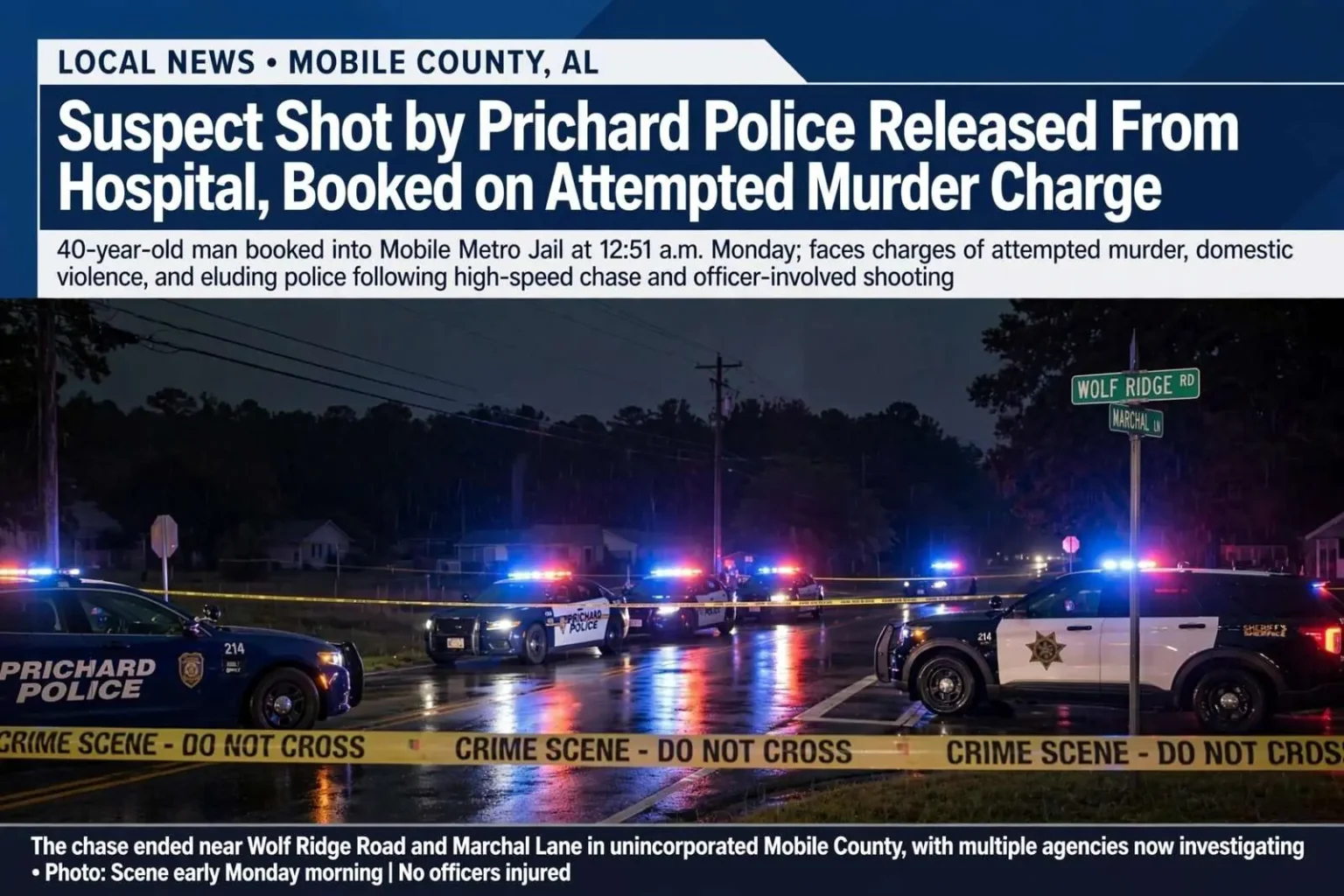
A 40-year-old man who was shot by police after a high-speed chase in Mobile County was released from the hospital and booked into the Mobile Metro Jail overnight, according to jail records, turning a freeway-speed exchange of gunfire into the opening entry of a criminal case. Cecil James was booked at 12:51 a.m. Monday on an attempted murder charge, records show. He also faces charges of domestic violence and eluding police — a stack of accusations that traces the incident from whatever prompted the initial stop, through the pursuit, to the gunfire that ended it.
The case began, authorities said, with a traffic stop that went wrong. Captain Paul Burch of the Mobile County Sheriff’s Office said the chase began when a Prichard police officer attempted to pull James over. What followed was a vehicle pursuit through the streets of the county — the kind of escalating sequence that moves quickly from routine policing to emergency response, as the fleeing driver’s choices multiply the danger to everyone along the route. Prichard, the small city just north of Mobile along the U.S. 45 and Telegraph Road corridors, is patrolled by its own municipal department, whose officers handle the daily traffic and street-level calls of a community of roughly 20,000.
According to authorities, James fired shots at the officer from his car during the pursuit, and the officer returned fire. The exchange transformed a fleeing-suspect case into an officer-involved shooting, triggering the layered review that such incidents always bring: the immediate criminal case against the shooter, and the separate administrative and legal review of the officer’s use of force. No officers were injured in the encounter.
The pursuit ended near Wolf Ridge Road and Marchal Lane, where James was shot six times, according to officials. The location sits in the unincorporated county area north of Prichard, terrain the Mobile County Sheriff’s Office patrols, which is how the sheriff’s office became central to the case alongside the Prichard department. James was wounded at the scene and transported for treatment of his injuries — the hospital stay that preceded his overnight booking.
The Charges and the Questions
The attempted murder charge reflects the account authorities gave of the pursuit: a driver firing a weapon at a police officer is charged as an attempt to kill, regardless of whether the officer was struck. The accompanying domestic violence charge indicates authorities believe a separate offense against a household or family member was connected to the episode, and the eluding charge covers the pursuit itself under Alabama law, which treats fleeing or attempting to elude a police officer as a criminal offense whose severity climbs with the danger created.
Burch could not confirm why the officer initiated the traffic stop — a gap that underscored how much of the incident’s origin remained under investigation even as the criminal charges moved forward. But the sheriff’s office noted one detail from the scene: the vehicle James was driving carried an expired tag, one that had been expired since 2003. A twelve-year-expired plate is the kind of detail that makes a vehicle conspicuous to patrol work, and it was among the few concrete facts released about what first put the car in the officer’s sights.
The investigation that follows such a shooting is deliberately redundant. The FBI and the Mobile Police Department are assisting with the case, and agents were on the scene in the hours after the gunfire. FBI involvement in a local officer-involved shooting serves two functions at once: it provides additional investigative resources, and it establishes the federal review that determines whether the shooting violated federal civil rights law — a review that runs independently of whatever the state charges produce. Mobile police assistance reflects the region’s practice of borrowing investigators across jurisdictions when an incident involves a smaller department, spreading expertise and preserving public confidence that the inquiry is not left solely to the agency whose officer fired.
FBI Assisting Through VGRIP
The FBI agents on the scene were supporting Prichard police as part of VGRIP — the Violent Gang and Gun Investigative Partnership — an ongoing county operation in which federal and local agencies jointly patrol high-crime areas. The program pairs municipal officers who know the streets with federal agents who carry federal statutes and federal sentencing power, concentrating attention on the guns and repeat offenders that drive the county’s violent crime. For a city like Prichard, which has grappled for years with violent crime rates well above state averages, the partnership puts resources on the street that a department of its size could not field alone.
VGRIP’s presence in the case means the traffic stop that started everything may have occurred in a context of heightened, targeted patrol activity — though authorities did not say whether the officer involved was working a VGRIP assignment at the time. What the arrangement guarantees is that the aftermath is being examined through multiple lenses: Prichard’s internal review of the officer’s actions, the sheriff’s office criminal case against James, and the FBI’s parallel federal assessment.
The incident also dropped into an ongoing public conversation in the Mobile area about police pursuits and their risks. Pursuit policy is among the most closely scrutinized areas of patrol work precisely because of how the danger spreads: a high-speed chase endangers the officer, the suspect, and every motorist and pedestrian along the route, for an offense — a traffic violation — that starts as a paperwork problem. Departments across the country weigh that calculus in their written pursuit policies, restricting chases to cases where the danger of letting a suspect go is greater than the danger of chasing him. When a pursuit escalates to gunfire, as this one did, the original reason for the stop becomes the central question of the review — which is why the unresolved detail of what prompted it looms over the case.
James, meanwhile, moves from hospital bed to jail dockets. Booked shortly before 1 a.m. Monday on the attempted murder, domestic violence, and eluding charges, he will face the state’s case in Mobile County District Court, where initial appearances set bond and schedule the preliminary hearings that test the prosecution’s account. The officer involved remains on the administrative side of the ledger pending the reviews, and the FBI’s findings will arrive on their own timeline. What began with an expired tag on a dark Prichard street ended six miles, one gunfight, and six bullets later — and every part of it is now being unwound, formally, by three agencies at once.
The geography of the chase explains how several agencies converged on one case. Prichard sits just north of Mobile’s city limits, and its streets connect quickly to unincorporated Mobile County on the city’s northern and western edges — the area around Wolf Ridge Road included. A vehicle fleeing a Prichard officer can cross jurisdictional lines in seconds, which is why pursuits in that corridor routinely involve the Mobile County Sheriff’s Office, and why the case against James landed in the county’s system rather than a single municipal court. The Mobile Metro Jail on the county complex, which books arrestees for every agency in the area, logged James’s arrival at 12:51 a.m. — the formal handoff from a hospital ward to the criminal justice machinery.
The domestic violence charge attached to the case adds a dimension authorities did not elaborate on, but its presence on the docket alongside the pursuit charges is significant in Alabama’s system. Domestic violence offenses carry their own court procedures, protective-order implications, and federal firearms consequences, and prosecutors treat an armed suspect facing such a charge as an elevated risk — context that may bear on the account of the night’s events even as the details remain unreleased. Under Alabama’s record-sealing practices for domestic violence arrests, much of that context may never become public unless the case proceeds to trial.
For Prichard residents, the shooting and its multi-agency aftermath are the latest chapter in a long relationship with violent crime and the policing that answers it. The city has cycled through police leadership and state assistance over the years, and its neighborhoods have lived through the tension every community feels when officers fire their weapons — the demand for both safety and accountability, held at once. VGRIP’s joint patrols are part of how the county has tried to answer the first demand; the FBI’s presence in this investigation speaks to the second. Both will determine how the story of the pursuit near Wolf Ridge Road is ultimately understood.
The immediate facts, though, are the ones authorities could confirm: a 40-year-old Mobile County man, driving a vehicle with a tag expired since 2003, fled a Prichard traffic stop, fired at an officer from his moving car, was shot six times when the officer returned fire, survived his wounds, and was booked into the Mobile Metro Jail before dawn on attempted murder, domestic violence, and eluding charges. No officers were hurt. The chase ended near Wolf Ridge Road and Marchal Lane; the legal case it produced is just beginning.


