SUV Bursts Into Flames at Mobile Intersection; Driver, Passenger Escape Unharmed
An SUV burst into flames Monday morning at a busy Mobile intersection, with the driver and passenger escaping safely before the vehicle was fully engulfed.
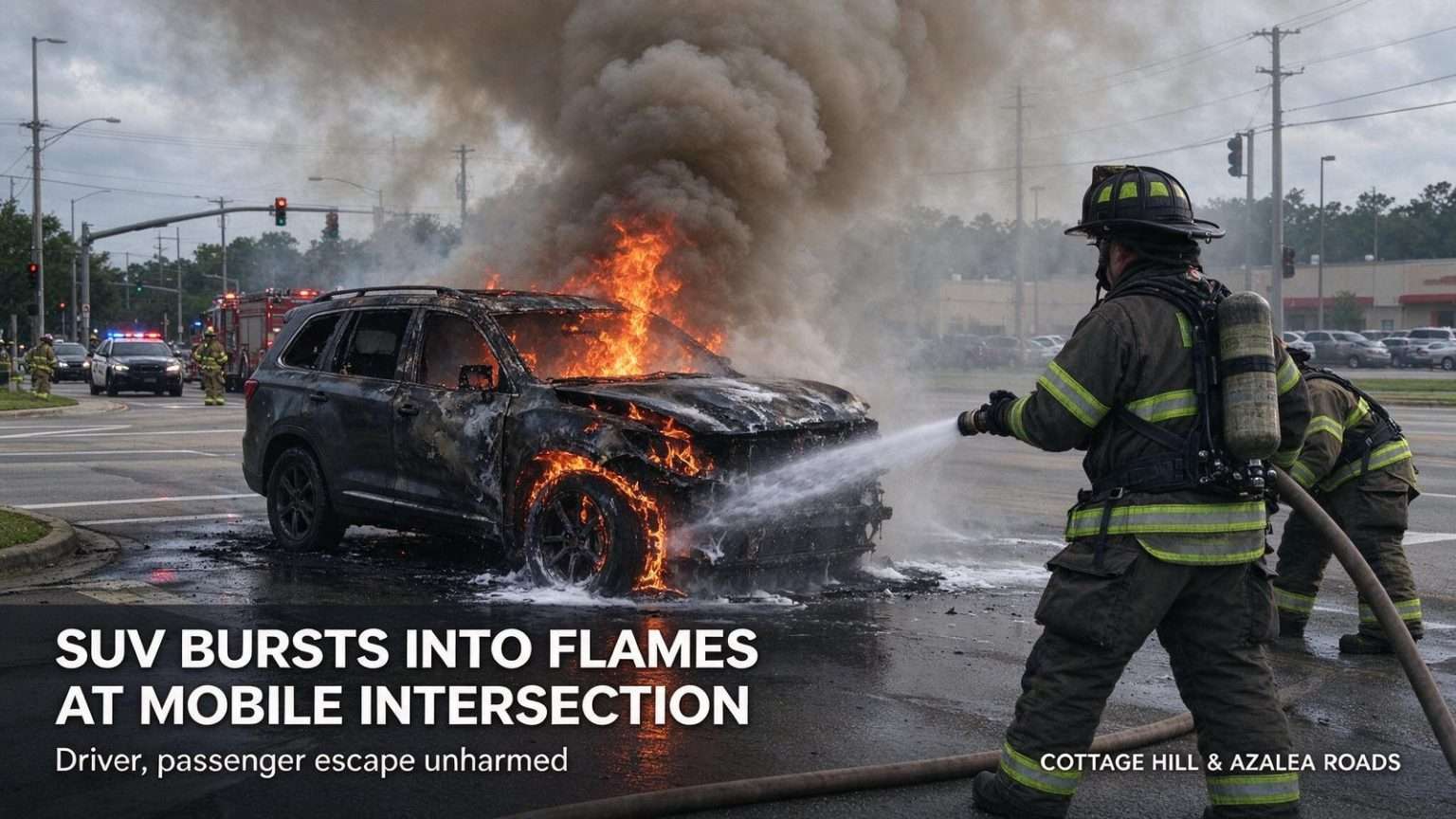
Two people walked away uninjured Monday morning after the SUV they were riding in caught fire at a busy west Mobile intersection. The fire broke out around 9:15 a.m. at the intersection of Cottage Hill Road and Azalea Road, one of the area’s busiest crossroads, and the vehicle was fully engulfed before firefighters could stop the flames.
Witnesses reported a loud pop followed by a plume of smoke, with flames shooting out of the vehicle’s grill and engine block. The driver and a passenger were able to get out of the SUV before the fire spread into the passenger compartment. Police said no one was injured, and investigators believe a mechanical problem was responsible for the blaze.
A close call at a major intersection
The Cottage Hill Road and Azalea Road intersection sits in the heart of west Mobile’s commercial corridor, surrounded by shopping centers, restaurants and office parks, and it carries heavy traffic throughout the day. A vehicle fire at that junction during the mid-morning hours drew immediate attention from passing drivers and nearby businesses, and emergency crews had to manage both the burning vehicle and the traffic around it.
Vehicle fires at intersections create hazards beyond the flames themselves. Burning vehicles release toxic smoke, and there is always a risk the fire will spread to nearby cars or that the vehicle will move if it was left in gear. First responders typically close the affected lanes and sometimes the whole intersection until the fire is out and the wreck can be removed, which means a fire like Monday’s can snarl traffic on Cottage Hill and Azalea for some time even after the last flames are gone.
Why engine fires start
Fire investigators said the initial evidence points to a mechanical problem, which is consistent with how most vehicle fires begin. The engine compartment concentrates nearly everything a fire needs: fuel lines, hot exhaust components, electrical wiring, flammable fluids and battery connections. A leaking fuel line that drips onto a hot exhaust manifold, a chafed wire that arcs, or a failed component that sprays oil across a heat source can ignite a fire that spreads in seconds through the engine bay.
The loud pop witnesses described is a common feature of vehicle fires. It can come from a hose or belt failing, a component bursting under heat and pressure, or small parts exploding as the engine compartment heats rapidly. Once flames reach rubber, plastic and fluid lines under the hood, the fire accelerates quickly — which is why the occupants’ fast exit mattered so much. A fire that starts in the engine bay can reach the passenger compartment within minutes, filling the cabin with smoke and toxic gas before the vehicle is visibly engulfed.
What drivers should do if their vehicle catches fire
Safety agencies give the same advice after every vehicle fire: get out, get away, and call 911. Drivers who notice smoke, a burning smell or warning lights should pull over immediately, shut off the engine and exit with all passengers, moving well away from the vehicle and keeping other people back. Officials warn against opening the hood to look for the source — a sudden influx of air can turn smoldering into an open fire and can direct flames back toward the person standing there.
Firefighters also urge motorists never to attempt to fight a vehicle fire beyond, at most, using a small extinguisher on a tiny, isolated fire from a safe distance with an escape route behind them. Vehicle fires burn hot enough to rupture struts, bumpers and fuel lines, and burning fluids can spread across pavement quickly. The two occupants of the SUV did exactly what experts recommend: they left the vehicle instead of trying to save it, and that decision is why no one was hurt.
Warning signs that a vehicle may be at risk
While Monday’s fire appeared to come on suddenly, vehicle fires often telegraph themselves first. Mechanics and safety officials point to a checklist of warning signs owners should never ignore: the smell of burning rubber or plastic, smoke from under the hood or from the vents, a fuse that blows repeatedly, oil or fluid spots left under a parked vehicle, an engine that runs noticeably hotter than normal, or a temperature gauge that climbs into the red. Electrical problems — flickering lights, a burning odor when the air conditioner runs, or intermittent failures of accessories — deserve the same immediate attention.
Older vehicles are not automatically unsafe, but deferred maintenance raises the risk that a worn hose, a corroded fuel line or brittle wiring will fail at the worst possible moment. Routine inspections give a mechanic the chance to catch leaking fluids and damaged lines before they meet an ignition source. Drivers who have been putting off a repair for a smell or a leak can take Monday’s burned-out SUV as a reminder that those small symptoms are worth a service visit.
The response in Mobile
Police and fire crews responded to the intersection and secured the scene while the fire was brought under control. Mobile Fire-Rescue handles hundreds of vehicle fires across the city in a typical year, and the department’s standard response includes not only extinguishing the fire but making sure the vehicle is stable, checking for hazards such as leaking fuel, and turning the scene over to police for traffic control and documentation.
Because no injuries were reported, Monday’s incident will likely be recorded as a property-loss event rather than an injury crash. Investigators determine the cause based on the physical evidence — the origin point of the fire, the pattern of burning, and the condition of the vehicle’s fuel, exhaust and electrical systems. In fires like this one, where the evidence points to a mechanical failure rather than a collision or an ignition source outside the vehicle, the investigation typically closes quickly.
After the fire: insurance and towing
For the SUV’s owner, the aftermath involves a tow from the scene, a report for the insurance company and a decision about the vehicle’s future. Comprehensive coverage on an auto policy generally applies to fire damage, including fires caused by mechanical failure. Once an insurer declares a vehicle a total loss — common when fire reaches the passenger compartment or destroys the engine bay — the company pays out the vehicle’s actual cash value, and the wreck is sold for salvage.
Drivers without comprehensive coverage bear the cost themselves, and a burned vehicle still has to be lawfully disposed of rather than abandoned. Mobile residents can work through their towing company and insurer on that process. The episode at Cottage Hill and Azalea Roads ended without injuries, but it left a stark image: a burned-out vehicle in the middle of one of west Mobile’s busiest intersections, a reminder of how quickly an ordinary Monday drive can turn dangerous.
A shareable lesson from a no-injury fire
The most useful takeaway from Monday’s fire may be how it ended. Both occupants escaped before the vehicle was fully engulfed, and no one who stopped to help or who was caught in the resulting traffic was hurt. Emergency responders often note that the first minutes of a vehicle fire decide the outcome — occupants who exit immediately and move away give firefighters a straightforward job, while those who stay to retrieve belongings or inspect the engine put themselves and rescuers at risk.
As traffic returned to normal at Cottage Hill and Azalea Roads, investigators were left to confirm what witnesses and officers already suspected: a mechanical problem turned an ordinary commute into a burned vehicle and a closed intersection. It was, in the end, the best possible version of a bad morning — and a demonstration that pulling over and getting out is never the wrong call.
Vehicle fires in the Gulf Coast climate
The Gulf Coast’s climate adds its own stress to aging vehicles. Long, hot summers push engine temperatures to their limits, humidity accelerates corrosion on electrical connections and fuel lines, and stop-and-go traffic on corridors like Cottage Hill Road keeps cooling systems working hard. Mechanics across Mobile County report that late summer is when they see the most heat-related failures — overheated engines, burst hoses and battery problems — and those are precisely the failures that can set the stage for an engine fire.
Residents who park outside, as most in the region do, can reduce risk with a few habits: checking under the car for fresh fluid spots, listening for changes in how the engine runs, and taking any burning smell seriously the first time it appears. A vehicle that has recently been repaired should get extra attention after a visit to the mechanic, because improperly seated hoses or connections introduced during service are a known contributor to under-hood fires.
Emergency officials in the Mobile area periodically remind drivers about vehicle fire safety after high-profile incidents, and Monday’s fire at Cottage Hill and Azalea Roads gives them a fresh local example. The message rarely changes: maintenance prevents many fires, early warning signs predict most of the rest, and a fast exit protects lives when prevention fails. The two people in Monday’s SUV are a reminder that following that sequence works.