SUV crashes into building on Dauphin Street in Mobile
Mobile Police are investigating after an SUV crashed into a building on Dauphin Street near I-65; one person was taken to the hospital with minor injuries.
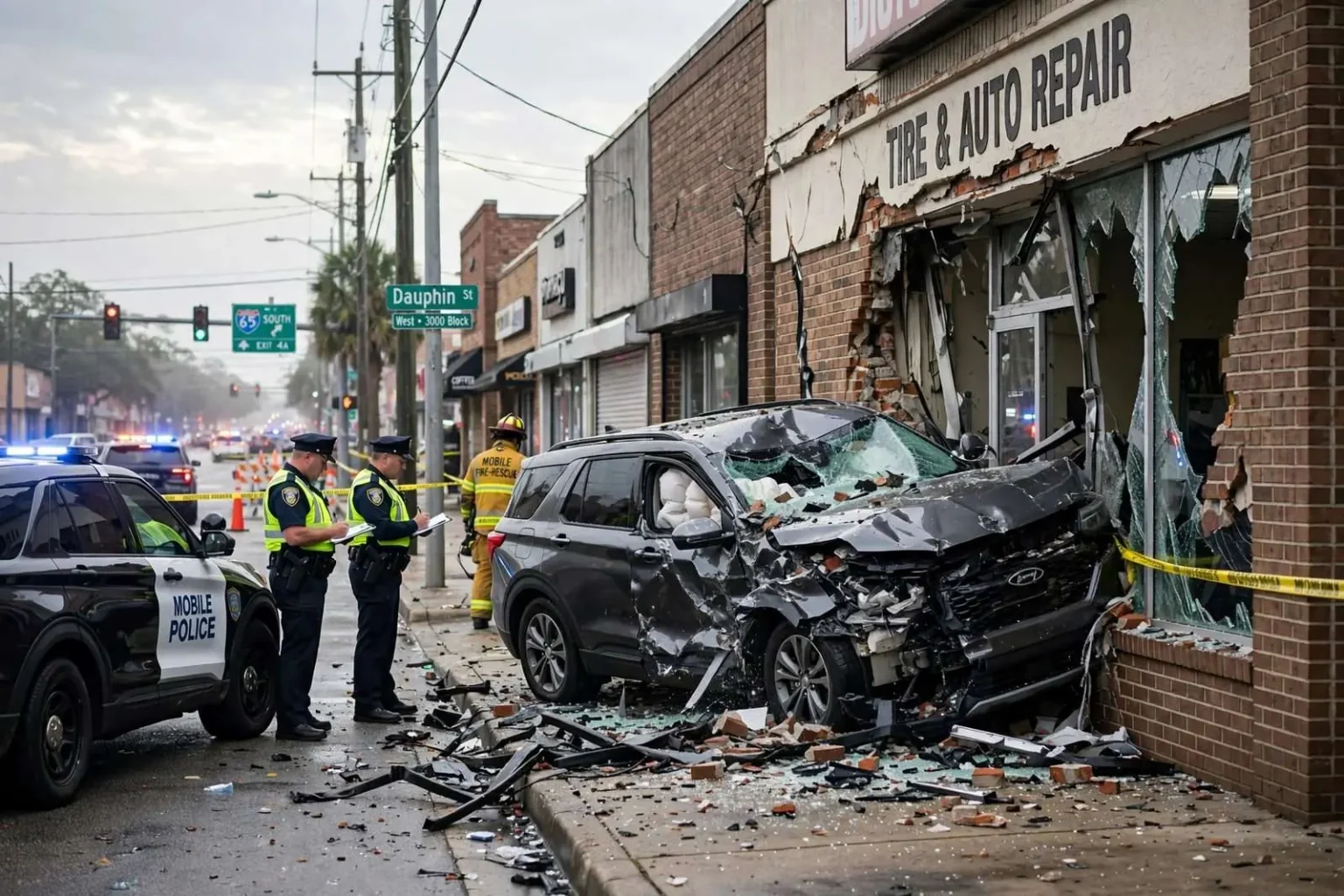
MOBILE, Ala. — Mobile Police are investigating after an SUV crashed into a building Sunday morning, leaving one person injured and raising familiar questions about the hazards that come when vehicles leave the roadway at speed.
The crash happened just before 9 a.m. Sunday on Dauphin Street near Interstate 65, one of the busiest stretches of one of Mobile’s principal east-west corridors. The SUV struck a building at the location, and emergency responders arrived to find one person injured in the incident.
That individual was taken to a local hospital with what were described as minor injuries — a notably fortunate outcome given the nature of the crash. Vehicle-into-building collisions frequently produce far more serious results, both for occupants of the vehicle and for anyone inside the structure, and the reported injuries in this case were minor by comparison.
Police did not immediately release details about what caused the SUV to leave the roadway and strike the building, and the investigation remained active as officers worked the scene and began piecing together the sequence of events. As is typical in the early stages of such investigations, authorities had not determined whether driver error, a medical emergency, impairment, distraction, or some mechanical failure was responsible.
The Scene on Dauphin Street
Dauphin Street is one of Mobile’s oldest and most important thoroughfares. It runs from the historic downtown core westward through the heart of the city, and the stretch near Interstate 65 sits in the city’s busy western section, where commercial development lines both sides of the road and traffic volumes are heavy throughout the day. The intersection area near the interstate ramps funnels vehicles between the surface street and the interstate, adding to the constant movement of traffic.
Corridors like this one concentrate exactly the conditions that produce vehicle-into-building crashes: fast-moving traffic, frequent turning movements, congested intersections, and buildings set close to the roadway with parking areas between. When a driver loses control in such an environment, the margin between staying on the pavement and striking a structure is thin.
Crashes of this kind typically trigger responses from multiple agencies. Police secure the scene and investigate the cause; fire crews evaluate the structural stability of the building, check for fuel leaks and fire risk, and assist with extrication if anyone is trapped; and emergency medical services transport the injured. The coordination is routine for first responders, but it reflects the genuine complexity of a crash that involves both a vehicle and a structure.
Vehicle-Into-Building Crashes: A Recurring Hazard
Crashes in which vehicles strike buildings are far more common than most people realize. National estimates count thousands of such incidents every day across the country, ranging from minor bumper taps against storefronts to catastrophic impacts that collapse walls. Storefronts, restaurants, and buildings near intersections bear the brunt of these crashes, and the causes cluster around a handful of familiar patterns.
Pedal error — a driver intending to brake but pressing the accelerator — is among the most frequent causes, particularly in parking lots and near driveways where drivers maneuver at low speed. Speeding and loss of control account for many of the high-impact crashes on surface streets. Medical emergencies behind the wheel, impaired driving, and mechanical failures round out the common causes. Determining which of these applied on Dauphin Street was the central task facing Mobile Police investigators as they examined the SUV and the crash scene.
The people inside the building are often at the greatest risk in such crashes, since no building code anticipates a vehicle arriving through the wall. Store owners and employees near busy corridors experience the threat as an ongoing hazard, and safety advocates have long pushed for protective measures — bollards, curbing, and parking configurations that separate vehicles from structures — as inexpensive ways to reduce the damage.
Mobile Police and Crash Investigation
The Mobile Police Department handles traffic crash investigations across Alabama’s second-largest city, from routine fender-benders documented by patrol officers to serious-injury and fatality crashes worked by specialized traffic units. A crash involving injuries and a struck building falls into the category that requires more than a routine report: investigators document the scene, photograph vehicle damage and building damage, measure skid marks and final resting positions, and interview witnesses.
Modern crash reconstruction draws heavily on physical evidence. The path the SUV traveled, the point of impact, the damage profile, and the vehicle’s final position all feed into an analysis of speed and direction. When the investigation requires it, investigators can obtain a warrant to download information from the vehicle’s event data recorder — the so-called black box that records speed, throttle position, and braking in the seconds before an impact.
Investigators will also want to account for the driver’s condition. Standard practice in injury crashes includes evaluating whether impairment played a role, checking for signs of a medical emergency, and reviewing whether distraction — a phone in use at the moment of the crash — contributed. Each of these possibilities carries different legal consequences, which is why police departments avoid announcing causes before the evidence is in hand.
The fact that only one person was reported injured, with minor injuries, narrowed the investigative scope considerably. Crashes with serious injuries bring hospital interviews, longer reconstructions, and sometimes criminal charges; crashes with minor injuries still get full documentation, but the process moves faster and the scene typically clears sooner.
Dauphin Street’s Traffic History
The corridor where the crash occurred has long been part of Mobile’s traffic map. Dauphin Street extends from the downtown district — where it anchors the city’s historic street grid and its entertainment scene — westward through residential and commercial districts for miles, eventually reaching the city’s western edges near the Interstate 65 corridor.
The intersection of a major surface street with an interstate is a natural crash concentration point. Vehicles enter and exit the interstate at speed, merge into surface traffic, and navigate signals and turning lanes within a compact space. Add the commercial density that gravitates toward such intersections, and the environment produces regular incidents of every kind, from rear-end collisions in congested lanes to the occasional dramatic departure from the roadway like Sunday’s crash.
City and state traffic engineers track crash patterns along corridors like Dauphin Street to guide improvements — signal timing, turn lanes, signage, and lighting all get adjusted in response to the record. A crash that puts an SUV into a building adds to that record, and whatever its cause, it becomes another data point in the long effort to make the corridor safer for the drivers, pedestrians, and businesses that share it.
For the building’s occupants and owner, Sunday’s crash began an entirely separate process from the police investigation. Structural damage from a vehicle impact must be assessed before the building can safely reopen, and the repairs that follow — wall reconstruction, electrical checks, possible code upgrades — can take weeks depending on the severity of the impact. Commercial insurance typically covers vehicle-into-building damage, but the disruption to a business’s operations is real regardless of how the claim resolves.
Sunday Morning Crashes and Emergency Response
That response sequence matters, because the first minutes after a vehicle strikes a building carry specific risks that responders are trained to manage. Fuel systems can leak and ignite. Walls damaged by impact can shift or collapse. Airbag residue, broken glass, and fluid spills create hazards for anyone moving through the scene. The quick stabilization of the scene — the vehicle secured, the building checked, the injured person assessed and transported — is the visible product of training that Mobile’s first responders carry out on dozens of crash scenes every week.
The injured person’s transport to the hospital with minor injuries was the best available outcome from the incident. Emergency medical protocols for crash victims err on the side of hospital evaluation even when injuries appear minor, since some internal injuries present subtly at first. The description of the injuries as minor suggests the individual was awake, alert, and expected to recover — a result that, given the potential severity of vehicle-into-building crashes, borders on the fortunate.
What Happens Next in the Investigation
In the days following a crash of this kind, Mobile Police investigators typically complete their scene documentation and move to the slower work of the file: reviewing witness statements, gathering any available camera footage from nearby businesses, and consulting with the vehicle examination findings. Many commercial corridors in west Mobile are covered by security cameras, and footage from those systems frequently provides the most direct evidence of how a crash unfolded.
The department’s eventual public accounting of the crash will depend on what that evidence shows. If the investigation concludes that the crash resulted from simple driver error, the matter typically ends with citations if warranted and an insurance process. If impairment or recklessness was involved, criminal charges can follow. If a medical emergency caused the driver to lose control, the incident usually closes as an unavoidable accident.
Until that determination, the details police released — an SUV, a building on Dauphin Street near Interstate 65, a Sunday morning just before 9 a.m., one person injured and hospitalized with minor injuries — remain the complete public record. Departments like Mobile’s deliberately keep early statements minimal in injury crashes, both to avoid prejudicing the investigation and to ensure that what they do release is accurate.
The Larger Picture of Traffic Safety in Mobile
Sunday’s crash fits within a broader traffic safety landscape that Mobile, like cities across the country, continues to manage. The metro area’s road network carries hundreds of thousands of daily trips, and the corridor system — interstates 10 and 65 crossing at the heart of the city, ringed by major surface arterials like Dauphin Street — concentrates traffic onto a limited number of routes. Corridors of that kind experience the metro’s share of crashes in proportion to their traffic, which means the busiest streets see the most incidents.
Traffic safety officials have increasingly focused on the behaviors that drive serious crashes — speed, impairment, distraction, and unbuckled occupants — because those behaviors account for the large majority of severe outcomes. The minority of crashes, like this one, that involve vehicles leaving the roadway entirely draw attention to a different set of countermeasures: roadway design, clear zones, and the physical separation between traffic and structures.
For the businesses and residents along Dauphin Street’s western stretch, Sunday morning’s scene — police vehicles, the SUV against the building, the response units working the incident — was a brief disruption that ended comparatively well. One person went to the hospital with minor injuries. The building took damage that can be repaired. And the investigation that followed will add Mobile Police’s conclusions to the record of a crash that, by the standard of what could have happened, ended gently.
The department’s investigation remains the authoritative account in progress. Anyone with information about the crash — particularly drivers or residents who were in the area of Dauphin Street near Interstate 65 just before 9 a.m. Sunday — can provide that information to Mobile Police, where it becomes part of the file that will eventually explain how an SUV came to leave one of the city’s busiest corridors and end its morning inside a building.