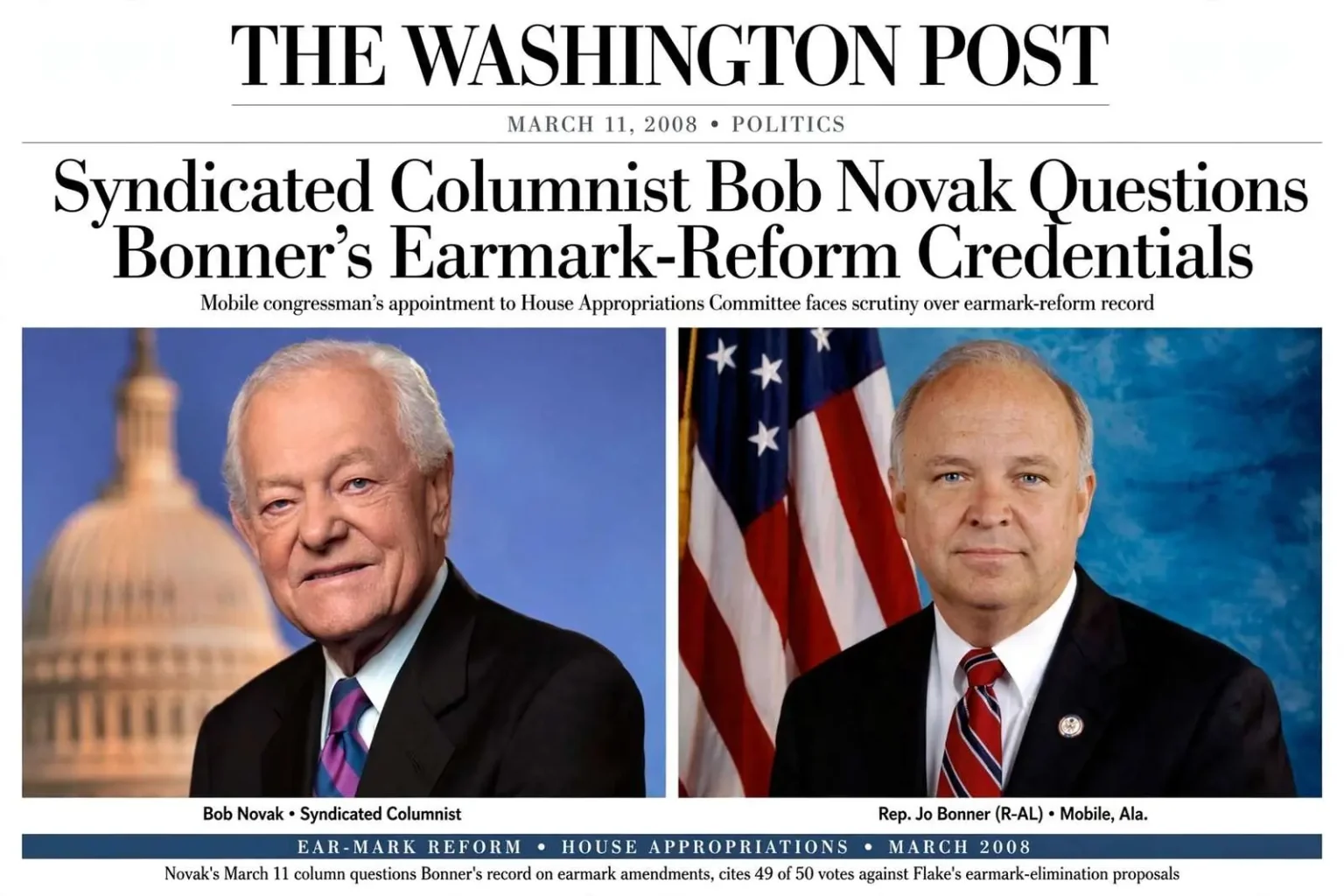
MOBILE, Alabama – Mobile’s congressman drew an unflattering mention from one of Washington’s most widely read political columnists in mid-March 2008, when Bob Novak used his nationally syndicated column in The Washington Post to question whether Rep. Jo Bonner was the right pick to help lead earmark reform on the House Appropriations Committee. For a hometown lawmaker who had built his career in the institution’s back rooms, the national spotlight was an uncomfortable one.
Novak’s column, published March 11, took aim at House Republican Leader John Boehner for the way he filled a vacancy on the powerful committee. Unlike Senate Minority Leader Mitch McConnell, Boehner does not request earmarks himself and has criticized the practice publicly. But according to Novak, Boehner passed up a chance to make a bolder statement at the start of the session, when he could have pushed the House Republican Conference to adopt a yearlong earmark moratorium and installed Rep. Jeff Flake of Arizona, one of the chamber’s most consistent earmark opponents, in the open Appropriations seat.
Instead, Republicans chose Bonner, a Mobile-area Republican who spent 18 years as a House staffer before winning his own seat in 2002. The choice of a veteran congressional insider for a seat that reformers hoped would go to an anti-earmark crusader was precisely the contrast Novak wanted to draw, and it framed the appointment as a test of whether the House GOP’s rhetorical commitment to spending discipline would survive contact with the committee that controls federal spending.
Novak noted that Bonner has voted against Flake’s earmark-elimination amendments in 49 of 50 attempts, a record that made the appointment difficult to sell as a reform measure. Flake, who represented a Phoenix-area district, had made a name for himself by taking to the House floor week after week to challenge individual earmarks, forcing colleagues to vote on spending projects they would rather have passed without a recorded vote. His amendments rarely succeeded, but the votes they produced became a public scorecard that columnists and watchdog groups mined for evidence of who supported the practice and who opposed it.
The “fair value” defense
The columnist also observed that Bonner has told his constituents he would work to get them “fair value” for their tax dollars, the same rationale lawmakers have long used to justify bringing federal earmarks home to their districts. In Bonner’s framing, the alternative to earmarking is not automatically less spending – it is spending decided entirely by executive branch bureaucrats with no input from the representatives who answer to the affected communities. That argument has long been the standard defense of the practice, and Novak’s column treated it as evidence that Bonner was an unlikely standard-bearer for its reform.
Novak wrote that Boehner nonetheless hailed Bonner’s selection as a step toward earmark reform, a characterization the columnist clearly viewed with skepticism. The episode is the latest example of the national scrutiny Bonner has drawn since conservatives pushed for his appointment to the Appropriations Committee as part of a broader earmark-reform push within the House GOP. Bonner’s move to the committee marked a significant career milestone – Appropriations seats are among the most coveted in the House, controlling one-third of federal spending – but the reform politics of 2008 meant the appointment arrived wrapped in a controversy about what it signaled.
Novak himself was a fixture of Washington journalism by 2008, having written his syndicated column for decades and built a reputation for sourcing the capital’s inside disputes. A mention in his column carried weight precisely because it reflected the internal debates of the party’s own leadership circles rather than outside agitation, and for Mobile readers it offered a window into how their congressman’s promotion was being discussed in Washington terms they rarely saw.
The earmark fight of 2008 was one of the defining intra-party battles of the era. The practice of directing federal money to specific projects – roads, universities, harbors, museums – had grown explosively through the 2000s, and scandals involving individual members had turned earmarks into shorthand for Washington excess. Fiscal conservatives like Flake argued that the system bred corruption and wasteful spending, while members who secured projects for their districts argued that Congress, not the administration, was the constitutionally designated body to direct federal spending.
Is the criticism fair?
Whether that criticism of Bonner is entirely fair is another question. Bonner is unlikely to match Flake’s hawkishness on spending cuts, but he is also a different kind of appropriator than Rep. John Murtha, the committee’s Democratic chairman and one of the House’s most prolific earmarkers, or even Alabama’s senior senator, Richard Shelby, who has never shied from using earmarks to direct federal money to Alabama projects. Shelby’s willingness to steer funding to the state has made him one of the most influential figures in Alabama politics, and it illustrates the competing reality that the same practice conservatives condemn has delivered tangible projects to South Alabama – from port and harbor work to university research – that the region might not otherwise have secured.
Bonner’s own path to the committee reflected the district’s long tradition of congressional seniority. He succeeded longtime Rep. Sonny Callahan, a Mobile Republican who himself served on the Appropriations Committee and used the seat to steer federal money to the Gulf Coast. Bonner’s 18 years as a House staffer before winning the seat in 2002 gave him a deep command of the institution’s procedures, the kind of inside expertise that committee work rewards – and the kind of profile that reformers, who prized outsiders over institutionalists, viewed with suspicion.
The tension embedded in the appointment is one that touches every member who takes an Appropriations seat. The committee’s power comes from its control of spending, and members are elected in part for their ability to bring that spending home. Asking the same member to reform the system that defines his value to the district is a contradiction that Bonner’s critics considered disqualifying and his defenders considered manageable: a member can support stricter disclosure, competitive processes and transparency rules without renouncing the practice altogether.
The debate Bonner walked into has never fully gone away. In the years since, House Republicans have at times banned earmarks entirely, then watched pressure rebuild to restore them, with members arguing in each cycle that the ban simply shifted decisions to the executive branch. Flake’s floor amendments, the moratorium proposals and the columns written about them all belong to a single continuing argument about whether Congress can direct spending responsibly – an argument Bonner’s appointment became a small but symbolic part of.
For Mobile-area readers, the column is a reminder that a hometown congressman’s committee assignments and voting record can draw national attention well beyond the district, particularly during a period when earmark spending had become one of the most contentious issues in Washington. A vote cast in the House chamber shows up on scorecards compiled by watchdog groups, feeds into columns read across the country, and shapes the national reputation of a lawmaker whose daily work is otherwise devoted to local needs – harbor dredging, highway projects, military installations and the constituent services that never make headlines.
How Bonner balances that national profile against the expectation, voiced by his own constituents, that he will continue delivering federal money to South Alabama projects is likely to remain a point of scrutiny as the earmark-reform debate continues. The district’s interests give him every reason to defend the practice; his party’s reform politics give him every reason to show restraint. Between those two pressures sits the Appropriations seat itself – powerful, coveted, and, as the March 11 column made plain, impossible to fill without choosing a side in the argument over how Washington spends.
What the episode ultimately illustrated is the double edge of congressional seniority for Gulf Coast districts. The same committee position that lets a Mobile congressman influence federal spending for the region also makes him a target whenever the politics of spending turn hostile, as they had by 2008. Novak’s column was one journalist’s verdict on how the House Republicans handled that tension; the district’s voters would render their own judgment at the ballot box, where the promise of “fair value” for local tax dollars has always been an easier sell than the abstractions of reform.
The scrutiny of the committee appointment also reflected the times. The spring of 2008 was a season of fiscal anxiety in Washington, with war costs mounting and the economy sliding toward recession, and every spending practice in the Capitol was being reexamined through that lens. Presidential candidates in both parties had made earmark pledges part of their campaigns, and House leaders felt that pressure directly. Against that backdrop, the choice between Flake and Bonner for a single committee seat became a proxy for the direction of the entire conference.
Novak’s audience for the critique was precisely the constituency that mattered in that fight: conservative readers, party activists and the members themselves, who track how their leadership decisions play in the movement press. A critical column from an established Washington hand could complicate the leadership’s narrative that the appointment advanced reform, and it added to the accumulating public record that reform advocates would draw on in later debates over disclosure rules and moratorium votes.
For Bonner, the practical effect was to raise the price of the committee promotion he had long sought. Any future votes on earmark disclosure, any project requests he submitted, and any defense he offered of the practice would now be read against the reform label his leadership had attached to his appointment. Members of Congress routinely navigate such contradictions, but rarely with a national columnist keeping score from the moment the gavel falls on their appointment.
South Alabama’s stake in the outcome is easy to understate from Washington’s vantage. Appropriations members influence decisions on Mobile’s port, the region’s military installations, coastal environmental programs and the federal research dollars that flow to area universities – funding streams that shape the local economy in ways constituents feel directly. That is why the “fair value” argument resonates at home even when it draws skepticism nationally, and why Bonner’s balancing act between the two audiences was never a matter of rhetoric alone but of real dollars reaching the district.