Temporal City Festival Brought Site-Specific Art to Abandoned Downtown Mobile Spaces During Arts Alive 2011
The Temporal City Festival transformed abandoned downtown Mobile buildings near Cathedral Square into art installations during the 2011 Arts Alive weekend.
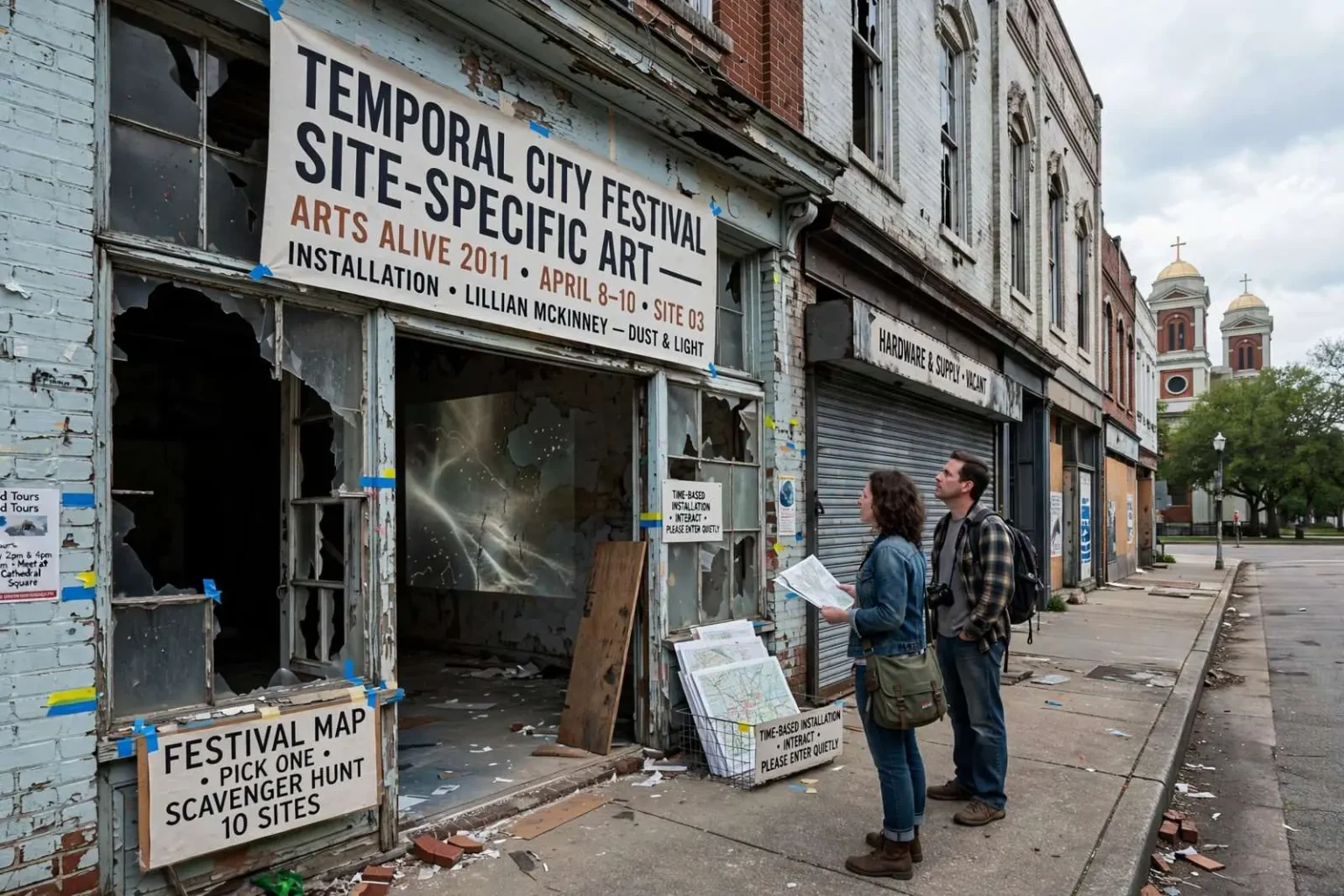
In April 2011, the streets and forgotten buildings of downtown Mobile became an open-air gallery as the Temporal City Festival transformed vacant and derelict spaces within a three-block radius of Cathedral Square into sites for creative exploration. For three days, the festival invited the public to step through doors that normally stayed locked, into storefronts and upper floors that had sat empty while downtown’s revival gathered pace around them. The event turned the city’s architectural gaps into its artistic assets, arguing that even unused buildings hold stories worth telling.
A Festival Within a Festival
Organized as a companion event to the annual Arts Alive celebration, Temporal City ran from April 8 through April 10 and focused on time-based and durational media art. The festival invited ten artists to create site-specific installations in unused downtown buildings, merging the city’s architectural landscape with unconventional artistic media. Time-based art — work that unfolds over minutes, hours or days rather than hanging static on a wall — demands a different kind of attention from viewers, and the festival’s organizers built the entire program around that premise. Where a painting waits, a durational work insists on presence, and the empty buildings of downtown Mobile gave audiences a reason to linger.
Participating artists included Lillian McKinney, Joe Hobbs, Adam Taylor, Ryan Jetten, Jimmy Lee, Riley Brenes, A. Friend, Timothy Dixon, and Elizabet Elliott. Each was tasked with developing a project tailored to a specific abandoned or underused space, ensuring that the works responded directly to the character and condition of their surroundings. Peeling plaster, dusty plate glass, stairwells closed for decades — every flaw in a building became material. The artists spent time in their assigned spaces before the festival opened, studying how light moved through the rooms and how the structures had been built, so that each installation grew out of its site rather than being imposed upon it.
The three-block radius around Cathedral Square was chosen deliberately. The square, anchored by the Cathedral of the Immaculate Conception on Dauphin Street, sits at the heart of Mobile’s historic district, where blocks of antebellum and early twentieth-century commercial buildings alternate with vacant lots and shuttered storefronts. Concentrating the festival in that footprint made it walkable, allowed visitors to see multiple installations in an afternoon, and placed the art in the exact neighborhood where questions about preservation, redevelopment and vacancy were most alive.
Art as a Scavenger Hunt
Rather than confining the experience to a single venue, the festival organizers designed viewership around the concept of a scavenger hunt. Visitors received an artist-designed map of the downtown area that marked the locations of all sited works, as well as scheduled artist talks and guided tours. The map encouraged attendees to chart their own course through downtown, discovering installations as they went. Each work revealed itself only to those willing to find it — down an alley, up a staircase, behind a door marked only with a festival sign.
Guided tours were also offered throughout the three-day event, along with opportunities for public conversation and dialogue with the artists. The format was intended to draw people deeper into the downtown streetscape while fostering direct interaction between artists and the community. Tour groups moved between sites on a schedule, giving visitors who wanted context a structured experience, while independent explorers followed the map at their own pace. At several sites, artists were present to answer questions about their process, turning the installations into conversations rather than displays.
The scavenger-hunt structure also solved a practical problem common to site-specific art: audiences rarely seek out work they cannot find. By gamifying the experience, organizers gave casual attendees a reason to visit installations they might otherwise skip, and the maps themselves — designed by the participating artists — became keepsakes that documented the festival’s geography. Visitors who completed the circuit saw downtown Mobile from angles residents had not seen in years: second-floor ballrooms, forgotten retail spaces, the bones of buildings awaiting renovation.
Revitalizing Vacant Spaces Through Art
The Temporal City Festival reflected a growing movement in Mobile’s arts community to reclaim neglected urban spaces for creative purposes. By placing artwork inside abandoned buildings and along underused corridors near Cathedral Square, the festival demonstrated an argument that arts advocates had been making for years: that vacancy is not the same as worthlessness, and that temporary uses can sustain buildings through the long gaps between redevelopment. Cities across the country had begun experimenting with similar approaches — pop-up galleries in empty storefronts, performances in warehouse districts — and Mobile’s arts organizers adapted the model to the city’s own stock of historic commercial architecture.
The timing was significant. Downtown Mobile in 2011 was in the midst of a slow recovery from decades of suburban flight, with new restaurants, loft apartments and investment arriving block by block while other buildings waited for buyers. Festivals like Temporal City kept those waiting buildings alive in the public imagination, and they introduced audiences to spaces that would, in some cases, be renovated or demolished in the years that followed. For many attendees, the festival was the first — and in some cases the only — chance to stand inside structures they had walked past their entire lives.
The integration with Arts Alive gave the experiment a built-in audience. Arts Alive had established itself as Mobile’s annual celebration of the visual and performing arts, drawing crowds to galleries and venues across the city, and the companion festival channeled some of that energy into the less polished corners of downtown. The pairing suited both events: the established festival gained an adventurous new component, and the younger project gained credibility and foot traffic it could not have generated alone.
What Time-Based Art Demands of a Place
The choice of durational and time-based media shaped everything about the festival, from the buildings selected to the way visitors moved through them. Work in these modes — video, performance, sound, slowly evolving installations — resists the quick glance of gallery browsing. A piece that changes over the course of an afternoon rewards return visits, and the festival’s three-day span allowed exactly that kind of extended engagement. Some installations incorporated the passage of days directly, marking time through accumulating materials, shifting light or scheduled actions, so that a visitor on Friday saw a different work than one who returned Sunday.
The empty buildings proved remarkably suited to such work. Deprived of furniture, fixtures and daily use, the spaces offered raw acoustics, unfiltered daylight through grimy windows and vast stretches of uninterrupted wall and floor. Artists exploited those qualities — sound pieces that echoed through empty retail halls, video projections that turned cracked plaster into screens, installations that documented the buildings’ own histories through the debris left inside them. The architecture was never just a container for the art; it was a collaborator in it.
For the ten artists, the festival offered something increasingly rare: free rein in a historic urban core, and audiences willing to hunt for their work. Site-specific practice is expensive andlogistically demanding in normal circumstances, since a work built into a building cannot easily travel or sell. Festivals like Temporal City exist precisely to absorb those costs for the sake of work that could only exist where it was made.
Building an Audience for the Unbuilt City
The public response reinforced what organizers had suspected: Mobile residents were curious about their own downtown. Attendance flowed through the three days, with the guided tours filling quickly and the maps circulating well beyond the festival’s opening crowds. Families explored together, photography enthusiasts documented the installations, and longtime residents traded memories of the businesses that had once occupied the now-empty rooms — a shoe store here, a barber shop there — layering personal history over artistic interpretation.
That exchange between memory and art was perhaps the festival’s deepest purpose. Every installation implicitly asked what these buildings had been and what they might become, and the answers visitors gave were as varied as the audience itself. Some saw the spaces as candidates for restaurants and apartments, in keeping with downtown’s revival; others valued them exactly as they were, as repositories of the city’s working past. The festival did not resolve that tension, but it made the buildings visible enough that the conversation could happen with real places in mind rather than abstractions.
The model left its mark on Mobile’s cultural landscape. Site-specific and place-based art projects continued to appear in the years that followed, and the festival’s scavenger-hunt format — mapping art across a neighborhood rather than concentrating it in a hall — recurred in other local events. In its three days around Cathedral Square, Temporal City demonstrated that Mobile’s vacant spaces could hold an audience, that its artists could rise to the demands of unusual sites, and that the most compelling gallery in the city might be the city itself.