Ten Years of Growth: How Mobile’s Arts Scene Transformed From 2003 to 2013
A decade-long look back shows Mobile's arts scene has grown significantly since 2003, with Space 301, the restored Saenger Theatre, a revitalized Mobile Arts Council and a wave of new festivals, theater troupes and grassroots creative groups reshaping the city's cultural landscape.
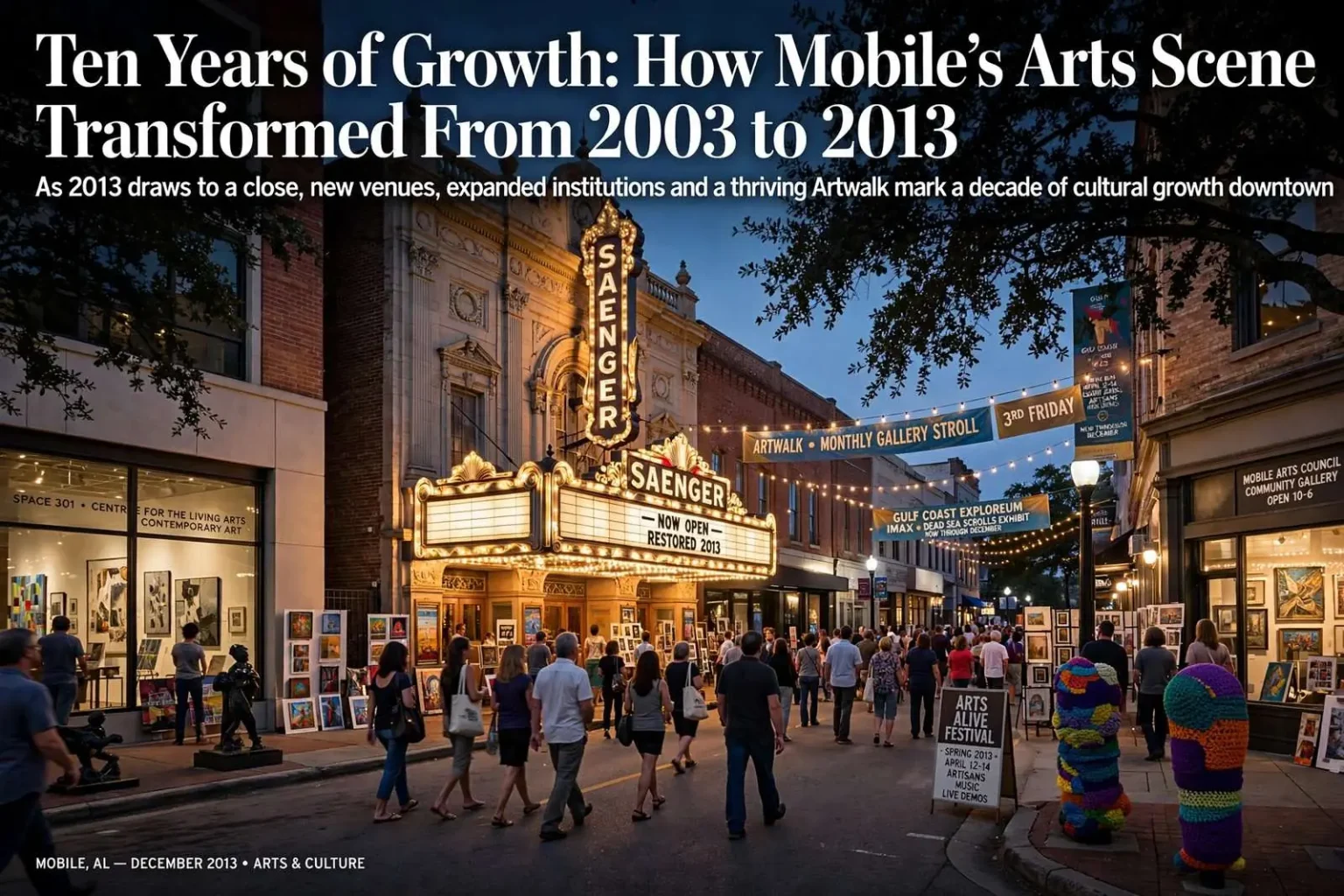
As 2013 draws to a close, Mobile’s arts and cultural community can point to a decade of tangible growth, with new venues, expanded institutions and a calendar of events that simply did not exist ten years ago. A look back at the last ten years shows just how much has changed for the city’s galleries, theaters, museums and grassroots creative groups — even as some familiar challenges remain.
Perhaps the most visible shift has been the rise of the monthly Artwalk. A decade ago, no such event existed downtown. Today, the monthly gallery stroll draws crowds large enough that police have experimented with closing an 11-block stretch of Dauphin Street to traffic to accommodate the foot traffic.
The Centre for the Living Arts has undergone a similar transformation. Ten years ago, the organization was putting the finishing touches on a new exhibit space inside a building on Cathedral Square that had once housed the city’s daily newspaper. That location, now known as Space 301, has since become one of the region’s premier venues for contemporary art, expanding to include CLA offices and additional amenities while hosting work from internationally recognized artists.
The CLA’s stewardship of the historic Saenger Theatre has also come full circle. A decade ago the organization was managing the aging downtown theater as best it could. Since then, the Saenger has undergone a $6 million restoration, returning it to its former grandeur, and control of the building has been handed back over to the city of Mobile.
The Mobile Arts Council has seen a similar rebound. Ten years ago the nonprofit was between directors and working out of a cramped downtown office. It has since hired a director who relocated from Indiana, secured a street-level home with high visibility, opened its own gallery space, ramped up fundraising events and launched an annual awards program recognizing members and organizations across the local arts community. The council has become a central gathering point for artists and arts supporters alike.
The Arts Alive festival, first held a decade ago, has evolved over the years but continues to return each spring, spotlighting the region’s artisans and creative disciplines.
At the Gulf Coast Exploreum, a string of record-breaking traveling exhibits — including the Dead Sea Scrolls, artifacts from Pompeii and Egyptian mummies — have drawn tens of thousands of visitors over the past ten years. Paired with its IMAX theater, the museum has become a major draw for both children and adults with an interest in science and history.
Next door, the History Museum of Mobile has seen leadership changes of its own, most recently bringing in a director whose résumé includes stints overseeing presidential libraries around the country. The museum’s former home on Government Street has since been repurposed as Mobile’s Carnival Museum, offering a year-round introduction to the city’s Mardi Gras traditions for visitors from out of town. The celebration itself gained international attention when Mobile native Margaret Brown made Mardi Gras the subject of her acclaimed documentary “The Order of Myths,” which examined both the joyous and complicated aspects of the tradition.
The Mobile Museum of Art, which unveiled a $15 million expansion a decade ago, has changed directors twice since but has built a reputation for engaging and provocative exhibitions during that stretch.
The Mobile Symphony Orchestra has also raised its profile considerably, hosting some of classical music’s most celebrated names over the past ten years, including violinist Joshua Bell, cellist Yo-Yo Ma and violinist Itzhak Perlman.
Film has found a lasting home downtown as well. The Crescent Theater, unforeseeable a decade ago, now serves as a permanent venue for arthouse and independent cinema. The city’s film offerings have grown alongside it, with the annual South Alabama Film Festival, the Fairhope Film Festival and Mobile’s inclusion on the Southern Circuit of Independent Filmmakers all adding to the calendar.
The biennial Southern Literary Trail has likewise become a regular fixture, celebrating notable authors with ties to the region.
Grassroots creative efforts have multiplied as well. A local yarn bomber known as the Knitting Loon began adorning downtown fixtures with colorful knitwork, while a graffiti artist working under the name Priest drew attention for Banksy-influenced pieces around the city before relocating to New Orleans. The Rumor Union, an artists’ collective focused on community engagement, established headquarters downtown and launched the annual Temporal City Festival, which repurposes the city’s vacant buildings for contemporary art installations. The group also helped organize a three-day festival honoring avant-garde composer John Cage earlier this year.
Theater has seen new life as well. While community theater groups in Midtown, Fairhope and Chickasaw remain the backbone of local dramatic arts, a satirical theater company called South of the Salt Line re-emerged in 2013, poking fun at the region’s local quirks and eccentricities, with plans for future productions.
Not every development over the past decade has been positive. WHIL-FM, long a fixture for fine arts programming, remains on the air but is no longer produced locally. GULF ArtSpace, a contemporary arts venue that made a splash in Fairhope, closed after a handful of years, and several downtown Mobile galleries that struggled to generate sales have shuttered or relocated during the same period.
The decade also brought the loss of several people who shaped the region’s cultural life, including patrons Palmer Bedsole, Ann Delchamps and Sam Eichold; former arts editor Gordon Tatum; entrepreneurs Leila Holloway and William Chesser; and artists Ira Swingle, Lil Greenwood and David McCann. Their absence remains felt across the community they helped build.
Even so, the growth across Mobile’s museums, theaters, festivals and grassroots arts organizations over the past ten years points to a cultural scene that has expanded well beyond where it stood in 2003 — and one that residents and observers expect will continue to build in the years ahead.
Roots of Two Landmarks
The Saenger Theatre opened in 1927 as a downtown movie palace. The Mobile Museum of Art traces its beginnings to the Fine Arts Museum of the South, founded in 1964, and sits in Langan Park in west Mobile.