Terry Lathan Tells Mobile Republicans the Closed Primary Fight Returns in 2027
Former ALGOP Chair Terry Lathan told the North Mobile Republican Women's Club that closed primary legislation will return in 2027 and that gubernatorial support could be decisive. She also discussed the SAVE Act and the Senate's 60-vote threshold.
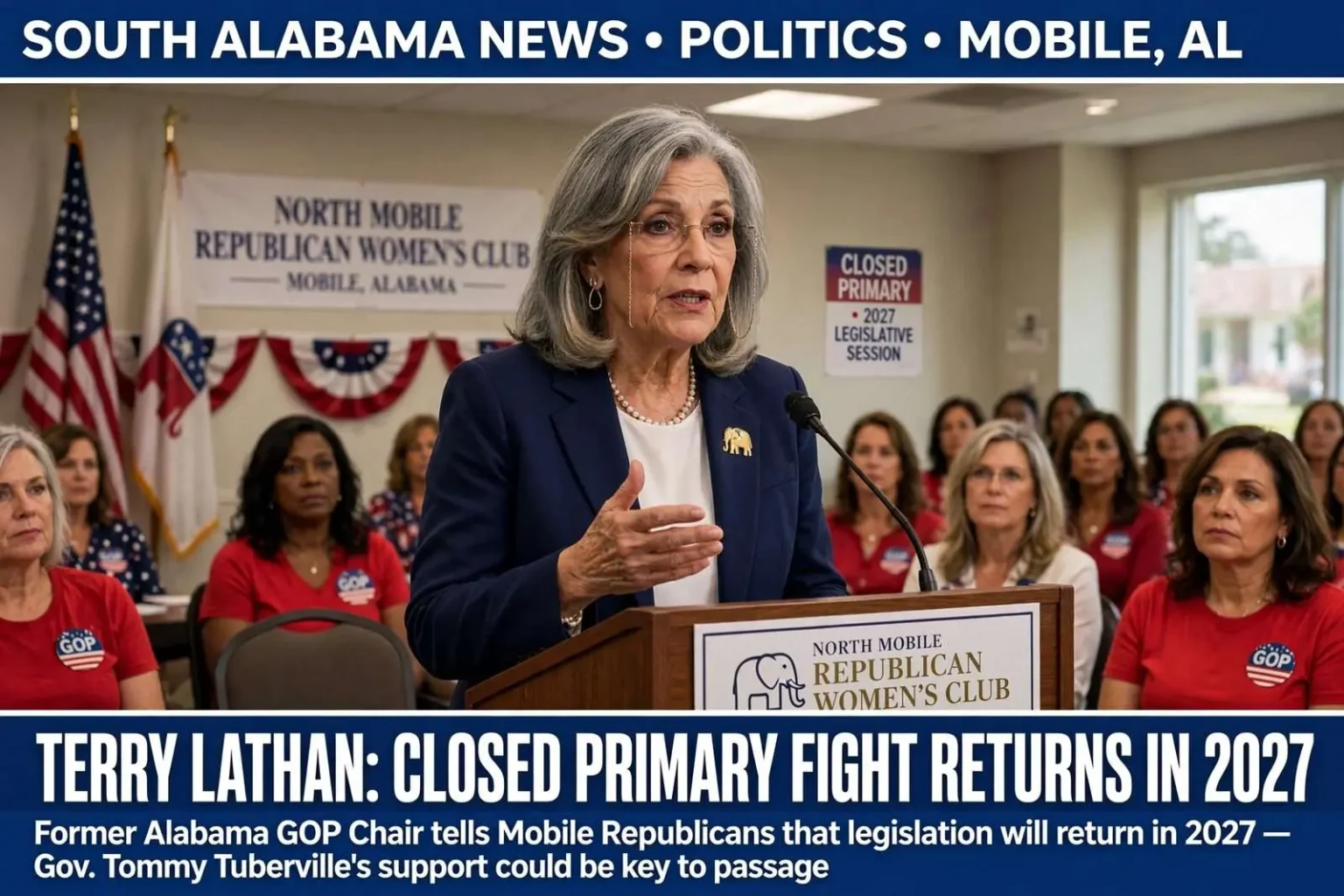
MOBILE, Ala. — Former Alabama Republican Party Chair Terry Lathan told the North Mobile Republican Women’s Club on Tuesday that closed-primary legislation will return in the 2027 legislative session, and that a Gov. Tommy Tuberville could be what finally gets it passed.
Lathan, of Mobile, served as state GOP chair from 2015 to 2021. She spoke to a full room of Republican women and political activists about the outlook for election reform.
She predicted bills mandating closed primaries will be introduced in 2027, though she said there is uncertainty about what form the proposals will take.
“We feel confident that will not be the case in 2027. Closed primaries are a high priority of the Alabama Republican Party,” Lathan said, referring to the 2026 session in which the House passed a closed primary bill but the Senate ran out of time.
What a Closed Primary Would Change
Alabama currently operates open primaries. A voter does not register by party, and on primary election day may choose either party’s ballot. The only existing restriction is that a voter who participates in one party’s primary may not vote in the other party’s runoff.
A closed primary system would restrict participation in a party’s primary to voters registered with that party, which requires party registration — a mechanism Alabama does not currently have.
The arguments on each side are well established.
Supporters contend that a party’s nominee should be selected by that party’s members, and that open primaries permit crossover voting in which members of one party influence the other party’s nomination. In a state where one party dominates general elections, they argue, the primary is the decisive contest, and voters who do not share the party’s principles should not determine its nominee.
Opponents contend that closed primaries disenfranchise independents, who make up a substantial share of the electorate, and that in a state where the general election is frequently not competitive, closing the primary excludes voters from the only meaningful contest. They also note the administrative burden of building a party registration system and the cost of maintaining it.
Evidence on whether crossover voting occurs at scale sufficient to change outcomes is mixed, and the question is genuinely contested among researchers.
The Governor’s Race Factor
GOP gubernatorial nominee Tommy Tuberville is on record supporting closed primaries. Tuberville is the frontrunner in the Nov. 3 governor’s race, and Lathan argued that support from the governor’s office could make the difference in passing the legislation.
That assessment reflects how Alabama’s legislative process actually works. A governor controls the call for special sessions, sets a public agenda that shapes what legislators prioritize, and can apply pressure through the budget and appointment processes. A bill with active gubernatorial backing moves differently than one that lacks it.
The 2026 outcome illustrates the point. The bill did not fail on a vote; it ran out of time in the Senate. Alabama’s regular sessions are constitutionally limited in length, and bills that clear one chamber late frequently die simply because the calendar expires. Priority determines what gets floor time, and priority is shaped substantially by the governor.
The Party Platform Change
The most recent meeting of the State Republican Executive Committee added a plank to the party platform supporting closed primaries and party registration.
That action, proposed by State Auditor Andrew Sorrell, is the strongest step the party can take on its own. Lathan noted that the party cannot itself require closed primaries; it can only encourage the legislature to write the change into law.
That limitation is worth understanding. Primary elections in Alabama are administered by the state at public expense under state law. The rules governing who may participate are therefore statutory, not internal party rules. A party platform expresses a position; it does not change election administration.
The SAVE Act
Lathan also addressed the Safeguard American Voter Eligibility Act, a federal proposal to require documentary proof of U.S. citizenship when registering to vote.
Originally introduced by Rep. Chip Roy of Texas and sponsored in the Senate by Sen. Mike Lee of Utah, the bill has developed into a suite of legislation.
“While President Trump is relentless on passing the SAVE Act, the legislation stalled in the U.S. Senate,” Lathan said. “Although the vote to move it to the floor was 53-47 with all Republicans voting for it and all Democrats and two independents voting against it, the 60-vote threshold was not met. The U.S. House has passed it three times with the Republicans voting yes.”
A Room Votes on the Filibuster
Lathan used the SAVE Act’s stall to walk the audience through Rule 22 of the U.S. Senate, which establishes the cloture threshold that requires 60 votes to end debate on most legislation, and then asked attendees to express their views on whether the rule should be kept or abolished.
The majority of guests voted to keep it.
Lathan explained the reasoning she found persuasive: while it is frustrating to hold a majority and still be unable to reach 60 votes, eliminating the rule would enable a complete reversal of Republican policy whenever Democrats next control the Senate.
She noted that the Senate currently uses a simple majority for confirmations while retaining the 60-vote threshold for most other business — a distinction that reflects rules changes made over the past decade by both parties.
The exchange captures a durable tension in institutional politics: procedural rules that frustrate a current majority also protect a future minority, and the value assigned to each depends heavily on how long one expects the current arrangement to last.
Turnout and Complacency
Lathan spent the remainder of her remarks on the Nov. 3 election, arguing that Republicans need to focus and that personal outreach matters more than institutional effort.
“The Democrats have fielded more candidates on the ballot than they have in a long time. GOP votes are needed to offset their pockets of enthusiasm,” she said. “The ALGOP will be very helpful in election plans. We will have poll watchers in our challenging precincts.”
“Complacency is the Republican Party’s biggest problem right now. Democrats are motivated, and we must counter that. We have the numbers, we just need the action taken on November 3.”
She encouraged attendees to serve as poll watchers, saying the party is seeking 50 volunteers.
What Is on the Ballot
Alabama’s Nov. 3 midterm election will decide:
- The governorship
- One U.S. Senate seat
- All state constitutional offices
- Two seats on the Public Service Commission
- Both houses of the state legislature
- A number of state appeals judgeships
- A number of county offices
That is an unusually comprehensive ballot, and it means the composition of the body that would consider closed primary legislation in 2027 is itself being determined in November.
South Alabama News covers political events across the region and reports remarks as delivered. Readers seeking the case against closed primaries will find it advanced by independent voter advocacy organizations and by legislators in both parties who have opposed the change in prior sessions.