The Art of Perception Vol. 2 brings urban and alternative artists to Mobile
The Alabama Contemporary Art Center hosted The Art of Perception Vol. 2, a group show of urban and alternative Gulf Coast artists, May 21-July 23, 2017.
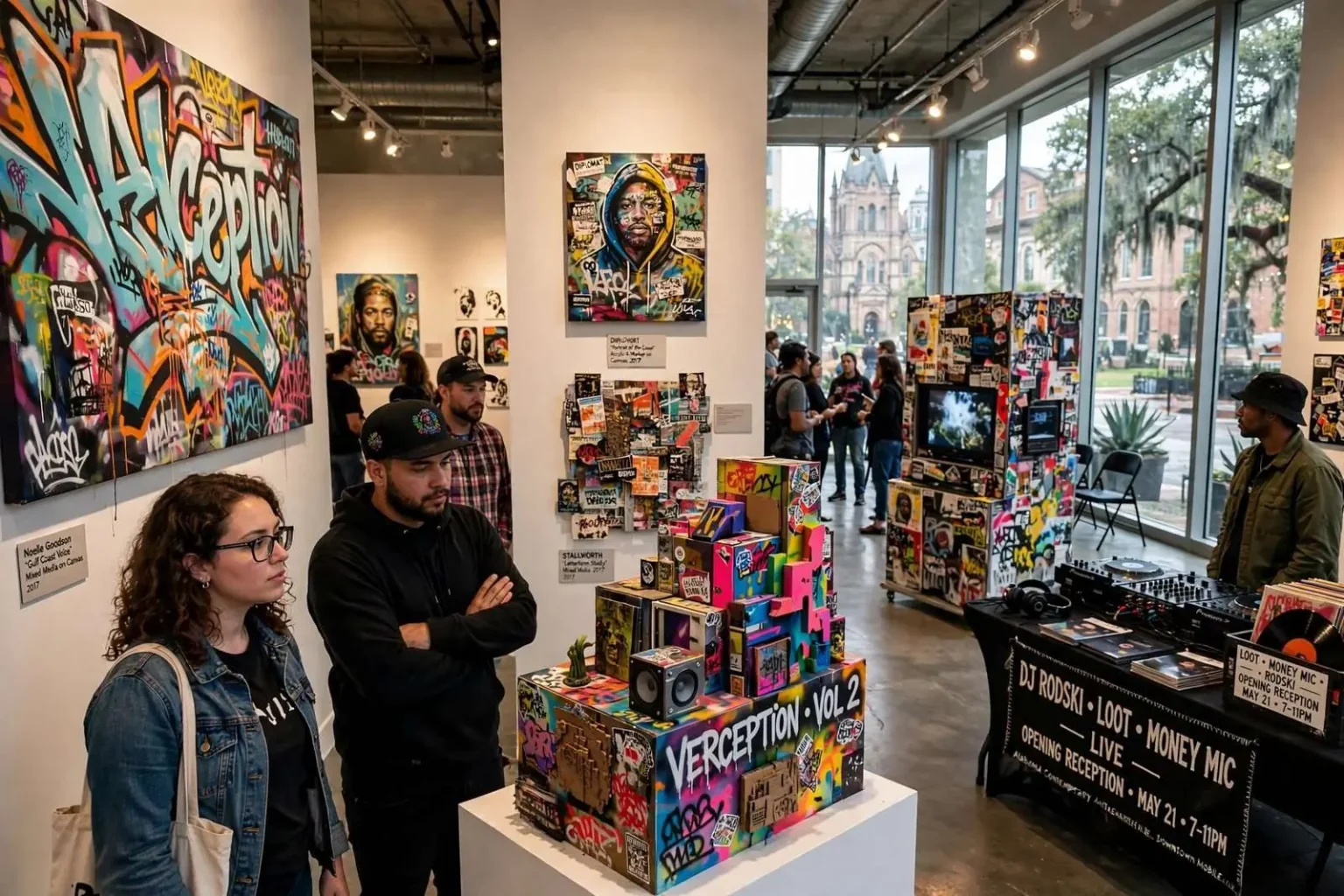
The Alabama Contemporary Art Center hosted The Art of Perception: Volume 2, a group exhibition of new work from urban and alternative artists in Mobile and the surrounding Gulf Coast. The show ran May 21–July 23, 2017, with an opening reception Sunday, May 21, from 7 to 11 p.m. featuring DJs Rodski, Loot, and Money Mic.
Widely seen as a missing link in the Gulf Coast art scene, the exhibition put a fresh spin on the traditional art show — a fusion of vibrant art and dynamic energy. The premise was straightforward: the region’s urban and alternative artists, many of whom show their work in public space and online rather than in galleries, deserved a room in the city’s premier contemporary art institution, with their work hung and lit the way any exhibition would be.
More than 20 artists were featured, including Noelle Goodson, Diplomat, Stallworth, and Conz300 of Red Cup Revolt. The roster drew from across the Gulf Coast’s street-art and hip-hop-influenced community, pairing established names with artists whose reputations had been built on murals, social media, and the region’s music scene rather than on gallery résumés.
Many of the works were urban- and hip-hop-inspired pieces exploring graffiti murals, 2D and 3D displays, and multimedia art. The range was deliberate: a single exhibition that could hold painted canvas, dimensional work, and multimedia installations side by side, asking viewers to read them together as one regional movement rather than as separate genres.
The Show and Its Setting
The Alabama Contemporary Art Center sits on Cathedral Square in downtown Mobile, and its galleries are built for exactly the kind of curatorial risk that The Art of Perception represented. The center’s mission — contemporary art, actively shown — gave the exhibition institutional legitimacy while the artists brought the street credibility the institution could not manufacture. The pairing is what made the show read as a missing link rather than another group exhibition.
The opening reception set the tone. Running from 7 to 11 p.m. on a Sunday evening, with DJs Rodski, Loot, and Money Mic spinning, the reception blurred the line between art opening and block party — artists and audience mingling in the galleries, music running through the night, and the work on the walls doing what it was made to do: carry the energy of the culture it came from.
The reception was also a chance to meet and mingle with the gallery artists. For collectors and casual visitors alike, that access matters: meeting the artist behind a piece changes how it is seen, and for artists who built followings online, the opening put faces and names in front of Mobile audiences for the first time in person.
What Visitors Saw
The works on display drew from the visual languages of graffiti and hip-hop — letterforms, mural-scale compositions, portraits, and the layered texture of street media — translated into formats a gallery can hold. The 2D pieces ranged from painted canvas to mixed-media works; the 3D displays gave the show physical depth; and the multimedia pieces connected the visual art to the music and digital culture that informs it.
The show was open to the public, with gallery hours Wednesday through Saturday, 11 a.m. to 5 p.m., and 11 a.m. to 11 p.m. on Artwalk Fridays. The extended Friday hours aligned the exhibition with Mobile Arts Council’s Artwalk — the downtown gallery night that fills Cathedral Square and the surrounding streets with visitors each month — letting Artwalk crowds flow through the ACAC galleries on their route.
Admission was $10, with tickets available through Eventbrite. The paid-admission model reflected the exhibition’s scale — more than 20 artists, multiple galleries, and a full programming calendar — and the Eventbrite ticketing gave the center a record of attendance for a show whose audience extended well beyond the institution’s usual visitors.
The Art of Perception: Volume 2 built on the first volume’s premise, and the two iterations together charted something the Gulf Coast scene had lacked: a sustained institutional platform for urban and alternative artists. Volume 1 made the case that the region’s street-side and self-taught artists belonged in a contemporary art center; Volume 2, with more artists and a longer run, treated it as established fact.
Why the Exhibition Mattered
Exhibitions of this kind do cultural work that outlasts their run dates. For the artists included — Noelle Goodson, Diplomat, Stallworth, Conz300 of Red Cup Revolt, and the rest of the more than 20 names — an ACAC exhibition is a credential that travels: a museum-quality show on a résumé that previously held murals and mixtapes. For the center, the show drew an audience that a conventional exhibition schedule does not reach.
The “missing link” framing from the show’s reception in the scene captures the structural gap it addressed. The Gulf Coast has long had working urban artists — muralists painting commission walls, painters selling work through social media, multimedia artists tied to the region’s hip-hop community — and a contemporary art center downtown. What it lacked was the connective tissue: the institutional show that treats the street as a source, not a subject. The Art of Perception: Volume 2 ran May 21 through July 23, 2017, and stood in exactly that gap.
For Mobile’s art-going public, the summer of 2017 offered the chance to see the region’s alternative art scene gathered under one roof — the DJs of the opening night, the more than 20 artists on the walls, and the gallery hours that ran through the season’s Artwalk Fridays. The exhibition closed July 23, 2017, after a run that made the case, room by room, that the Gulf Coast’s urban artists had arrived in the center of the city’s contemporary art conversation.
The show’s legacy is visible in what followed along the coast: more mural commissions, more institutional doors open to self-taught and street-rooted artists, and an audience in Mobile that learned, over one summer at Cathedral Square, to read graffiti-influenced work as contemporary art — because for three months, that is exactly what the Alabama Contemporary Art Center showed them it was.
The artists in the show represent the range of practices the Gulf Coast’s urban scene encompasses. Noelle Goodson’s work has moved between illustration and mural-scale painting; Diplomat and Stallworth brought the letterform and portrait traditions of the region’s graffiti community into the gallery; and Conz300, of the Red Cup Revolt collective, connected the exhibition to Mobile’s hip-hop underground. Around them, the rest of the roster of more than 20 filled the galleries with the show’s cross-section of media and approach.
Group shows of this size are curatorial feats as much as artistic ones. More than 20 artists means more than 20 studio visits, pickup runs, and hanging plans, and the ACAC’s galleries had to be sequenced so the works spoke to each other rather than competing. The exhibition’s balance of 2D, 3D, and multimedia work was the visible result of that effort — a gallery walk that moved between canvas, object, and screen without losing its thread.
The timing of the run also served the show’s audience-building goal. Opening May 21 and closing July 23, the exhibition occupied the heart of Mobile’s summer, when the indoor gallery season is otherwise quiet. A paid show with extended hours and a DJ-driven opening gave the city a summer art event with a different texture than its spring festival calendar — and gave the artists’ followings, many built online, a physical destination for three months.
Artwalk Fridays extended that reach. The downtown gallery night already draws Mobile residents who might not visit a gallery otherwise, and the Art of Perception’s late Friday hours meant those crowds encountered the exhibition in the middle of a social evening — murals and multimedia on the walls, the square outside full of music and food vendors. The alignment made the show part of the city’s cultural routine rather than a separate destination.
The $10 admission, handled through Eventbrite, positioned the exhibition as an event rather than a drop-in gallery visit — a framing that matched its content. Ticketed shows can price out casual audiences, but the modest fee and the online ticketing lowered the friction for the younger, scenewise audience the exhibition was built for, many of whom were buying tickets to a contemporary art center for the first time.
The exhibition’s two-volume structure — Volume 2 following the first show — also marked how the relationship between the center and the scene had matured. The first exhibition proved the audience existed; the second programmed it as a season-long fixture with a bigger roster, a longer run, and an opening night that filled Cathedral Square-adjacent galleries from 7 to 11 p.m. That trajectory is what a “missing link” looks like once it connects: not a one-night showcase, but a platform the region’s urban and alternative artists can build careers on.