‘The Bandit’ Brings Country Legends Back to Mobile Airwaves as Local Station Rebrands
Mobile radio station The Soul has rebranded as The Bandit 92.5, a new country legends format from the team behind WZEW and The Crab.
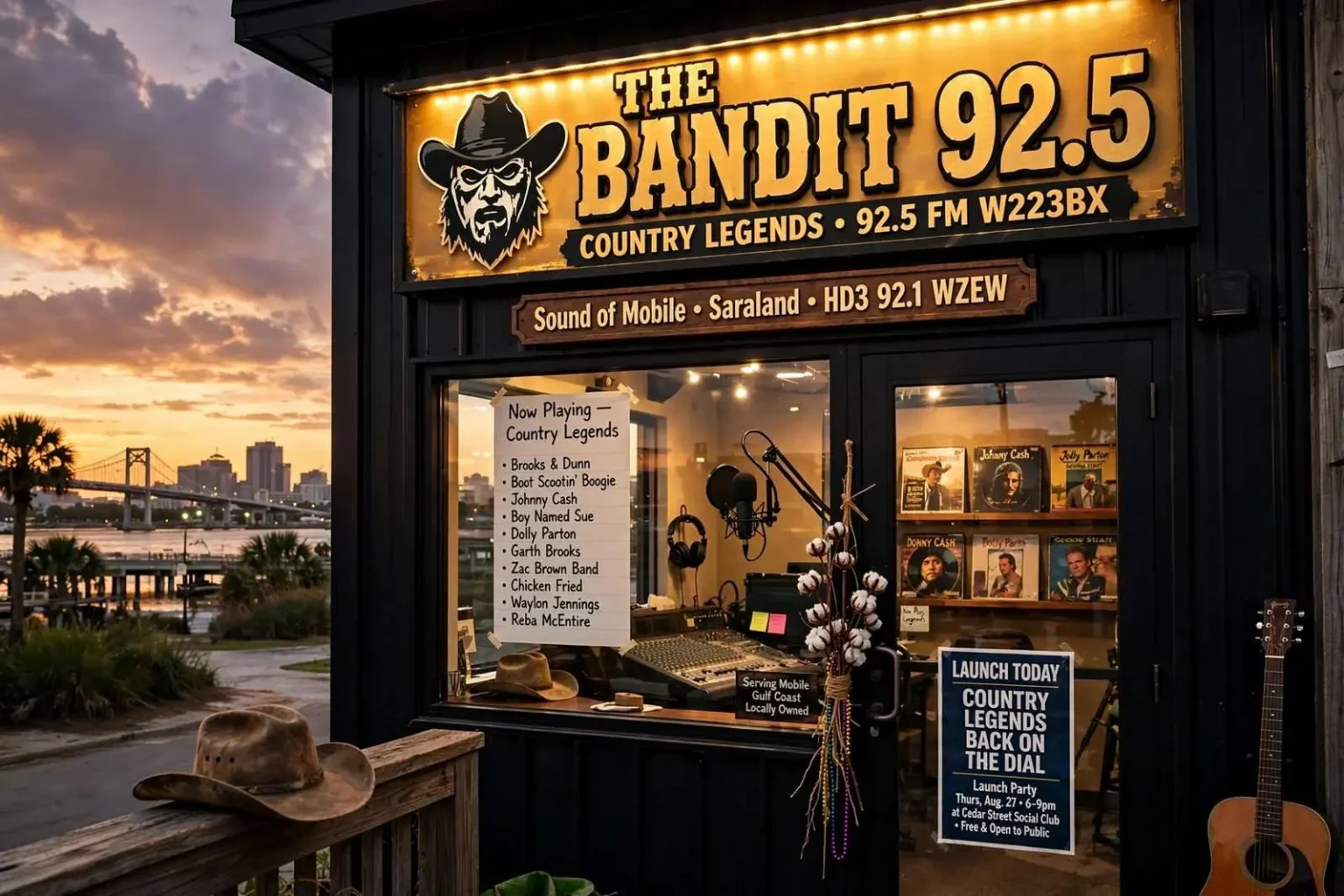
Country radio has a new home on the Mobile dial. After several days of unexplained format changes — including a day of Mardi Gras music and another of musical theater tracks — the locally owned station previously known as The Soul officially unveiled its new identity Monday as The Bandit 92.5, a channel devoted to “country legends.” The stunt programming, a radio tradition designed to leave listeners guessing, ended with a format that fills a hole in the local dial that its programmers believe has been sitting open for years.
The station, broadcast on 92.5 FM as W223BX, a signal licensed to Saraland that is also carried on the HD3 subchannel of 92.1 WZEW, is part of the Sound of Mobile family alongside WZEW-FM 92.1, sports-talk station WNSP-FM 105.5 and classic-rock outlet The Crab at 96.5. The Soul and The Crab both launched in 2018 as offshoots of The ZEW; The Crab placed a classic rock and blues channel next to the more powerful iHeartRadio classic rock station WRKH-FM 96.1, while The Soul programmed classic R&B alongside Cumulus Media’s WBLX-FM 92.9. The rebrand reshuffles that lineup and, in the process, gives the locally owned group a presence in the market’s most reliably listened-to format.
Matt McCoy, program director at WZEW, said the idea came from asking what the market lacked. “We asked ourselves, ‘What’s missing?'” McCoy said. “Legendary country!” He said The Soul had a tougher fight for listeners than its sister station. “The Soul was a great station, but there were so many urban stations in town that we just got lost,” McCoy said. “It’s hard to compete with BLX and DLT [WDLT-FM 104.1], The Beat [WRGV-FM 107.3]. Their signals are stronger and they’ve had more heritage.” In a radio market, being fourth in a category is a difficult commercial position even when the programming is good, and The Soul had spent years in exactly that spot against competitors with deeper signals and longer histories.
An opening in classic country
McCoy and the team instead saw an opening in classic country. Several Mobile-Pensacola market stations already lean toward contemporary country, he said, but the genre’s back catalog wasn’t getting much airplay — a gap that left fans of the music’s golden decades with little to listen to on the local dial. The Bandit draws a distinction from a purely “classic country” format, McCoy said, describing its lineup as “country legends” spanning generations.
“A country legend could be Zac Brown,” he said. “A country legend could be Jason Aldean or Carrie Underwood just as much as a Johnny Cash or Dolly Parton. It’s the newer versions of the legends. … We’re going to span all the generations, literally, like late ’60s, all the way through ’70s, ’80s, ’90s, and then probably wrapping up at about, like, 2010 is where we’ll stop.” The definition gives the programmers freedom to reach across five decades without pinning the station to the hay-bale imagery that “classic country” carries for many listeners.
The mix leans heavily toward the 1990s, meaning listeners can expect frequent spins of the so-called “Class of ’89” — Garth Brooks, Clint Black, Alan Jackson and Travis Tritt — and their contemporaries, alongside older staples like Patsy Cline, Waylon Jennings, Johnny Cash, Ronnie Milsap, Brooks & Dunn and Reba McEntire. Station materials also promise the likes of Hank Williams, George Strait, Willie Nelson, Merle Haggard, Loretta Lynn and Randy Travis. “Generations of people still listen to this music, so there’s a need for it,” McCoy said. On Monday’s launch, the playlist mixed Brooks & Dunn’s “Boot Scootin’ Boogie” and the Zac Brown Band’s “Chicken Fried” with Cash’s “Boy Named Sue,” Milsap’s “Smoky Mountain Rain” and Jennings’ “Luckenbach, Texas” — a set list that doubled as a mission statement for what the station intends to be.
“I would love for people to discover those artists again,” McCoy said, naming Clint Black, Randy Travis and Travis Tritt as acts he feels have faded from rotation on the formats that once built their audiences. “Because to me, I feel like they brought country to the forefront again in the ’90s.” The observation reflects a broader truth of the radio business: as formats have tightened their playlists around current hits, the artists who defined entire eras have found themselves dropped from the airwaves entirely, remembered by fans but unheard in the car.
The team also wanted the new format to honor Tim Camp, a founder of the Sound of Mobile who died in 2025, by continuing to evolve the lineup for Gulf Coast listeners. Camp’s fingerprints were on the group’s strategy of placing distinctive, locally programmed digital channels alongside its flagship signals, and The Bandit — built on a formula no one else in the market is running — is exactly the kind of product that strategy was designed to produce.
An official launch party is planned for Thursday, Aug. 27, from 6 to 9 p.m. at Cedar Street Social Club, giving the station’s staff a chance to meet the audience it hopes will make the format a fixture. For a locally owned operation, the launch has particular meaning: the Sound of Mobile competes against national groups whose Mobile holdings include some of the market’s most powerful signals, and its survival has depended on finding niches the big broadcasters leave open.
The economics behind the rebrand are straightforward. Radio advertising follows audiences, and country listeners in the Mobile-Pensacola market are numerous and loyal — but the advertising money that follows them has concentrated around the contemporary country stations, leaving the genre’s older catalog without a local home. By pitching “country legends” rather than current hits, The Bandit aims to win listeners that no local station is actively serving, a strategy that has worked for the group before: The Crab survived next to a much larger classic-rock competitor by programming deeper into the catalog than the corporate station would.
The mobile dial’s history makes the move notable as well. Country music has a long record of success in Mobile, a city whose radio listeners helped carry artists from Hank Williams’ Gulf Coast touring days through the urban-cowboy era and the country-pop boom of the 1990s. Formats in the market have shifted repeatedly over the past two decades, but observers of local radio have long argued that the classic side of country was underserved — a judgment McCoy and his team have now acted on with a dedicated channel.
The Bandit’s launch also restores a competitive dynamic to the local country market that had been missing. With WBLX and other urban outlets holding their audiences and the contemporary country leader concentrating on new music, the older-catalog listener had no station to call home — and no reason to keep a preset. A dedicated legends format gives that listener a reason, and gives advertisers a way to reach an audience segment that skewes toward established households with spending power.
For the Sound of Mobile staff, the week carried the texture of both loss and renewal. The Soul’s sign-off marked the end of a locally programmed R&B channel that had given the group a presence it valued, and the jazz brunch’s return under a new host acknowledges a loss the station family still feels. Both changes, though, follow the same instinct that built the group: program something real for Gulf Coast ears, and let the market discover it.
Jazz returns to the Sunday dial
In other Sound of Mobile programming news, The ZEW is bringing back Sunday jazz. A longtime Sunday Jazz Brunch ended with the 2023 death of host Catt Sirten, whose voice had been part of Mobile weekends for decades, and the slot had remained quiet since. A new jazz brunch broadcast launches Sept. 6, airing live from Penton’s Bistro in downtown Mobile from 9 a.m. to 1 p.m., hosted by Chip Herrington, who has led the Mobile Big Band Society.
“I cannot fill Catt’s shoes,” Herrington wrote in a Facebook post. “Rather, I will do my best to honor the legacy of my friend and to keep real jazz alive and accessible to Mobile, the Gulf Coast, and the world.” The humility of the note reflects Sirten’s standing in local radio — a broadcaster whose Sunday program was as much a Mobile institution as any of the stations he worked for — and the live-restaurant format gives the revival a communal feel that studio broadcasting cannot match.
The two moves together represent a rare week of programming change for a locally owned group. In a market dominated by national owners and corporate formats, the Sound of Mobile’s bet is that Gulf Coast listeners still want radio that sounds like it belongs to the place — a country station built for people who remember when country ruled the dial, and a Sunday jazz brunch that keeps a beloved tradition alive in a downtown dining room.
Listeners can tune in to 92.5 The Bandit or download the free Sound of Mobile app for access to all of the group’s stations. The app matters more than it once did: digital subchannels like 92.5 W223BX ride on a parent signal, and the app carries the same programming to listeners in areas where the over-the-air signal fades — or to the diaspora of Mobile natives who want the local dial wherever they live.