

Six acres of woods, one wandering creek, and a very small bear
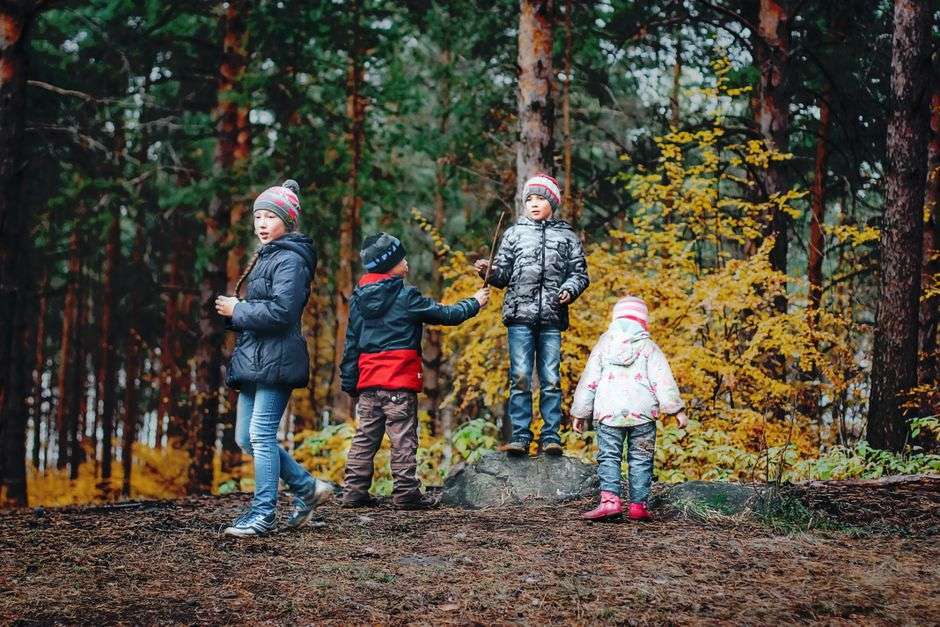
Walk onto the campus of Nature Connect School in Montrose and the first thing you notice is what is missing: walls. The second thing you notice is what is everywhere — children. On a recent visit, six acres of woods hummed with kids climbing, digging, building, and playing while teachers moved among them, asking questions designed to stretch their thinking rather than answer it.
One small boy issued a solemn warning about the bears. There were a lot of them hibernating, he explained, and visitors should watch their step. The fantasy was worth following, and it led directly to a tiny bear hidden in the leaves — one fashioned from a toilet paper roll, tucked into a shelter built from twigs. His name, the boy said, was Tiger. It was that kind of morning.
This is Nature Connect, the outdoor school founded by Fairhope native Brinkley Hutchings, and it has quietly become one of the most sought-after early learning programs on the Eastern Shore. Its classroom is a converted barn on the Church of the Apostles property in Montrose. Its curriculum is the woods, and the creek that runs through them.
From a camp of twelve to a school of hundreds
Hutchings did not set out to become a school founder. She grew up outside in Baldwin County — collecting creek clay, bird banding at Fort Morgan with her father, hiking with her mother — and went on to earn an environmental science degree from the University of North Carolina at Wilmington. Work with a nonprofit followed, with projects across the country, but a visit to a nature school in Boulder, Colorado changed her direction. Seeing children pulled away from screens and into the outdoors, she later said, showed her what she needed to do.
She studied the model where it was already thriving, working at nature schools in Northern California, then started her first program in Wilmington in 2016. When she came home to the Eastern Shore in 2017, the Alabama version of Nature Connect began modestly: a one-week summer camp with twelve children signed up. Half of them were her cousins, she has joked.
The growth since then has been remarkable. The school now runs dozens of summer camp sessions each summer, with hundreds of children coming through the woods, and during the school year it serves roughly a hundred families with a staff of about ten. The original North Carolina chapter, sold after eight years of programming, continues under a new name — which means the organization Hutchings built is now entirely rooted in Alabama, serving families from both Baldwin and Mobile counties.
The campus itself explains much of the appeal. Red Gully Creek meanders through the property, winding past banks of the red clay that gives the gully its name, and most drivers passing on Highway 98 have no idea it is there. The converted barn looks, at first glance, like any cheerful early-childhood classroom, complete with colorful learning tools — except for the doors and windows that stand open, and the screened porch where cots wait for rest time. Outside, outdoor classrooms sit under the trees, and chickens and rabbits in their coops are part of the daily work. The children feed them, care for them, and learn from them.
What the research says about learning outside
If Hutchings’s approach sounds sentimental, the research increasingly backs her up. Forest schools originated in Scandinavia in the 1950s and have spread steadily across Europe and North America; a national survey of American nature-based educators found nature preschools and forest kindergartens operating at record numbers, with students typically spending about three-quarters of the school day outside.
Studies of nature-based learning have linked the approach to real gains. A systematic review of research on children ages four to twelve found that nine of eleven studies reported improved educational outcomes — including reading, spelling, mathematics, science, and learning motivation — for children who took part in nature-based learning. Other reviews have associated forest schooling with better balance, stronger self-regulation, richer play interactions, and more physical activity than indoor settings, with no evidence of harm.
Hutchings sees the same effects on her own six acres. Because the days are so physically active — exploring, building, splashing in the creek — the students are not restless or fidgety when they sit down to academic work, she says. Their focus and concentration improve. Many of her kindergartners, she notes proudly, arrive at first grade over-prepared.
The same academics, different walls
That matters, because Nature Connect is not a rejection of academics. The school follows state standards and teaches the same material a traditional school would — reading, writing, math — with nature-based education woven through everything else. Two preschool classes serve children ages three to five, a kindergarten class rounds out the early grades, a homeschool enrichment program serves ages six to twelve, and a Forest Families program brings parents and children from birth to five into the woods together.
The teachers arrive with educational backgrounds and certifications, then are trained in naturalist knowledge on top of it. The mission, as the school frames it, is to help children become dedicated leaders and environmental stewards in their communities by developing a deep appreciation for each other and the natural world. Hutchings puts the case more directly: who is going to preserve the land and keep the air and water clean, she asks, if children never form a connection to the outdoors?
The programs themselves read like a list of things childhood used to include: exploring outdoors, animal tracking, nature and sensory awareness, storytelling, study of local plants and animals, primitive skills and crafts, and generous amounts of unstructured play. On the day of one visit, children were building forts and shelters from materials gathered in the woods — a sculpture that doubled as a vessel for fighting space invaders here, an alien face made of berries and sweet gum balls fixed with creek clay there. Farther down the slope, a crew of boys negotiated strategy for a bridge across the creek. Every child seemed busy, engaged, and delighted.
A day in the woods, hour by hour
The daily rhythm at Nature Connect would be recognizable to anyone who has watched a child turn a stick into a dozen different things, but it is structured with intention. Mornings begin up the hill at the barn — backpacks dropped, snacks and a song in the pavilion — before the class heads down toward the gully, moving like a line of slightly distracted ducks. Teachers carry the questions with them: what made this track, why does the clay stick, where does the water go when it rains.
Walkie-talkies connect the adults scattered through the woods, a reminder that the freedom on display has careful supervision behind it. A nature shelf near the classroom overflows with the day’s finds — clay, sticks, shells, leaves — which travel home in backpacks like daily progress reports. Parents do not need a newsletter to know what their children did; they need only check their pockets.
Weather does not cancel the program so much as reshape it. The model, borrowed from schools that operate outdoors year-round in far harsher climates, treats rain and cold as curriculum rather than obstacle. On the Gulf Coast, the barn’s screened porch, kitchen, and restrooms give the school the practical backbone that lets the woods do the teaching in every season.
A movement finding its way to the South
Nature Connect arrived on the Eastern Shore as part of a wider shift. Nature schools are common in California and long established in Scandinavia and Germany, but the Southeast has been slower to develop them, which is precisely the gap Hutchings noticed. When she visited a nature school in Boulder during her nonprofit years, the model struck her as an obvious answer to a modern problem — children spending their early years indoors, in front of screens, with fewer chances to dig, climb, and get genuinely dirty.
Her instincts matched what educators were seeing nationally. Surveys of American nature-based early childhood educators have documented the field’s rapid growth, and researchers studying the programs have consistently linked them to physical activity, richer imaginative play, and stronger connection to the natural world. In a county growing as fast as Baldwin — adding thousands of new families a year, many of them arriving with young children — the demand was already waiting. It just needed a barn, a creek, and someone who knew what to do with them.
The result is a program that feels unusual only until you watch it work. The children who spend their days at Nature Connect learn the standard academics of any Alabama early-childhood classroom; they simply learn them with clay under their fingernails, and they retain, along with their letters and numbers, the names of the plants and animals outside the door.
The childhood she had, for a new generation
For Hutchings, the school is in some ways a reproduction of her own upbringing, a few miles from where she grew up. Adults in her life, she has said, were always pointing out the beauty of the outdoors and then taking her to experience it — and Nature Connect is her way of handing that childhood to a new set of children, scratches and small tumbles and all. Conversations with parents set expectations honestly: it is rough out there, kids get bumps and bruises, and that is part of learning what their bodies can do.
The waiting list suggests parents agree. Enrollment for the school year and summer camps opens in February, and the program’s popularity has grown to the point that families plan around it. What began in 2016 as one woman’s idea, tested on twelve campers and half a set of cousins, has become an institution on the Eastern Shore — one that measures its output not in test scores alone but in children who can name the trees, read a creek bank, and build a shelter out of whatever the woods provide.
Most adults who grew up without cell phones remember that feeling: the forts, the clay, the bugs, the invention. The bet behind Nature Connect is that it mattered — that children who love the woods grow into adults who protect them. On six acres in Montrose, that bet is paying off one small bear shelter at a time.