Stapleton School’s Outdoor Classroom Earns Statewide Wildlife Certification
Stapleton School's homegrown outdoor classroom, started two decades ago as a simple butterfly garden, has earned certification from the Alabama Wildlife Federation.
A small rural school in Baldwin County has turned an unused patch of grass into a certified outdoor learning laboratory, and this week that effort earned formal recognition from a statewide conservation group. Stapleton School received certification for its outdoor classroom from the Alabama Wildlife Federation, capping off a project that has been growing quietly for roughly two decades. The designation places the small north Baldwin County campus alongside far larger schools in the federation’s network of certified outdoor classrooms, a program that encourages schools to use their own grounds as living laboratories for science, math and environmental study.
Principal Jim Perry said the honor means a great deal to a campus that doesn’t have some of the resources larger schools take for granted. “We’re very delighted,” Perry said. “Our school is a terrific little rural school, small school. And we have a lot of advantages as a small school, but one of the disadvantages is we don’t have some of the things that a larger school might have, like a STEM lab or full-time STEM teacher, but we have a beautiful outdoor campus.”
What is now a multi-station outdoor learning space started as a simple butterfly garden planted in an empty parking lot years ago. Since then, teachers and students have steadily added new features, turning the area into a hands-on complement to classroom science lessons. The slow, incremental growth is part of what makes the project notable: rather than arriving as a single funded initiative, the classroom took shape over years of small additions, each one installed by staff, students and volunteers with more time and energy than money.
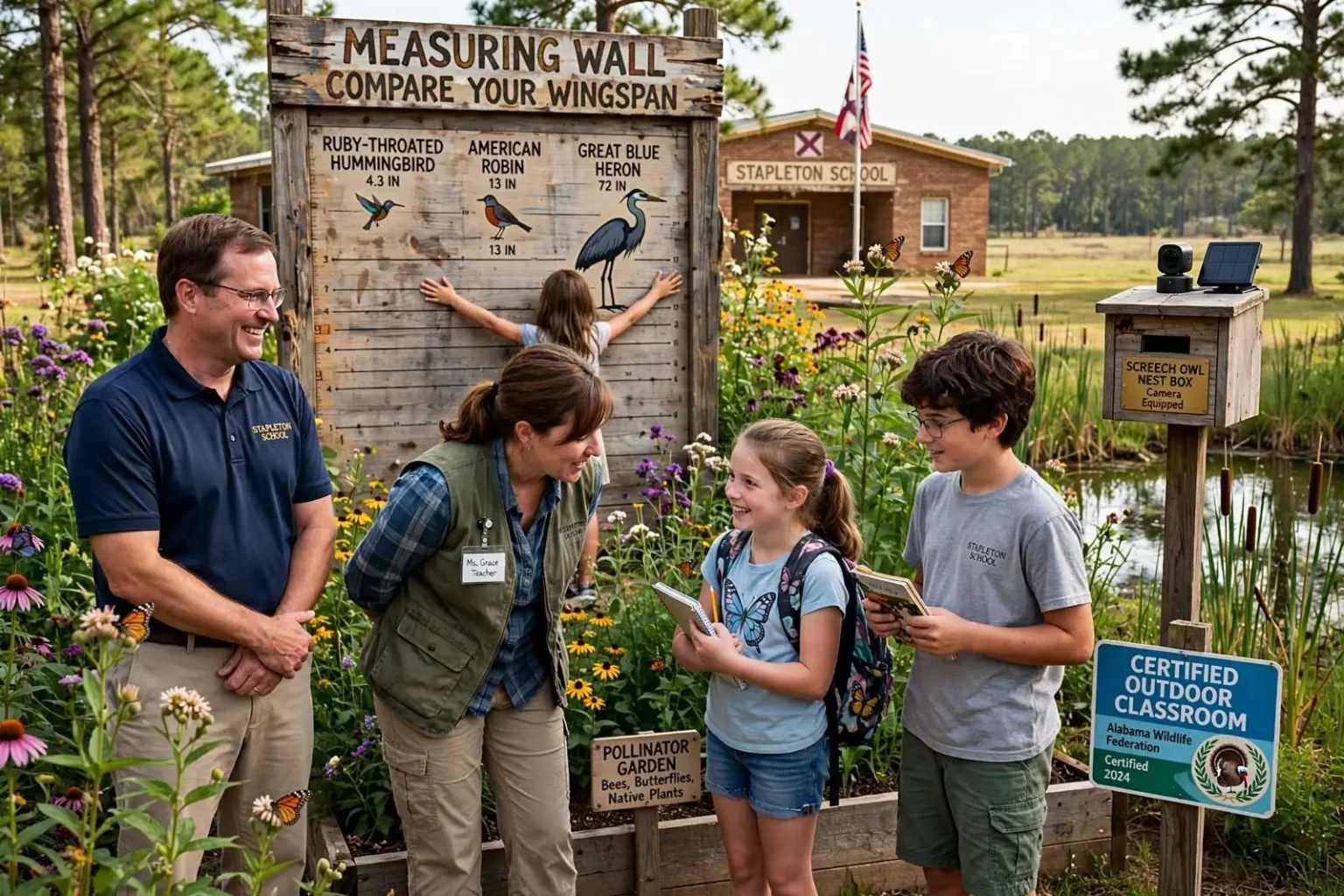
“We have a measuring wall, where students can compare their [wingspan] to the wingspan of Alabama birds, so they have a real way to get a sense of what widths [look like],” Perry explained. “In addition to the butterfly garden, there’s a pollinator garden, [because of] the importance of bees and other pollinators, so we help our kids learn about them.” The measuring wall turns an abstract arithmetic concept into something a child can stand inside with arms outstretched, comparing a human wingspan to that of a great blue heron or a ruby-throated hummingbird, both familiar sights on the Gulf Coast.
Lessons that stick outside four walls
Students say the outdoor lessons stick with them in a way a textbook page doesn’t always manage. Fifth grader Sydney Moye said the space gives students a break from four walls without losing the educational value. “I like it. I feel like it’s a good learning experience, other than learning in the classrooms and stuff. We can come out here and look at all the scenery and stuff,” Moye said.
For rural schools across south Alabama, that kind of engagement is the whole point of the outdoor classroom movement. Children in Baldwin County grow up surrounded by pine flatwoods, tidal creeks, farm fields and bayous, and a curriculum that connects classroom science to the landscape outside the window gives them a framework for understanding the place they live. Educators have long noted that hands-on learning improves retention, and the federation’s certification program is built around that research, requiring schools to develop stations that support specific lesson objectives rather than simply beautifying the grounds.
Perry credited teacher Tammy Grace with getting the whole initiative off the ground by planting that first butterfly garden, a small step that eventually grew into the certified outdoor classroom the school has today. The origin story is a familiar one in small schools, where a single committed teacher often supplies the vision and persistence that a district-funded program would provide elsewhere. Grace’s garden attracted butterflies, then students, then colleagues, and the project compounded one season at a time.
For sixth grader Payton Sellers, watching nature unfold in real time beats reading about it after the fact. “To me it’s way more interesting than looking at a science book and saying, ‘oh, this is how tadpoles grow,’ when really you can just come outside your classroom and be like, ‘oh yeah, tadpoles are getting bigger every day,'” Sellers said.
Sellers’ observation captures the difference between learning about life cycles and watching one. A wet-weather pond or water feature on a school campus becomes a season-long experiment, with eggs appearing in spring, tadpoles growing legs over weeks, and young frogs dispersing into the grass by summer. No diagram in a textbook reproduces that sequence as vividly as a student checking the same pond every few days and keeping a record of what changed.
What certification brings
Certification through the Alabama Wildlife Federation comes with more than a plaque. Schools that earn the distinction also receive an outdoor classroom activity kit, and Stapleton chose a package that included a new irrigation timer, a screech owl nesting box, a wireless camera, and a set of instructional DVDs and lesson plans to help teachers tie the space back into their curriculum. The wireless camera aimed at an owl box gives students something especially compelling: the chance to watch a nest box they pass every day reveal its inhabitants on screen, turning a dormant wooden box into a season-long observation project.
The federation’s outdoor classroom program has spent years helping Alabama schools develop exactly this kind of space, providing technical guidance on site selection, native plantings and station design, and requiring schools to show that the classroom is genuinely integrated into instruction before certification is granted. For a school like Stapleton, the activity kit supplies tools and materials that a small rural campus could not easily purchase on its own, stretching the value of the certification well past the recognition itself.
Plans for the next season
The school isn’t finished expanding the grounds. Staff plan to add a station where students can sample and identify mint, giving younger children a sensory introduction to plant identification and the herb garden tradition that runs deep in Alabama’s rural communities. Mint spreads readily in the Gulf Coast climate, making it a forgiving first crop for student gardeners and a plant they can smell, touch and taste as part of a lesson.
They’re eyeing a dry creek bed installation for the fall that would help the campus handle the heavy, sudden downpours common in the area during storm season. A dry creek bed is more than landscaping; it is a working stormwater feature that channels runoff from hard surfaces through a planted rock-lined course, slowing erosion and letting water soak into the ground instead of sheeting off the campus. For students, it doubles as a geology and hydrology lesson in miniature, illustrating the same drainage principles that shape the creeks and rivers of Baldwin County and the Mobile Bay watershed beyond.
Stormwater management has become an increasing practical concern for schools across the coastal plain, where afternoon thunderstorms can drop inches of rain in an hour and turn poorly drained campuses into muddy hazard zones. Designing the creek bed as a teaching feature lets Stapleton address a maintenance problem and a curriculum goal at the same time, an approach that conservation planners have promoted to schools and municipalities throughout the region.
A rare distinction in a fast-growing county
Stapleton now joins a small group of schools with a certified outdoor classroom in Baldwin County, one of five in the county to hold the distinction, according to Perry. That number is striking in a county with more than two dozen public schools, and it reflects how unusual a sustained, two-decade effort like Stapleton’s is, even as outdoor learning has gained adherents statewide. Baldwin County Public Schools, one of the larger systems in Alabama geographically, spans beachfront communities in the south and rural crossroads communities like Stapleton in the north, and the resources available to a campus can vary widely with its size and location.
The rural schools of northern Baldwin County sit in a landscape of small farms, pine timberland and steadily encroaching subdivision development, as growth spilling north from Spanish Fort, Daphne and Fairhope changes the county’s character year by year. A campus-scale outdoor classroom gives students in those communities a structured way to study that change, cataloging the plants and animals around them while the landscape itself shifts around the school.
What other schools can take from Stapleton
The two-decade arc from butterfly garden to certified classroom offers a template that other small schools can follow. The federation’s program does not require a large budget or a specially built facility; it asks for committed teachers, a plan that ties each station to instruction, and the patience to let a campus project grow a few features at a time. Stapleton’s experience suggests the biggest ingredient is time measured in years, not dollars.
For now, the school’s students are the immediate beneficiaries, moving between the butterfly and pollinator gardens, the measuring wall, the owl box camera and the stations still to come, with a mint bed and a dry creek bed on the way in the fall. Perry’s pride in the recognition was evident, and his framing of the school, a “terrific little rural school” without a STEM lab but with a beautiful outdoor campus, is likely to become the kind of story conservation educators tell when they encourage the next school to plant its first butterfly garden.