Propane Explosion Sparks Fire, Damages Property in Stapleton
A propane explosion sparked a fire that damaged three buildings on a Stapleton property Sunday, though firefighters saved the main home and no residents were injured.
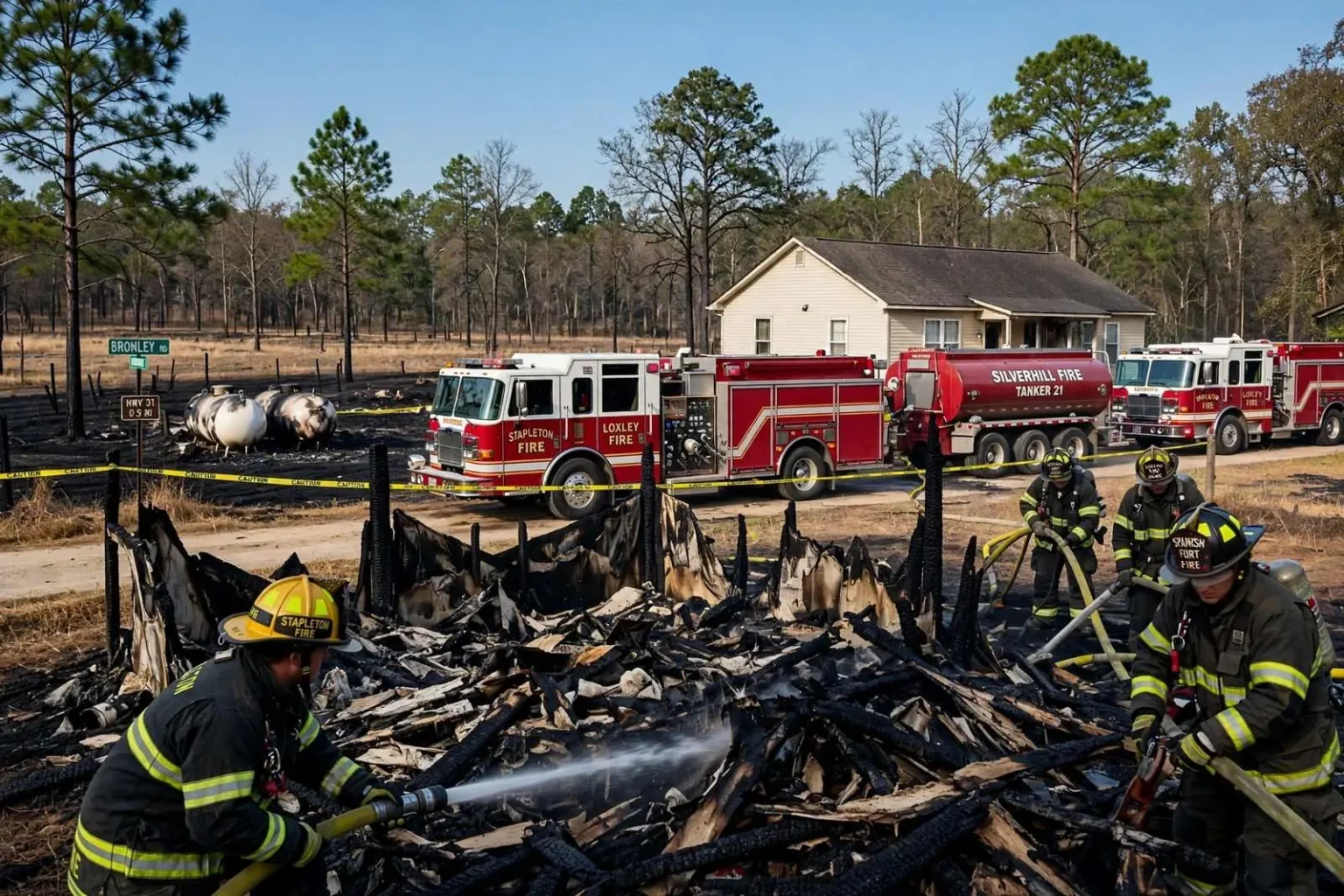
A propane explosion sparked a large fire at a home in Stapleton on Sunday, damaging property but causing no injuries to residents. The fire broke out around noon at a home on Bromley Road near the intersection of Highway 31, drawing fire crews from across southern Baldwin County to the rural property.
Stapleton Fire Chief Richard Burt said fire crews from Spanish Fort, Whitehouse Fork, Loxley and Silverhill responded to assist local firefighters at the scene. The mutual aid response reflected the scale of the blaze and the realities of rural fire protection, where a single volunteer department cannot always bring enough water, equipment and personnel to a working structure fire on its own.
Burt said either a small fire on the property or a lightning strike ignited propane tanks, sparking a brush fire and causing damage to three buildings on the property. Firefighters were able to get the flames under control and save the home’s main structure. No residents were injured in the incident, though two firefighters were treated at the scene for overheating before being released.
An Afternoon of Fast-Moving Danger
The combination of a propane explosion, a structure fire and a brush fire presented a layered challenge for responders. Propane tanks exposed to fire are among the most dangerous hazards a fire crew can face, because heated tanks can vent, feed the flames around them or fail explosively. Crews typically establish a perimeter, protect exposures and cool tanks from a distance while working to contain the surrounding fire.
The noon hour meant the fire was burning in the heat of an Alabama day, conditions that took a toll on the firefighters themselves. Battling a fire in heavy protective gear in summer heat leads to rapid dehydration and heat exhaustion, and the two firefighters treated at the scene for overheating were released after evaluation — an outcome crews consider a good one, given how quickly heat casualties can escalate.
That the home’s main structure was saved despite the damage to three buildings on the property marked a successful outcome for the crews involved. Rural structure fires spread quickly across outbuildings and vegetation, and stopping a fire that had already reached multiple buildings requires a coordinated water supply and aggressive work on the exposures closest to the house.
Mutual Aid in Baldwin County
The response — crews from Spanish Fort, Whitehouse Fork, Loxley and Silverhill joining Stapleton firefighters — illustrates how fire protection works in unincorporated Baldwin County. Much of the county is served by volunteer fire departments, whose rostered members respond from home and work when calls come in. For a working structure fire, departments activate mutual aid agreements that bring neighboring crews to the scene automatically or on request.
The system exists because of water. Rural areas lack fire hydrants, so departments depend on tanker shuttles — trucks that haul water from fill sites to the fireground in a continuous loop. A blaze of this size consumes thousands of gallons, and no single department in a rural jurisdiction keeps enough apparatus and water on hand to sustain that flow alone. Additional crews also provide the manpower for rotating through the physically punishing work of attacking a fire in midday heat, which is why the overheating casualties were treated and quickly managed.
Baldwin County’s volunteer departments train together regularly and coordinate through the county’s emergency management structure, so that a Sunday afternoon call on Bromley Road produces a unified response rather than a patchwork. The Stapleton fire showed that coordination working as designed: local crews plus four neighboring departments, a saved main structure and no injuries among residents.
About Stapleton and the Area
Stapleton is a small unincorporated community in Baldwin County, sitting along the U.S. Highway 31 corridor between Spanish Fort and the communities to the north. The area around Bromley Road is rural and semi-rural, with residences on larger lots, outbuildings, wooded tracts and the open land characteristic of central Baldwin County. Homes in communities like Stapleton commonly rely on propane for heating, cooking and other uses, making propane tanks a familiar feature of the rural landscape.
That reliance comes with responsibilities and risks. Propane is stored as a compressed liquid that vaporizes when released, and a leaking tank can produce a flammable cloud that travels to an ignition source. Rural homeowners are advised to keep tanks clear of brush and flammable vegetation, have systems inspected regularly, and know how to shut off the tank in an emergency. Fire officials across Baldwin County repeat those messages every storm season, when lightning and downed lines add ignition risks to the properties they serve.
The Highway 31 corridor through Stapleton connects a string of small communities — each with its own volunteer fire department — that have grown as Baldwin County’s population has expanded. The county’s growth has stretched fire services across more households every year, which is why departments increasingly emphasize recruitment, training and the mutual aid networks that make responses like Sunday’s possible.
Lightning and Brush Fire Season
The possible ignition sources Chief Burt cited — a small fire on the property or a lightning strike — both point to the everyday hazards of rural property maintenance. Small outdoor fires, whether trash burns or brush piles, can reach propane tanks or structures if they escape their intended footprint. Lightning, meanwhile, is a leading natural ignition source for brush and structure fires across the Gulf Coast, striking trees, power lines and open ground during the frequent summer thunderstorms that move through Baldwin County.
Once ignited, brush fires in central Baldwin County can move quickly through dry vegetation toward structures, and a fire that reaches a propane tank creates the explosive escalation that responders faced on Bromley Road. Fire officials recommend defensible space around rural homes — cleared vegetation, trimmed grass and fuel tanks positioned away from structures — precisely to interrupt that chain of events.
The brush fire component of Sunday’s blaze also meant crews had to work in two directions at once: protecting the buildings while containing fire in surrounding vegetation before it could spread to neighboring properties. Smoke from such fires is visible for miles along the Highway 31 corridor, and Sunday’s blaze drew attention from across the area as residents noticed the response.
After the Fire
With the flames under control and the home’s main structure saved, the property on Bromley Road was left with damage to three buildings and the aftermath of a brush fire. Damage assessment follows these incidents, as owners inventory what was lost and fire officials document the scene. Insurance processes for rural property fires typically cover structures, contents and outbuildings, and cleanup after a propane-related fire includes checking tanks and lines before any gas service is restored.
The two firefighters treated for overheating were released at the scene, but their experience underscores the physical demands volunteer crews face. Summer fire calls in Alabama push body temperatures to dangerous levels inside protective gear, and departments rotate crews through rehab — cooling, hydration and medical checks — during extended incidents. The quick treatment Sunday reflected protocols every department in the mutual aid network follows.
For the family whose home was threatened, the outcome was the best available under the circumstances: no injuries, a main structure saved and a community of fire departments that arrived when needed. Residents of the area often express gratitude to volunteer crews in tangible ways afterward, from donations to the departments to renewed interest in joining their rosters.
Propane Safety for Rural Homes
Fire officials use incidents like this one to remind rural residents of propane basics. Tanks should be installed and serviced by licensed providers, kept clear of overgrown vegetation and never stored or abandoned without proper handling. Homeowners should know the smell of propane — an odorant added to the otherwise scentless gas — and treat any suspected leak as an emergency: leave the area, avoid switches and open flames, and call the provider or 911 from a safe distance.
When outdoor burning is planned, officials recommend checking weather conditions, keeping burns small and attended, having water and tools on hand, and maintaining generous clearance from tanks, structures and property lines. In Baldwin County, outdoor burning is regulated, and residents are encouraged to verify conditions before lighting any fire on their property — particularly during dry stretches when brush ignites easily.
Lightning safety around rural properties is less controllable, but the consequences can be reduced. Surge protection, inspected propane systems and defensible space all narrow the paths a lightning-caused fire can take. Sunday’s fire on Bromley Road, whatever the final determination on its ignition, ended without injuries because crews responded fast and neighbors’ departments arrived in force — the combination that rural fire protection in Baldwin County depends on.
The investigation into the exact cause — whether the small fire on the property or a lightning strike ignited the tanks — was left to officials reviewing the scene. What was certain by Sunday evening was the outcome: flames under control, the home’s main structure saved, and every resident and firefighter accounted for.