

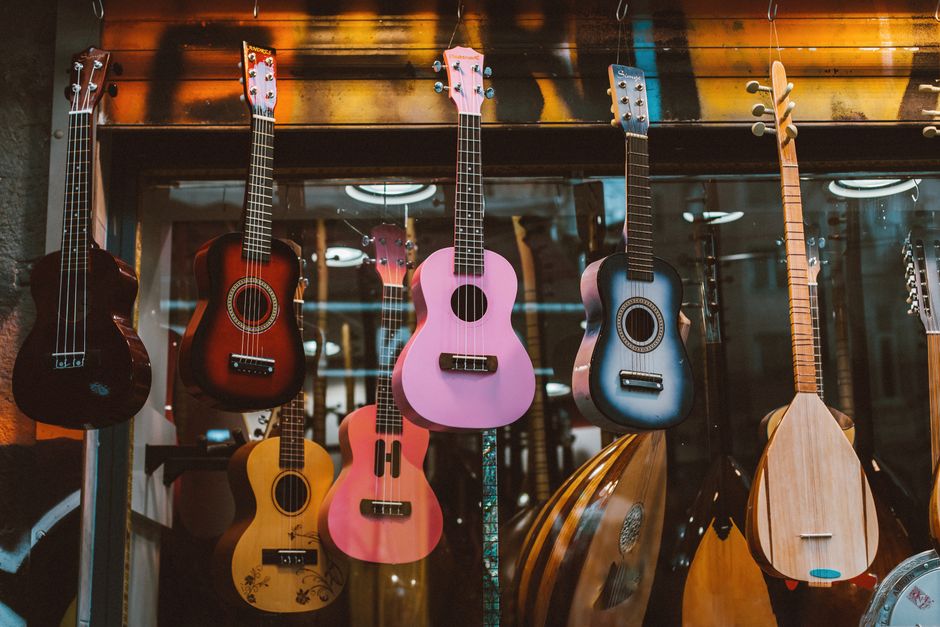
In the middle of Baldwin County, in an odd-shaped wooden building along Highway 31 in Stapleton, sits one of the coast’s most specialized small businesses — and one of its most quietly important musical institutions. Picker’s Paradise is a guitar shop in the fullest sense: a place to buy a vintage instrument, get one repaired, take a lesson on five different stringed instruments, and find out where the nearest bluegrass jam is happening this week.
Its owner, Andy MacDonald, has run the place for the better part of a decade, and he describes the ambition simply. He wants Picker’s Paradise to be the kind of shop he would seek out in a city he was visiting on vacation — the kind where you ask around for the bluegrass-y store, then ask where the jams are, then go to the jam. It is a vision of a music store as community, and after more than two decades in the building, MacDonald is both its proprietor and its most tireless participant.
From One Gig to a Career
MacDonald’s connection to the shop began in the early 2000s, when he came over from Mobile to perform at the store’s weekly bluegrass gathering. The original proprietors, Jim and Lyle Ball, saw something in his playing and his manner that suggested he would make a good instructor, and offered him teaching hours. He accepted — and never really left. By his own count he has been affiliated with Picker’s Paradise for more than two decades, the most recent stretch as its owner.
The teaching load alone would be a full-time job. Six days a week, Sunday excepted, MacDonald teaches back-to-back half-hour lessons, up to 30 hours a week, most of them from the same cozy space he has occupied since 2002. He keeps between 50 and 60 students on the books in a typical week. About half of those lessons are on guitar, the instrument he is best known for, but the roster also covers mandolin, banjo, bass guitar, violin and piano — the keyboard being the instrument he started on, before a guitar landed in his hands at 14 and permanently rearranged his priorities.
Three other instructors work alongside him, and MacDonald is quick to note that every instructor in the shop, himself included, is also a professional performer — a point of pride that shapes the teaching. Students learn from working players, not just teachers.
The Reset Every 30 Minutes
Anyone who imagines that teaching 30-minute lessons is an easy way to make a living in music should hear MacDonald describe the rhythm. “Giving lessons is the hardest work I’ve ever done,” he says, “because you do 30 minutes and then you immediately have to reset to the personality of the new student. It takes a while to get used to that.”
The no-show rate — typically around a quarter of the book on a given week — becomes an asset. An empty lesson slot means MacDonald pivots to the repair bench, where acoustic and electric instruments await adjustments, or catches up on phone calls and customer questions at the front counter. He learned the repair craft in part by watching two of the area’s acknowledged experts, Jim Ball at Picker’s and Eldon Bryson in west Mobile, both of whom have since passed away — a reminder of how much craft lives in a shop like this one, passed from hand to hand.
The other side of the ledger is familiar to anyone who has ever run a small service business. When every student shows up, the day’s revenue looks great and the repair queue grows by evening. MacDonald absorbs it with the particular stamina of a man who seems constitutionally incapable of doing one thing at a time.
From Laurel to Los Angeles and Back
MacDonald is a native of Laurel, Mississippi, and his route to a bluegrass shop in Baldwin County ran through rock and roll and television. Piano lessons came first, without much resonance. At 14 he picked up the guitar and was hooked within days; bass followed, and he found regional acclaim in an alternative rock band called Adley Madidafus. He developed behind-the-scenes skills in television news at stations in Hattiesburg and Mobile, then moved to Southern California, where he worked as a video editor for a company that customized movies for airlines.
The plot twist was bluegrass — a genre he had dismissed as hokey until, out west, he actually listened closely enough to hear the depth of its musicality. When he returned to Mobile and the station, he began playing regularly with his high-energy string band, Fat Man Squeeze, alongside longtime friend Cliff Fulkerson. The part-time teaching offer from Picker’s arrived just as his television job was being phased out, and he threw himself into recruiting students — the beginning of the two-decade run that continues today.
The Rest of the Résumé
What MacDonald does at the shop would be plenty. What he does outside it makes the point emphatic. He is a husband and a father of three sons, active at All Saints Episcopal Church in Mobile. He performs regularly in various configurations at bars, restaurants and special events around the area. And for going on 15 years he has written food columns as the culinary editor at a Mobile newspaper, a dream-adjacent job that nonetheless arrives with deadlines that have never once failed to come due.
For a period he was also building toward a second location — Picker’s Midtown, a satellite shop planned for the corner space of the small strip center that is home to Mobile Records, close to where he lives — a move that would put the shop’s brand inside the city limits for the first time.
An Ethos You Can Play
Step into either shop and you will not meet a hard sell. MacDonald is a practical businessman, but his philosophy of retail runs close to a philosophy of life. “Trying to sell something just for the sake of just moving it out the door doesn’t work,” he says. “If you’ve sold it to the guy who doesn’t need it, then you don’t have it to sell to somebody else who does need it, and he’s going to have to go somewhere else.”
He puts the rest of it more bluntly. People who treat others fairly, he has observed over a long career in retail and music, seem to keep meeting fair people. “When you’re in the mindset of screwing people over, you’re going to get screwed over. That’s it.”
It is a fitting creed for a shop whose real product is not inventory. The vintage instruments and the repair bench matter, but Picker’s Paradise earns its keep as a hub — a place where a traveling musician can find a jam, a beginner can find a teacher who plays five nights a week, and the middle of Baldwin County can hear a banjo and a mandolin trading licks on any given evening. The kind of place, in other words, that MacDonald himself would seek out in a strange city. He just built it at home instead.