

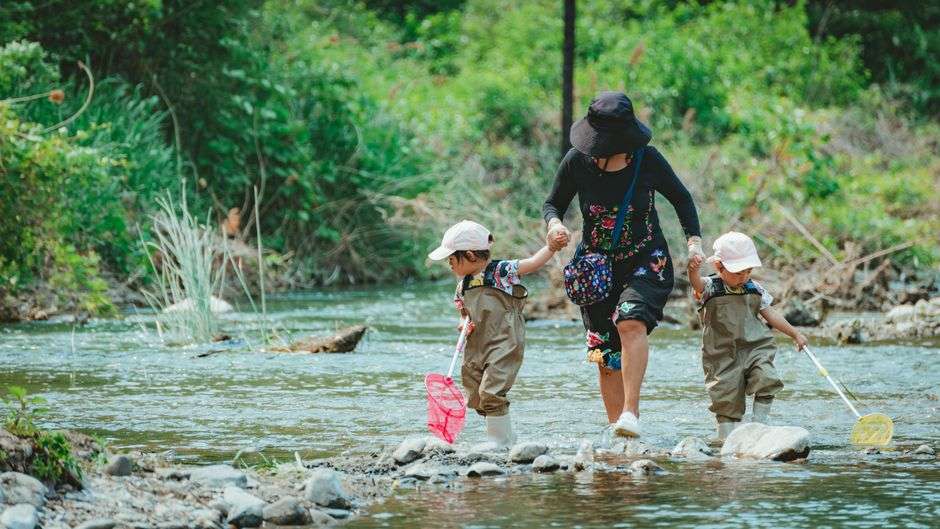
On the leafy campus of one of Fairhope’s most historic schools, a summer experiment in mud, minnows, and confidence is quietly changing the way a group of Baldwin County children see the natural world. Little Roots, Big Adventures, a weekly summer camp for ages 7 to 14, is the brainchild of Maria Hoffmann, an outdoor educator whose own childhood in the north Georgia mountains set the course for everything she now builds for other people’s kids.
“At Little Roots, Big Adventures, I want to give children what I had as a child,” Hoffmann says, and the enthusiasm in her voice makes clear this is not a slogan worked out for a brochure. With Native American heritage and a childhood spent in the mountains of north Georgia, she credits her grandfather with handing her the natural world, one hike and one camping trip at a time. Her memories are specific and sensory: walking barefoot in creeks, catching minnows, chasing frogs and lightning bugs through the dark.
That kind of upbringing has become rare, and researchers have spent two decades documenting what children lose without it. Journalist Richard Louv popularized the term “nature-deficit disorder” in his 2005 book “Last Child in the Woods,” linking the decline of outdoor play to rising rates of anxiety, attention difficulties, and obesity in children. Camps like Little Roots sit directly in the current pushing back against that trend, and Hoffmann has made it her life’s work.
From the Mountains to Mobile Bay
During the school year, Hoffmann teaches at the Renaissance School of the Eastern Shore in Daphne, where she created a brand-new outdoor education program from scratch. Her course, called Nature Academy, runs on a curriculum written entirely by Hoffmann herself, a distinction she mentions with pride. The program is anchored by six garden boxes on campus and one especially beloved faculty member: a tortoise named Tilly, who has become something of a living textbook.
Biology is the spine of her teaching, and for good reason. “Because this area is ecologically so diverse, I want to teach kids to grow into good stewards of this area,” she says. The Mobile Bay region she is talking about is not just pretty; it is genuinely extraordinary. The Mobile-Tensaw Delta and the rivers that feed it form one of the most biologically rich systems in North America, home to more species of freshwater fish, mussels, snails, turtles, and crawfish than nearly anywhere else on the continent. Scientists have called it “America’s Amazon,” and Hoffmann likes to challenge her students with a fact most adults have never heard: this region has more species of crawfish than anywhere else. Every class, she says, teaches her something new too.
A Historic Campus Gets Muddy Again
There is something fitting about where the camp meets each summer. Sessions are held at the Marietta Johnson School of Organic Education in Fairhope, a school with a storied past. Founded in 1907 by educator Marietta Johnson within the Fairhope Single-Tax Colony, the Organic School was a pioneering experiment in progressive education: no tests, no grades, and formal academics deliberately postponed until children were developmentally ready, all built around the idea that the child is a unified organism rather than a vessel to fill. John Dewey himself praised the school in his 1915 book “Schools of Tomorrow,” and it drew support from figures as prominent as Alexander Graham Bell and Henry Ford. More than a century later, it is still operating, and its grounds still carry that founding conviction that children learn best by living fully.
Little Roots puts a modern, dirt-under-the-fingernails spin on that legacy. The camp’s mission is to help children grow roots in three directions at once: in nature, in themselves, and in their community. Campers spend their sessions exploring native plants, coastal ecosystems, and the biodiversity of the school grounds and the nearby Mobile Bay shoreline. Sessions run weekly from 9 a.m. to 1 p.m., long enough for real exploration but structured for young attention spans.
The goal, Hoffmann says, is to provide a space where children are allowed to get dirty, and in doing so build confidence, curiosity, and compassion. There are no worksheets here. The curriculum is the marsh grass at the shoreline’s edge, the insects under a rotting log, the taste of a morning spent outside.
Teenagers Rebuilding Their Inner Child
One of Hoffmann’s favorite pieces of the program is the Trail Blazers, a volunteer counselor track for high school students. The arrangement makes elegant sense: Renaissance School students are required to log volunteer hours to graduate, so Hoffmann gets to bring her own former students back as leaders.
The transformation she watches in them is the part she talks about most. “Teenagers sometimes lose their inner child, and I love watching the walls come down when they interact with the campers,” she says. In her telling, something shifts in a teenager’s demeanor when responsibility for a younger child lands on their shoulders; they step into being leaders and pick up genuine naturalist knowledge along the way. Everyone involved, she says, gets to be outside, be themselves, and build a connection with nature and with each other. “When I leave camp each day, my heart is so full.”
A Shirt With Forty Species On It
Hoffmann’s conservation work extends well beyond June and July. At the top of her current projects is a T-shirt she designed featuring 40 native Alabama species on the back, a wearable field guide of the state’s remarkable wildlife. All proceeds from the shirt fund oyster reef restoration in Mobile Bay, a cause with real urgency behind it. The bay’s historic oyster reefs, which once sustained generations of Alabama fishermen and filtered the estuary’s water, have been decimated over the past century by overharvest, habitat loss, and storms. Restoration groups and state agencies now work to rebuild that hard substrate by planting shell and limestone cultch across the bay so that drifting oyster larvae have somewhere to settle and grow. Every healthy new reef becomes a nursery for fish, a buffer against shoreline erosion, and a living water filter.
Her other ventures stack up quickly. Hoffmann founded the Alabama Foraging Society, connecting people to the edible landscape around them. She plans to develop outdoor education programs with the Hope Community in Fairhope. She organizes Mobile Bay cleanups and is currently working to clean up the campus of the Organic School itself. And if that were not enough, she is writing an outdoor education curriculum for a private school in Robertsdale, extending her reach across the county.
Kids Who Love Nature Become Adults Who Care
There is a maxim Hoffmann lives by: kids that love nature become adults that care. It is a compact summary of a large body of research on environmental attitudes, which consistently finds that meaningful childhood experiences in nature are one of the strongest predictors of adult conservation behavior and eco-friendly practices.
It is also a fair description of Hoffmann herself, a barefoot creek-walker from the north Georgia mountains who turned her grandfather’s gift into a career of handing the same gift to the next generation. In Fairhope each summer, on a campus founded on the radical idea that children should be allowed to develop naturally, that gift is being passed on again, one muddy trail, one frog chase, and one teenage counselor at a time.
For the coastal community, the equation is simple and hopeful: a camp where getting dirty is the point, teenagers discover they can lead, and a tortoise named Tilly teaches biology better than any textbook. The roots being grown there, fittingly, are the kind that last.