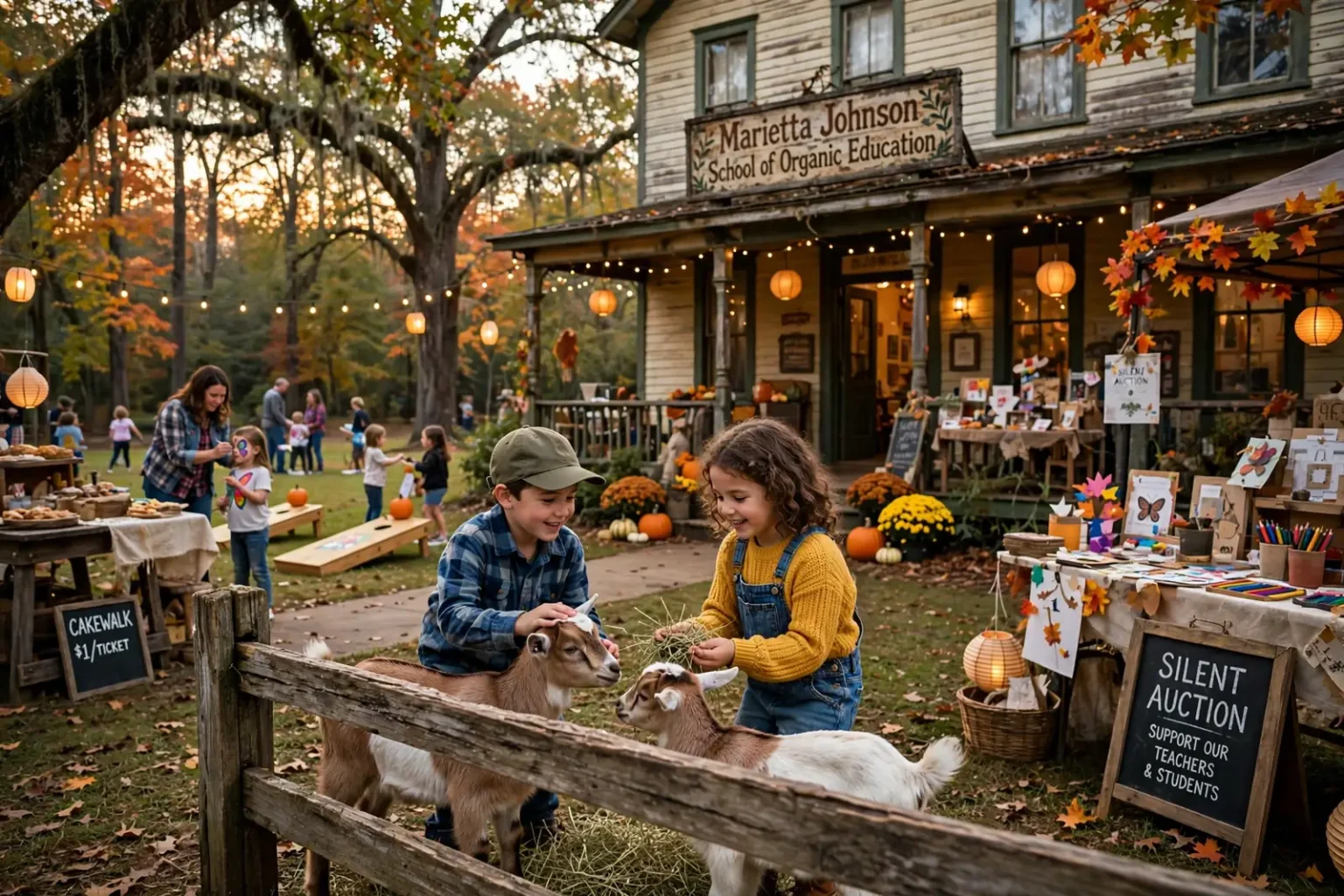
FAIRHOPE, Ala. — Baby goats, a cakewalk and a lantern-lit stroll through the woods are on the program when the Marietta Johnson School of Organic Education opens its Fairhope campus to the public on Saturday, Nov. 7, for an Organic School Fall Festival celebrating more than 119 years of hands-on learning in the city.
The festival runs from 3 to 6 p.m. at 8 Marietta Drive. Admission is free, and proceeds from activity tickets will support the school’s teachers and students.
What to expect at the Fall Festival
School leaders have planned an afternoon built for families, with activities that echo the school’s emphasis on play and the outdoors:
- Baby goats for children to meet
- Fall games, crafts and face painting
- A silent auction
- Food and treats
- An old-fashioned cakewalk
- A Lantern Walk through the school’s wooded campus at sunset
Activity tickets can be bought in advance at $20 for a bundle of 25, or at the event for $1 apiece.
For Executive Director Susan Roy, the festival is also a chance to correct a misconception she hears often around town.
“People stop me all the time and say, ‘I thought that school closed,'” Roy said. “We’re here. Come see what the kids are building.”
Roy knows Fairhope’s classrooms well. She taught first grade in Fairhope’s public schools for 25 years before joining the Organic School.
A school born in a utopian experiment
The school’s story is tightly woven into Fairhope’s own. The town was founded in the 1890s as a single-tax colony, an experimental community built around the economic ideas of Henry George, and it drew reform-minded settlers from across the country.
Among them was Marietta Johnson, a Minnesota educator born in 1864 who had trained teachers before moving to Fairhope in 1902. In 1907, with the backing of local supporters including Lydia Newcomb Comings and colony leader E.B. Gaston, she opened what she called the School of Organic Education. It began with six students.
Johnson’s central idea was that children learn best when they are free to learn through play, creativity and exploration of the natural world. Her school gave no tests or grades. It did not assign homework before high school, and it did not push young children to read before they were ready. Alongside academics, students worked with their hands, studied outdoors, practiced crafts and took part in folk dancing.
Drawing John Dewey and a creative crowd to Fairhope
The approach soon attracted national attention. The philosopher and education reformer John Dewey traveled to Fairhope to see the school for himself and called it “a decided success.” He wrote about it favorably in his book “Schools of To-Morrow,” which helped bring Johnson’s work worldwide recognition. Johnson went on to become one of the founders of the Progressive Education Association.
The school’s reputation pulled artists and thinkers to Fairhope so their children could attend. According to the school, anthropologist Margaret Mead’s parents sent her younger sisters, Elizabeth and Priscilla, there, and the sculptor and furniture maker Wharton Esherick came to Fairhope to teach art and enroll his own children. A boarding house known as the School Home hosted the children of visiting families. Former Fairhope teachers later founded The School in Rose Valley in Pennsylvania, carrying Johnson’s ideas north.
That influx of creative, independent-minded families helped give Fairhope the artistic character it is still known for today.
Johnson died in 1938, but the school she started has continued to operate through the Great Depression, two world wars and many changes in Fairhope. Three buildings on its historic campus — the Bell Building, Dahlgren Hall and the Art Barn — were listed on the National Register of Historic Places in 1988. The school now operates from its campus on Marietta Drive.
Organic education today
The school currently serves children from pre-kindergarten through second grade. It keeps a low student-to-teacher ratio and plans to add grades as its students move up.
School officials said the century-old philosophy still produces striking results, with students taking ownership of what they learn.
Lindsay Jackowiak, whose family moved back to Baldwin County this year, said she has seen it firsthand with her kindergartner. Her son had resisted reading and writing, but he recently took it upon himself to write out a work schedule for a “power plant” he and his friends had built on the playground.
“I was blown away,” Jackowiak said. “The kid who refused to write is now writing because he wants to. He’s so sad when there’s a school break.”
Tommi Sue Celli, who enrolled her son after moving to Alabama, described a similar change.
“He absolutely loves going to school now,” Celli said. “He even told me he wants to stay at the Organic School all the way through college.”
Those stories reflect what Johnson argued more than a century ago: that a child who is interested in a task will reach for the skills needed to complete it. Writing a schedule for an imaginary power plant, in that view, is not a break from learning but the point of it.
Why the festival matters to the school
Like many small independent schools, the Organic School depends on community support beyond tuition. Fundraisers such as the Fall Festival help pay for teachers and classroom needs, and they introduce new families to a school that many longtime residents may assume is part of Fairhope’s past rather than its present.
The festival also offers a rare chance for the public to walk the school’s wooded grounds. The sunset Lantern Walk, which closes out the afternoon, is meant to give families a quiet moment together after an afternoon of games and treats.
If you go
- What: Marietta Johnson School of Organic Education Fall Festival
- When: Saturday, Nov. 7, 3 to 6 p.m., with a Lantern Walk at sunset
- Where: 8 Marietta Drive, Fairhope
- Admission: Free
- Activity tickets: $20 for 25 in advance, or $1 each at the event
- Proceeds: Support the school’s teachers and students
The festival falls on a busy day in Fairhope, which also hosts the Best of the Bay Gumbo Championship on Nov. 7, giving families the option to make a full day of it on the Eastern Shore.