The Haberdasher Demonstrates Its Mad Hattin’ Cocktail in New Video Series
Downtown Mobile bar The Haberdasher shows how to mix its Mad Hattin' cocktail, a take on the Manhattan, led by head bartender Roy Clark.
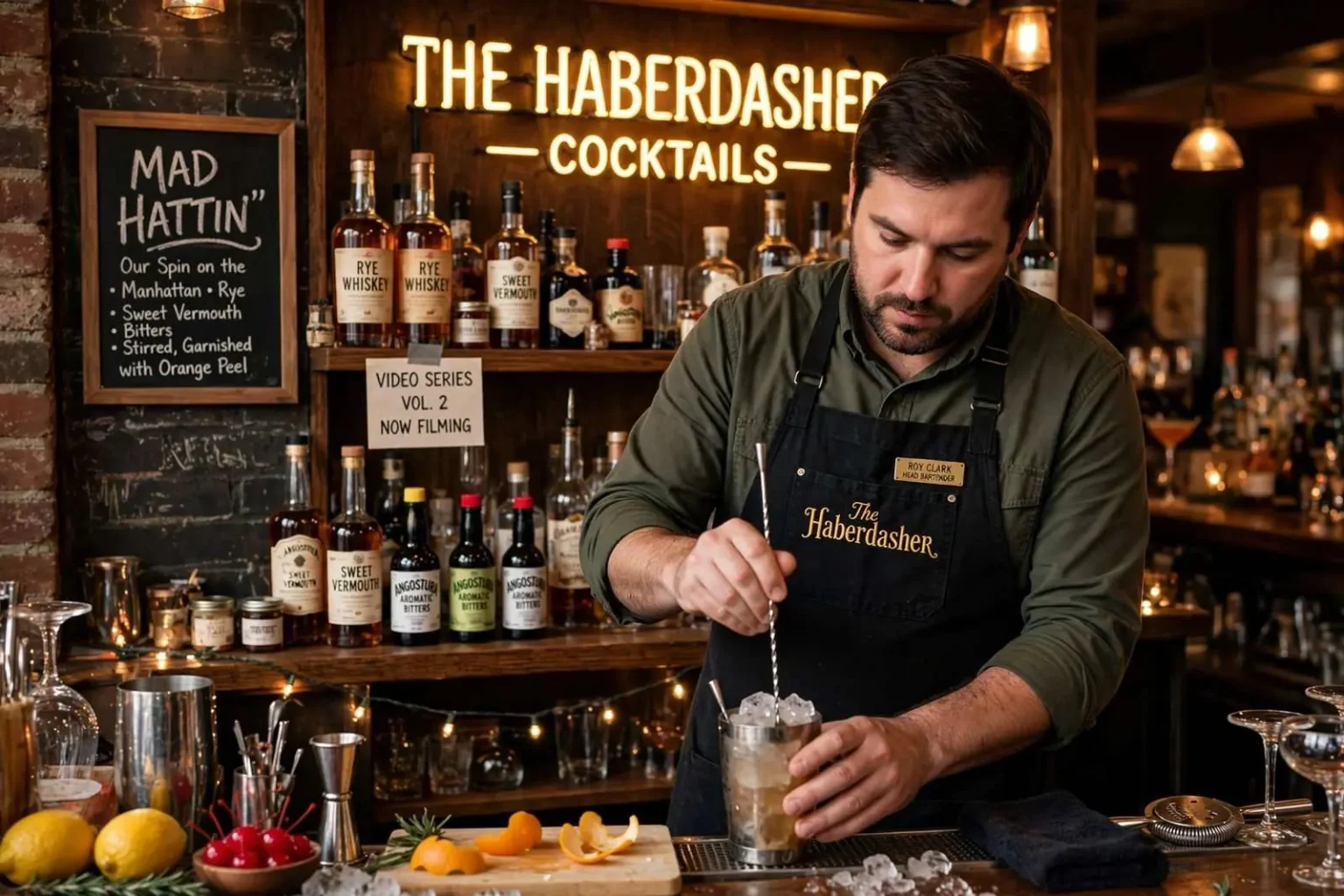
Downtown Mobile cocktail bar The Haberdasher has continued its video series with a second installment devoted to one of its signature drinks: the Mad Hattin’, the venue’s own spin on the classic Manhattan.
In the short tutorial, head bartender Roy Clark walks viewers through building the drink step by step in under three minutes, along with a bit of background on the cocktail’s inspiration at the Dauphin Street bar. The episode was created by Kris Skoda, Andy Vo, and Clark himself, with an opening theme contributed by Alabama rock band Banditos.
The series is part of the bar’s effort to share its craft approach to mixing drinks with a wider audience, following a format of quick, approachable lessons from behind The Haberdasher’s bar.
A Signature Drink, Explained
The Manhattan is among the most enduring templates in American cocktail making — whiskey, sweet vermouth and bitters, stirred and served cold — and nearly every serious cocktail bar eventually puts its own stamp on the formula. The Mad Hattin’ is The Haberdasher’s entry in that tradition, a variation that carries the bar’s name-flavored wit into the glass while keeping the skeleton of the classic intact. Signature variations like this do double duty for a venue: they give regulars a drink they cannot get elsewhere, and they give the staff a calling card that summarizes the house style in a single order.
In the video, Clark builds the drink on camera in real time, and the under-three-minute runtime is a deliberate choice. Rather than a long-form production designed for other bartenders, the episode is paced for home viewers — the kind of person who owns a shaker or a mixing glass, keeps a bottle of whiskey around, and wants to see how a professional treats each step: the proportions, the stirring, the chill, the strain, and the garnish that finishes the drink.
The background Clark provides on the drink’s inspiration is part of the episode’s appeal. Cocktails at craft-focused bars are rarely arbitrary; a signature drink usually has a story — a flavor the bartender wanted to feature, a classic that needed updating, or a nod to something in the room itself. Sharing that story alongside the recipe turns a tutorial into something closer to a tour of the bar’s thinking, which is exactly the kind of content a craft-focused venue can produce better than anyone else.
Behind the Series
The Mad Hattin’ episode is the second installment of the bar’s video series, and the credits read like a homegrown production: created by Kris Skoda, Andy Vo, and Roy Clark, with an opening theme from Banditos, the Alabama rock band whose raucous, roadhouse-rooted sound has carried them from the Southeast club circuit to national touring. Using a band’s music as a series theme is a natural fit for a bar built on atmosphere, and it ties the video series into the broader network of Alabama musicians and venues with which The Haberdasher shares an audience.
The series’ format — quick, approachable lessons filmed from behind the bar — reflects a broader shift in how cocktail bars communicate. Craft cocktail culture has a reputation for exclusivity, with jargon, rarified ingredients and an implicit entrance exam for newcomers. A short video that demystifies a single drink, hosted by the person who actually makes it, works against that reputation. It invites the viewer into the role of apprentice for three minutes and sends them away with something they can attempt at home, or order with more confidence the next time they sit down at the bar.
For the bar itself, the videos serve several purposes at once. They showcase the skill of the staff in a medium that travels far beyond Dauphin Street, they give the signature drinks a life online that a chalkboard menu cannot, and they document the house recipes in the clearest possible form. A viewer who learns the Mad Hattin’ from Clark has been handed the bar’s own standard for the drink — the exact proportions and technique the staff uses — which is a more convincing advertisement than any photograph of a coupe glass.
Craft Cocktails on Dauphin Street
The Haberdasher operates in the heart of downtown Mobile’s entertainment district, where Dauphin Street’s stretch of bars, music venues and restaurants draws a mixed crowd on any given night. In that landscape, a craft cocktail bar stakes out a particular position: fewer bodies, more attention per drink, and a menu built on classics executed properly and house creations with a point of view. The Mad Hattin’ belongs to the latter category, and the video series belongs to a wider strategy of making that position legible to people who might otherwise default to whichever door is loudest.
Bars that invest in cocktail education also invest in their own staff’s standing. A head bartender walking viewers through a recipe is demonstrating the kind of knowledge that separates tending bar as a job from tending bar as a craft, and Mobile’s growing scene of cocktail-focused venues has been built by people willing to do exactly that — studying the classics, tinkering with variations, and explaining their choices to customers who are curious rather than merely thirsty.
The timing of the series also reflects the way bars now reach audiences. A drink that exists only on a menu reaches whoever walks in the door; a drink explained in a three-minute video reaches anyone the internet delivers, including former Mobilians living elsewhere, travelers planning a night out, and home enthusiasts who may never visit but will try the recipe with a bottle of their own. For an independent bar competing against national chains’ advertising budgets, that reach is disproportionately valuable.
What Home Bartenders Can Take From It
Tutorials from working bartenders tend to emphasize the small things that home viewers overlook, and the Manhattan template rewards that attention. Stirring rather than shaking, adequate ice, a properly chilled glass, and a measured hand with vermouth and bitters are the details that separate a drink that tastes assembled from one that tastes composed. Watching a professional move through those steps in continuous, unhurried sequence is instruction of a kind that written recipes rarely capture, which is the enduring value of the video format.
The three-minute constraint, rather than limiting the teaching, sharpens it. There is no time for digression, so every moment on camera is a step or a reason for a step. Viewers who want to reproduce the Mad Hattin’ at home get the complete working method; viewers who simply want to understand what makes the bar’s version distinctive get the story behind it. Both leave knowing more than they did, which is the series’ quiet promise.
With two installments now released, The Haberdasher’s series has established its pattern: one drink per episode, the house bartender hosting, a local band’s music opening the proceedings, and production handled by the bar’s own people. It is modest, practical content of exactly the kind a craft venue is uniquely positioned to make — and for anyone who has stood at the Dauphin Street bar wondering what went into the glass, the answer is now on record.
The Banditos Connection
The choice of Banditos for the series’ opening theme deserves its own mention. The band, formed around Birmingham and the wider Alabama scene, built its reputation on a soulful, raucous blend of rock and roll, country and Southern soul, and its members have long been fixtures of the state’s independent music community. For a Mobile bar’s video series to open with Alabama-made music is a small act of regional solidarity: independent venues, craft bars and original bands draw from the same audience pool, and each act of cross-promotion strengthens the whole circuit.
The pairing also fits tonally. A cocktail tutorial filmed behind a dimly lit bar benefits from an opening burst of energy, and Banditos’ music supplies it. Viewers get an immediate sense of the room — that The Haberdasher is a bar with a soundtrack and a personality, not a laboratory — before the tutorial settles into its measured pace. It is a small production decision, but it signals that the series is about the bar as a place, not merely the drink as a formula.
Small Venues and the Craft of Self-Promotion
Independent bars have always relied on word of mouth, and the video series is word of mouth’s modern descendant. Instead of hoping a satisfied customer describes the Mad Hattin’ accurately to a friend, the bar has made the definitive description itself — hosted by the person who created the drink, filmed in the room where it is served. For a business that competes every night for discretionary attention downtown, controlling that narrative is a real advantage.
The economics also favor this kind of content. A three-minute video produced in-house costs a fraction of conventional advertising and keeps working long after it is posted, surfacing in searches and feeds whenever someone looks up the drink or the bar. Each new installment compounds the effect, building a small library of the venue’s signatures that grows more useful over time.
Most of all, the series captures what makes a craft bar worth visiting: people who take their work seriously enough to explain it. Roy Clark walking viewers through the Mad Hattin’ in under three minutes, with Skoda and Vo behind the camera and Banditos on the soundtrack, is a complete portrait of a bar in miniature — its skill, its collaborators, its sense of humor, and its willingness to open the recipe book to anyone watching. The Mad Hattin’, it turns out, is best appreciated two ways: stirred cold in a glass at the Dauphin Street bar, or understood from three feet away through a camera lens, one careful step at a time.